


Contract Management for SaaS Companies: A Playbook for Scaling Legal Teams

Huzaifa Sultana is a Marketing Associate at SpotDraft focusing on Organic Growth through SEO and AEO.
When you’re closing your first few enterprise deals, bandwidth allows your legal team the time to understand the context and review contracts carefully. As your business scales, however, your legal team spends a large amount of time trying to clear an ever-growing backlog of contracts. This turns them from being a strategic partner to a bottleneck, all because your processes weren't able to scale with your business.
This piece is authored for SaaS legal teams that know the queue is starting to build and aren’t sure where to intervene. If you’re looking for the broader operating picture first, our take on scaling legal teams sets the bedrock.
Book a demo and see how SaaS legal teams ship contracts faster on SpotDraft.
SaaS contracts aren't necessarily more complex than other commercial agreements. What makes them different is that they're highly repetitive, time-sensitive, and more closely tied to revenue recognition than most other contract types. Here's what sets them apart:
If you're newer to the SaaS contract stack, our guide to SaaS contract management covers the basics.
An expanding legal team at a SaaS company will spend eighty percent of its time working on four contracts. The start of a real playbook is knowing what each one is and where each one gets stuck.
The terms of engagement are specified in the MSA. The trap is that you treat every MSA as custom when you already have 70% of your positions decided. A pre-built MSA playbook enables your non-legal teammates to read the document like you do and enables your CLM to automatically flag any changes. Don't template your enterprise MSAs on a one-off basis. You'll be editing them anyway.
The Order Form is on top of the MSA. It’s also the part of the contract sales usually works with without getting legal involved. That is the right call, but only if the template is locked, the editable fields are limited, and intake is clean. First lock the Order Form. Then let Sales be close to it. This is where sales contract workflows can make or break.
All the privacy obligations are in the DPA. Sub-processor lists, breach notification timeframes and cross-border data transfer rules. Most SaaS companies will sign one DPA for every customer that processes personal data. Make a good DPA, then recycle it. Look carefully at the ones coming in. Our guide to reviewing DPAs walks through the relevant clauses.
Most NDAs lead nowhere. Some small share becomes a real deal. Not worth the time to route each one through legal. Almost every SaaS company after Series A has a pre-approved NDA template that anyone can fill out. If your GC still personally reviews NDAs, that’s the first thing you need to fix.
The three growth points that impact most SaaS legal teams are the same. If you know what one you are on, you know what to fix.
When you have the problems of the first stage, don’t buy the tools of the third stage. Advanced features are being adopted by growing legal teams instead of basic ones. The result is a fancy platform no one uses.
There is no one SaaS CLM setup that fits every situation, but there is a short list of moves that every growing team eventually makes. If you haven't built these yet, begin here.
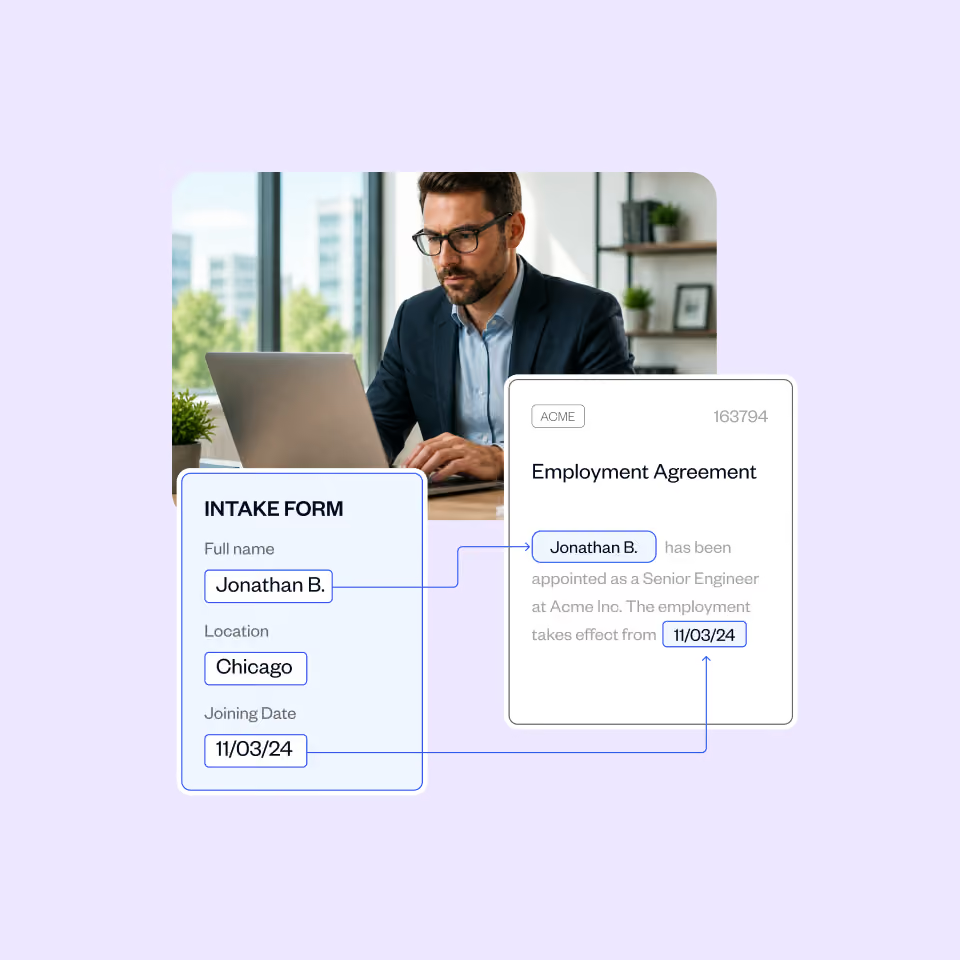
Every request that comes through Slack, Teams, email, or a hallway conversation makes your legal team's operations more complicated. A simple legal intake form, categorized by deal size or contract type, makes every request easy to track.
Beyond being a productivity tool for your legal team, templates make it possible to remove legal from routine work altogether. Account Executives can create an Order Form without needing to open Slack by using contract templates with locked clauses and editable fields.
Use AI tools like VerifAI to save your SaaS legal team a huge chunk of time on every contract. VerifAI understands your playbook, compares the other party's edits against your standard positions, and flags any deviations within seconds.
Small, routine contracts don't need to go through the same review process as large, high-risk ones. Use a clear approval workflow that sends each contract to the right reviewer automatically, so senior lawyers only spend time on deals that truly need their expertise.
Having signed PDFs in a Drive folder doesn't mean you have a contract management system in place. With a true contract repository you can search every agreement by company, value, clause, date or any other detail.
World Commerce & Contracting research puts the average loss from poor contract management at nearly 9% of yearly revenue, and most of it shows up at renewal time. Set up alerts before you set up dashboards. Auto-renewal tracking and contract reporting catch these before they cost you.
See how a working SaaS contract stack looks end to end. Book a personalized walkthrough.
Most teams don't blow it at one big thing. They are losing ground at some smaller ones. Watch out for those.
SpotDraft was built for how SaaS companies actually operate, not how a bank’s procurement team operates. You can set up in weeks, not months; use AI that learns your playbook from day one; access the built-in e-signature; and benefit from Salesforce and Slack integrations that sales actually use. As your contracting gets more complex, keep up with weekly product updates. No legal ops admin required to run. For a broader SaaS view, check out our SaaS solution page.
Book a demo and get a tailored walkthrough on your own contracts.

.png)

