Building What Comes Next: Women Reshaping Legal in Europe


“Come, Watson,” said Holmes, studying the evidence before him. “The game is afoot.”
“Afoot toward what?” Watson asked.
“The future,” Holmes replied calmly. “And if you observe, you will see who is shaping it.”
Watson glanced at the clues scattered across Europe’s legal landscape. Regulation tightening. Technology accelerating. Risk multiplying.
“And what do you deduce?”
“That the authors of this next chapter,” Holmes said, “are not waiting to inherit it. They are building it.”
Across Europe, women leaders in legal are not merely responding to change. They are designing systems, steering transformation, and redefining what modern legal leadership looks like. Here are the women reshaping what comes next.

When Catherine Bamford looked at the way lawyers were drafting documents, she saw something most people missed. Beneath the dense clauses and endless precedent folders, there were patterns. Decisions being repeated over and over again by very smart humans. Instead of accepting “that’s just how it’s done,” she leaned into curiosity. Why couldn’t that logic be captured? Why couldn’t contracts be smarter, faster, and more structured? That curiosity turned into a career at the intersection of law and technology, and eventually into BamLegala consultancy, built on the belief that great legal work deserves great systems behind it.
Founding BamLegal was about rolling up sleeves and doing the deep thinking first. Catherine became known for her practical, no-nonsense approach to document automation and legal engineering: map the expertise, design the decision trees, understand the humans, then bring in the tech. Through BamLegal, she has helped law firms and in-house teams move from chaotic drafting to structured, scalable workflows, all while making legal tech feel less intimidating and more empowering. Her journey proves that innovation in law is not about replacing lawyers. It is about amplifying their brilliance and giving them better tools to shine.
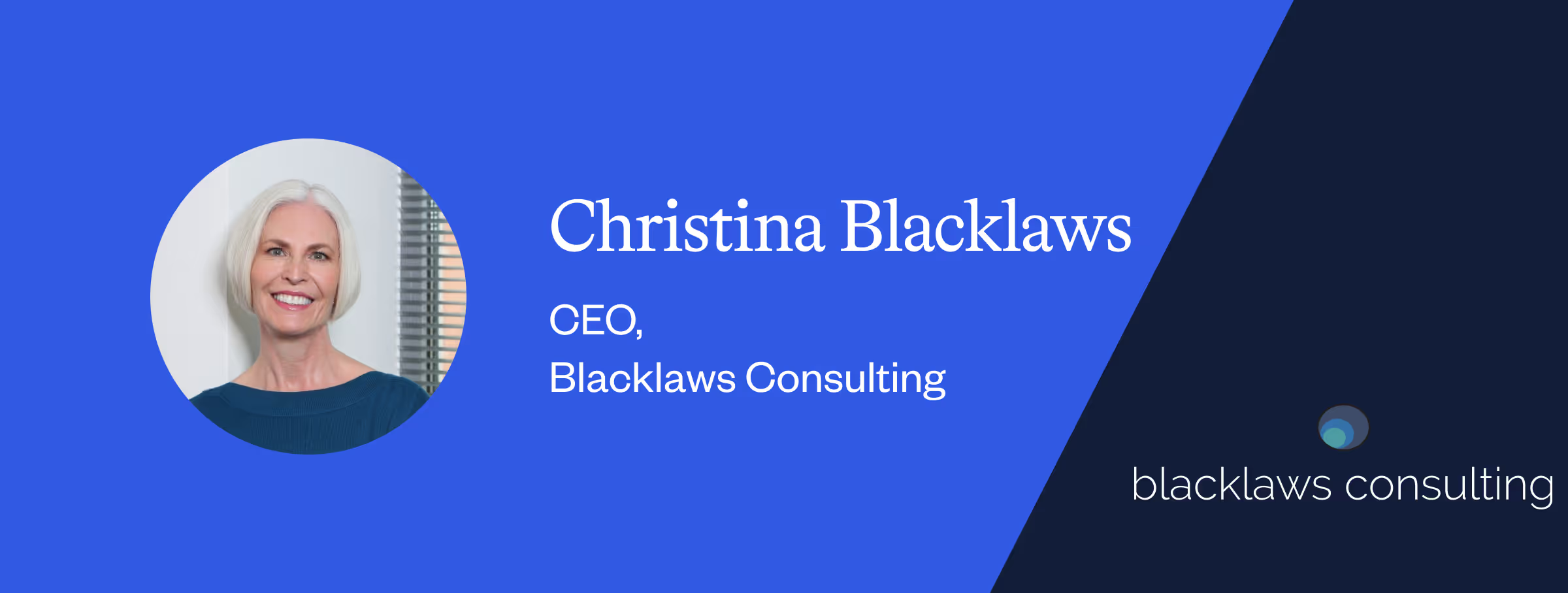
A former President of the Law Society of England and Wales, Christina is a driving force behind LawtechUK. Christina has consistently pushed the profession to think bigger, braver, and more human. Her career spans private practice, policy leadership, and legal tech advocacy, but the common thread is clear: she believes law should evolve with the world around it. Whether she’s speaking about AI, access to justice, or inclusion in the profession, she has a knack for translating complex change into something lawyers can actually engage with rather than fear.
What makes Christina especially compelling is that she pairs innovation with empathy. She talks as comfortably about emotional intelligence and well-being as she does about technology and transformation. For her, progress in law is not just about faster systems or smarter tools, but about creating a profession where people belong and thrive. She challenges lawyers to embrace curiosity, stay open to new ways of working, and see technology as an ally rather than a threat. In a sector often known for caution, Christina brings energy, clarity, and a refreshing sense of possibility.

Hannah Beko is not your typical lawyer-turned-coach. After beginning her career in commercial law, she experienced firsthand the kind of chronic stress so many in the profession quietly carry. Instead of accepting burnout as “just part of the job,” she chose to do something radical: change the conversation. Today, through her company Authentically Speaking, she helps lawyers reconnect with themselves, lead with clarity, and build careers that feel sustainable rather than exhausting. Her work blends psychology, nervous-system science, and practical leadership tools, all tailored specifically for the realities of legal life.
What makes Hannah stand out is her refreshing honesty. She talks openly about perfectionism, pressure, identity, and the emotional load of high-performance cultures. In her book, The Authentic Lawyer, she explores how legal professionals can thrive without sacrificing wellbeing or authenticity. She writes about burnout, leadership, and the quiet internal shifts that create real change. She is always thoughtful but never preachy, more like a trusted guide who understands the terrain because she’s walked it herself.

Ingrid Cope is a legal leader who brings both precision and personality to everything she does as the Senior Legal Counsel Europe at The Coca-Cola Company. With more than two decades of experience spanning private practice, compliance, and in-house leadership, Ingrid has built a career defined not just by expertise but by trust. She is the kind of lawyer who understands that great legal work does not sit on the sidelines; it enables ambition, protects reputation, and helps bold ideas move forward.
Outside the legal arena, Ingrid’s leadership shines just as brightly. She serves as a Trustee Director of Operation Smile UK, supporting life-changing surgical care for children, reflecting her deep commitment to social impact. And if you know Ingrid, you know how important sport is to her. Sport, she often says, has a remarkable way of bringing people together and creating inspiring moments of connection. One unforgettable example was when she had the privilege of carrying the Olympic Flame through the streets of Arezzo in beautiful Tuscany as part of the Milano-Cortina 2026 Torch Relay in February.
What made it even more meaningful were the teammates, family, friends, and colleagues cheering her on, a powerful reminder that achievement is never a solo act.
.avif)
As Chief Innovation Officer at White & Case, Parker leads global teams across data, knowledge, practice technology, research, and AI. Her remit is expansive, but her philosophy is clear: innovation succeeds only when it is embedded in the culture of a firm. In interviews, she speaks candidly about the importance of shared ownership. Innovation cannot sit with one team or one title. It has to be something lawyers feel part of, something that supports how they serve clients rather than disrupts it for the sake of headlines.
Her journey reflects that steady, culture-first approach. Before White & Case, Parker built and scaled innovation capability at Freshfields, helping shape one of the early, structured innovation functions in Big Law. Long before generative AI dominated the conversation, she was focused on process improvement, collaboration, and designing smarter ways of delivering legal work.
Today, she champions responsible AI adoption that is ethical, client-centric, and grounded in measurable value. She does not frame transformation as disruption for disruption’s sake. Instead, she positions it as evolution. Start small. Prove impact. Bring people along. And build a future of law that feels intentional rather than reactive.
.avif)
Julia is one of those rare founders who can see both the problem and the system around it. Trained as a lawyer and shaped by early work in international law, she quickly realised that access, efficiency, and trust in legal services weren’t just legal issues; they were design and technology challenges.
Before leading Legl, she founded CrowdJustice, a platform that helped people fund legal cases and brought transparency to a system that often felt out of reach. That early mission-driven work set the tone for everything that followed: using technology not to replace lawyers, but to remove friction and make the system work better for everyone inside it.
As CEO of Legl, Julia has focused on something deceptively unglamorous but incredibly powerful — compliance, onboarding, and the operational backbone of law firms. She’s been building infrastructure that helps firms move faster, stay compliant, and deliver smoother client experiences. Across her interviews, she comes across as thoughtful, commercially sharp, and refreshingly candid about the realities of building in an industry that doesn’t always love change. There’s a clear thread running through her career: law should work smarter, feel more human, and be built around the people using it. And she’s doing the hard, practical work to make that happen.

Leila El Gharbi’s journey into legal tech was a series of curious pivots, bold reinventions, and quiet realizations. Trained as an employment lawyer in France, she began her career in the classic way: mastering doctrine, advising clients, doing the serious work that law demands. But somewhere along the way, she noticed that the most interesting questions were not just about what the law says. They were about how people experience it.
How do teams actually use legal advice? Why do contracts feel inaccessible? Why does innovation in legal feel intimidating rather than empowering?
When she moved into corporate roles and later into legal tech in the UK, she found her sweet spot. Not in choosing between law and technology, but in translating between them. What started as an unplanned detour into legal tech quickly became a calling. She realised she had a rare strength: the ability to humanise complex systems, to make tech feel less like disruption and more like possibility.
She built Beautiful Souls in Legal Tech not as a glossy brand exercise, but as a genuine community for people navigating change. From lawyer to operator, from practitioner to community builder, from cautious adopter to thoughtful advocate of AI, Leila’s story is about embracing evolution without losing humanity. It is proof that you do not need to abandon law to reshape it.
.avif)
After making her mark as a General Counsel in high-growth environments, she has stepped into a more dynamic chapter as a freelance General Counsel, working closely with companies like Likezero, Convertr, and Cosmonauts. She also serves as an Interim Group Director of Legal, bringing steady leadership to organisations that need sharp legal judgment without the rigidity of a traditional structure.
Natalie thrives where things are scaling fast, where legal needs to be commercial, embedded, and forward-thinking rather than reactive. She doesn’t just advise from the sidelines. She builds frameworks, shapes culture, and helps businesses move with confidence.
Whether she is guiding fintechs through growth challenges or stepping in at the group level to stabilise and strengthen legal operations, she brings a pragmatic energy that turns legal into a growth lever rather than a blocker. Natalie represents a new wave of legal leadership. Flexible, strategic, commercially fluent, and deeply aware that the real power of legal lies in how well it enables the business to build boldly.
.avif)
When Sarah Irwin stepped into her first high-growth tech GC role, she quickly realised something surprising: being “the only lawyer in the room” was exciting… until it wasn’t. The pace was relentless, the decisions were big, and there was no ready-made playbook for scaling legal inside a startup. So she did what builders do. She created one.
What started as informal coffee chats with other in-house lawyers navigating the same chaos turned into a powerful insight: legal leaders in tech didn’t just need answers, they needed each other. That spark became Irish Tech General Counsel, better known as ITGCa space where in-house lawyers could swap war stories, share practical solutions, and admit what wasn’t working without judgment.
Founding ITGC wasn’t about prestige or panels. It was about proximity. Proximity to real conversations, real challenges, and real collaboration. What began as a small peer circle has grown into a trusted community where legal leaders talk candidly about scaling teams, adopting tech, proving ROI, and staying sane while doing it.
.avif)
A former in-house business lawyer who carved her own path across borders, she moved from corporate legal life into building something far more creative and disruptive: a platform that helps lawyers stand out, not blend in.
As the founder of Law But How?, Sarah challenges one of the legal profession’s biggest blind spotsthe obsession with technical expertise at the expense of visibility, influence, and commercial thinking. She believes legal skill is just the baseline. What truly sets lawyers apart is their ability to communicate clearly, build relationships, and make the law accessible to the people who actually need it.
From navigating a non-traditional background and international moves to embracing design as a tool for demystifying complex legal concepts, she has consistently chosen reinvention over comfort. Through her speaking engagements, podcast appearances, and LinkedIn thought leadership, she encourages lawyers to create their own opportunities rather than wait for them.
Her message is practical but empowering: build your brand, invest in your voice, focus deeply on solving real problems, and stop hiding behind jargon. In a profession often resistant to change, Sarah is proof that creativity and law are not opposites they are a powerful combination.
.avif)
If legal operations had a chief storyteller, it might just be Stéphanie Hamon. With a career that bridges private practice, in-house strategy, and legal ops consulting, she has become one of the clearest voices explaining how legal teams can move from reactive support functions to confident, business-aligned partners. Whether she’s speaking on a podcast, contributing to industry interviews, or advising global teams, Stéphanie has a way of turning what could feel like process-heavy transformation work into something energising and purposeful.
She understands the pressures legal teams face, the “do more with less” reality, and the cultural resistance that often comes with change. But instead of treating transformation as a tech rollout, she frames it as people-first leadership.
Through interviews and podcast conversations, she often speaks about relationships with outside counsel, smarter ways of working, and the importance of aligning legal with business priorities. The result is a body of thought leadership that feels grounded, actionable, and refreshingly human. You come away not just informed, but inspired to rethink how legal can truly operate at its best.
If there’s one deduction to be made from these stories, it’s this: progress in law rarely happens by accident. Much like a careful investigation, it takes curiosity, courage, and a willingness to question how things have always been done.
The women leading across legal and legal tech today are doing exactly that, challenging old assumptions, designing better systems, and opening doors for those who follow. Through innovation, community-building, and a commitment to making the profession more human and accessible, they are quietly reshaping the future of legal.
The conclusion is simple, really: when more voices lead, the entire profession moves forward.