


What Is Contract Negotiation? Process, Strategies and Best Practices

Huzaifa Sultana is a Marketing Associate at SpotDraft focusing on Organic Growth through SEO and AEO.

Contract negotiation is the process of discussing and modifying the terms of an agreement until the parties reach terms they're willing to accept and sign. It's the stage where a draft turns into something both sides can actually live with.
Negotiation can touch price, scope, payment terms, liability, timelines, intellectual property, confidentiality and other commercial or legal terms, depending on the deal.
This guide covers how contract negotiation actually works: who's involved, what typically gets negotiated, how to prepare, practical strategies and where technology fits in.
.webp)
Contract negotiation is the process of discussing and revising the terms of a draft agreement until both parties agree to sign it. It's what happens after a first draft exists and before anyone signs anything.
Negotiation changes the original draft. Terms get added, removed or reworded based on what each side is actually willing to accept, which is different from simply reviewing a contract for accuracy or risk. Review checks whether a draft says what it's supposed to say. Negotiation decides what it should say in the first place.
According to the Cornell Legal Information Institute, "Negotiation is the process by which parties bargain in an effort to reach an agreement. Parties often negotiate the terms of a contract before entering into it."
Negotiation shapes the whole business relationship. It sets clear expectations, decides who carries which risks, and builds trust between the parties.
The cost of getting it wrong is high. World Commerce & Contracting research shows "the average business loses almost 9% of value annually through poor contract management."
The problem scales globally, too. Deloitte research on agreement management found that "poor agreement management practices and systems cost organizations nearly $2 trillion in annual global economic value."
"Negotiation is 90% preparation, 10% talking."
~ Sterling Miller, CEO and Senior Counsel, Hilgers Graben PLLC
Ten Things: Business Skills All In-House Lawyers Must Know

Contract negotiation is usually cross-functional. The exact participants depend on the type and value of the agreement, and not every stakeholder below needs to be involved in every negotiation.
Legal typically focuses on legal risk, contract language, liability, indemnification, intellectual property, confidentiality, compliance and dispute resolution.
In customer and revenue-generating agreements, sales focuses on commercial objectives, pricing, deal timelines, customer requirements and revenue considerations.
In vendor and supplier negotiations, procurement focuses on pricing, supplier terms, service levels, delivery, commercial leverage and vendor risk.
Finance typically weighs in on payment terms, pricing, budget, financial exposure and revenue recognition where relevant.
The teams actually responsible for delivering or using the contracted service need to validate scope, deliverables, timelines, service levels and operational commitments. A deal legal and sales agree to can still fail if operations can't actually deliver on what was promised.
Negotiation isn't only an internal process. The customer, vendor, supplier or partner on the other side is an active participant with its own commercial and legal interests, not simply a party responding to your terms.
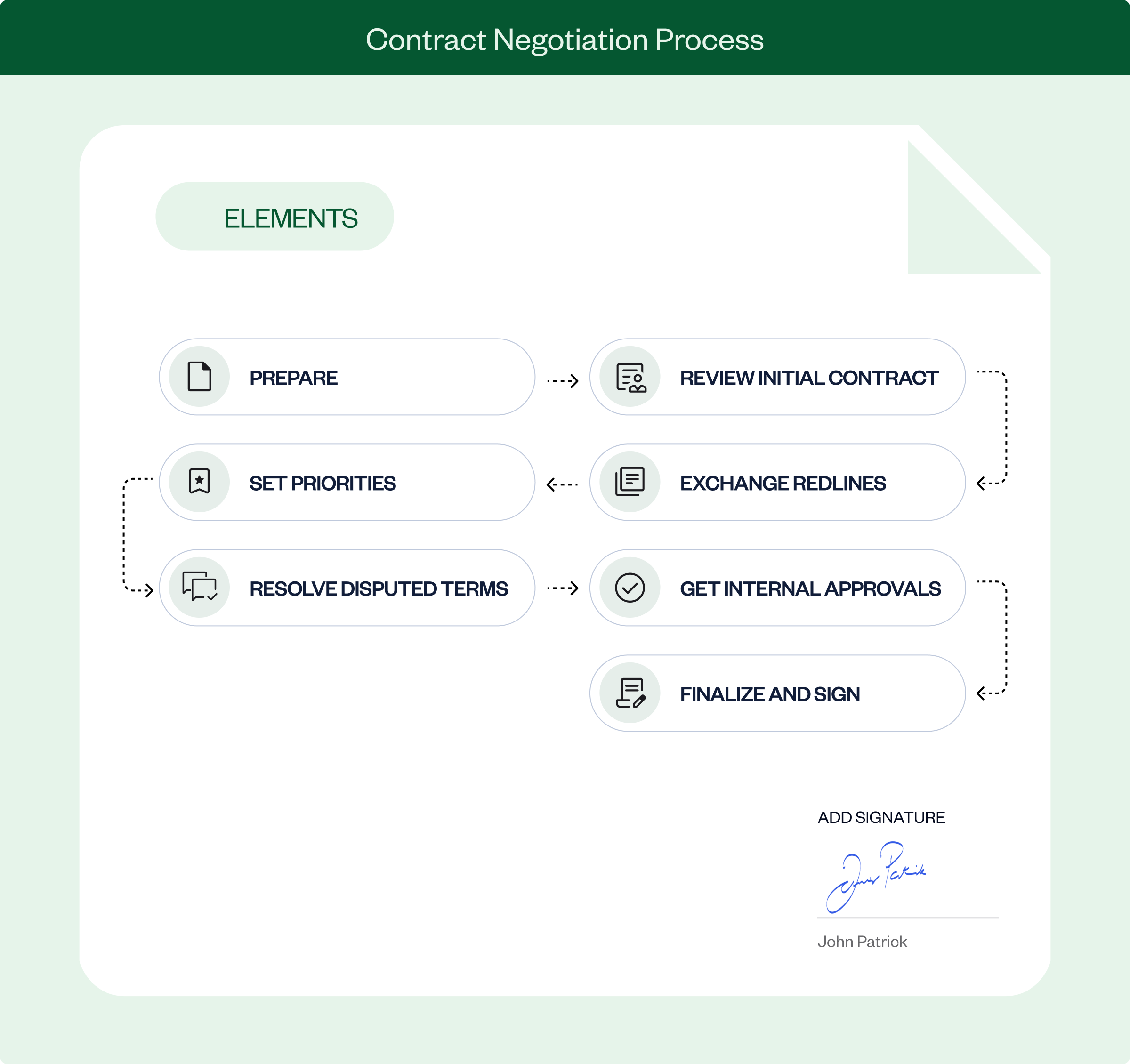
For a deeper walkthrough of this process specifically, see our contract negotiation process guide.
The table below shows the terms teams negotiate most and what's usually at stake. For a deeper breakdown, see SpotDraft's guide to the most negotiated contract clauses.
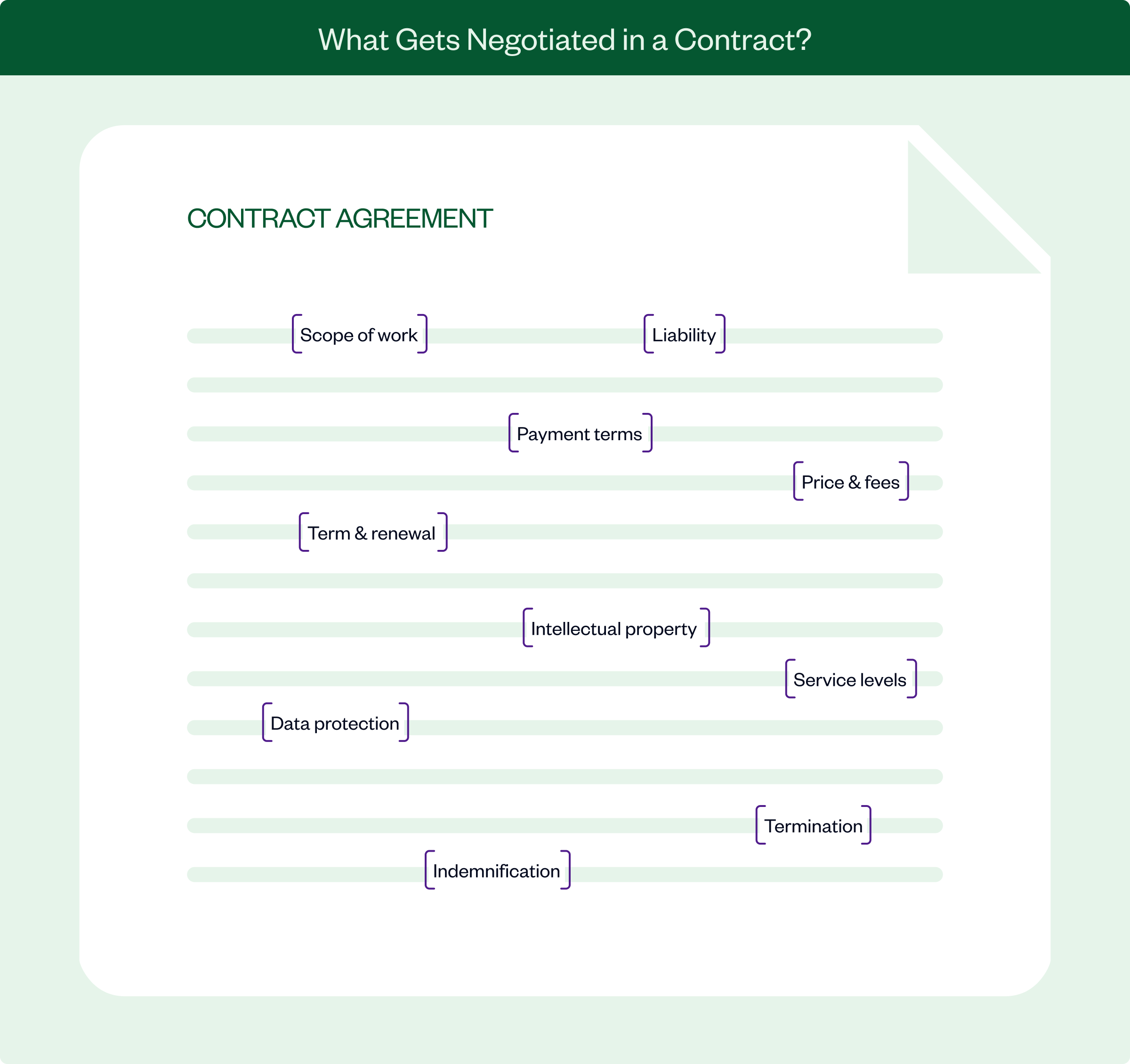
World Commerce & Contracting's Most Negotiated Terms 2024 report found limitation of liability, price and indemnification topping the list of most negotiated terms globally, which lines up with what shows up most often across commercial contracts generally, not just one industry or contract type.
For a deeper look at these approaches, see our contract negotiation strategies guide.
A redline is the visible, tracked version of proposed changes, and it's central to how most contract negotiations actually happen. Reviewing incoming redlines means distinguishing material changes (liability, payment, scope) from minor edits (formatting, phrasing) so attention goes where it actually matters.
Version control matters here more than people expect. Comments explaining the reason behind an important change help the other side actually understand what's being asked, rather than just seeing a deletion and a new sentence. Before signing, it's worth confirming the final agreed language actually matches what was negotiated, not an earlier version that got overtaken by later redlines.
Also Read: how to redline in Word and Google Docs
A negotiation playbook documents an organization's preferred positions, fallback positions, red flags, approval thresholds, escalation rules and approved alternative language for common negotiation points.
Playbooks let business teams handle routine negotiations within defined boundaries, while exceptions get escalated to legal automatically rather than by default. See our full contract playbook guide for how to build one and check out the NDA negotiation playbook template.
Most of these come down to the same root cause: negotiation happening across disconnected channels with no single record of what's actually been agreed to at any given point.
Manual negotiation is slow. In SpotDraft's 2025 Contracting Efficiency Benchmarking Report, teams with automated workflows completed NDAs and MSAs in 1 to 3 days. Manual teams often took a week or more, sometimes up to 30 days.
Modern tooling closes that gap. Real-time contract collaboration lets legal and business teams edit and redline in one shared space, tag colleagues, and keep full version history.
You can separate internal comments from external ones, so private guidance stays hidden from the other side. Notifications also flow into Slack and Microsoft Teams, so work happens where your team already is.
AI contract negotiation adds another layer. Advanced AI contract negotiation tools use automated compliance checks, suggest redlines, and let business users complete a compliant first-pass review right inside their word processor.
Also Read: AI Contract Negotiation Strategies
The payoff is measurable. A 2026 Deloitte and Docusign study found that AI tools drove 36% efficiency gains through time savings and shorter cycle times, plus 36% cost avoidance from mitigated risks.
Legal leaders are on board. The Association of Corporate Counsel 2024 survey found that "Sixty-seven percent of CLOs believe that AI will have a 'mostly positive' or 'somewhat positive' impact on the in-house legal profession."
Key point: Good AI works on your terms. SpotDraft designs its AI to follow your rules, respect your playbooks, and keep your data secure. This approach references guidance from the California State Bar and the ABA, so you stay in control while the software handles the busywork.
Also Read: ChatGPT for contract negotiation
These numbers are only useful when they point to a specific process problem worth fixing, a bottleneck at a particular approval stage, a term that gets escalated far more than it should. Tracking a metric without acting on it doesn't actually improve anything.
SaaS contract. The customer typically negotiates the liability cap, data protection terms, renewal conditions and pricing.
Vendor agreement. Procurement typically negotiates pricing, payment terms, service levels and termination rights.
Employment agreement. Both parties may negotiate compensation, benefits, start date, confidentiality and termination terms.
Partnership agreement. Partners typically negotiate responsibilities, revenue sharing, IP ownership and termination conditions.
IT contract. Negotiation usually centers on scope, implementation milestones, service levels, security requirements, IP and support terms, particularly relevant for IT contract negotiation involving new vendors or complex integrations.
"SpotDraft is the anchor in our contracting process. It unified everything — drafting, negotiation, signature, repository — all in one place. And it works where our teams already work."
- Nicole Ducharme
Director of Legal Operations & Contracts, Astronomer
SpotDraft brings negotiation into a structured contract workflow, so legal and business teams work from the same contract, the same positions and the same approval process instead of scattered email threads and disconnected files.
Explore SpotDraft or request a demo to see how negotiation fits into the rest of the contract workflow.
.webp)

.png)

