Common Sirion competitors include SpotDraft, Ironclad, Juro, LinkSquares, Workday CLM, Icertis, Agiloft, Conga, Leah, CobbleStone, HyperStart, and DocuSign CLM. The right shortlist depends on the workflows your team needs, including implementation effort, integrations, contract review, and post-signature depth.
What is the difference between Sirion and Icertis?
Sirion emphasizes obligation management, SLA tracking, supplier performance, and contract-performance workflows. Icertis combines contract intelligence with lifecycle workflows, obligations, and enterprise integrations including Microsoft, SAP, Salesforce, and Workday. Both cover broad enterprise contracting requirements, but their product structures and post-signature workflows differ.
How long does Sirion take to implement?
Sirion does not publish one standard implementation timeline. Its SaaS terms define implementation, integration, and consulting as Professional Services that may be provided by Sirion or a third-party implementation partner. Buyers need a deployment plan based on the specific services, integrations, and migration work included in their scope.
Is Sirion suitable for mid-market companies?
Sirion can be evaluated by mid-market companies that need its contract-management scope, particularly obligations, SLA tracking, supplier performance, and post-signature contract performance. Teams should compare those requirements with their implementation scope, integrations, and day-to-day contracting workflows before choosing a platform.
Can I switch from Sirion to a simpler CLM?
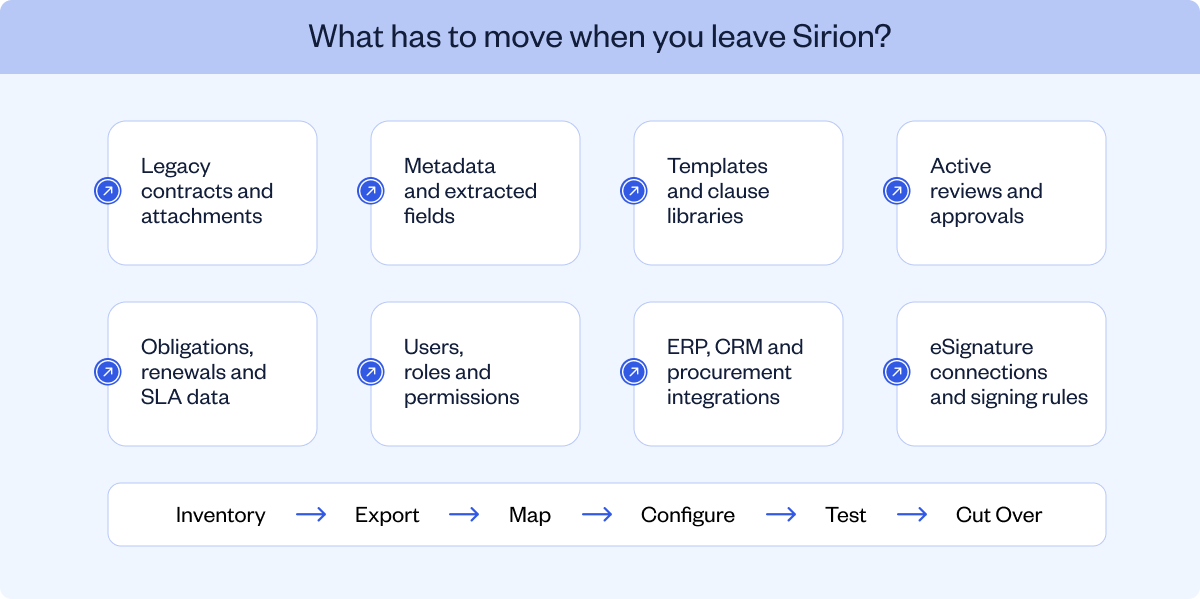
Yes, you can switch from Sirion to a simpler CLM. Start by inventorying contracts, metadata, templates, clause libraries, workflows, permissions, obligations and integrations. Then confirm what the new vendor can migrate directly, what needs to be reconfigured and how active contract processes will be handled during the transition.
Huzaifa Sultana is a Marketing Associate at SpotDraft focusing on Organic Growth through SEO and AEO.
TL;DR
Sirion covers obligations, supplier performance, SLA tracking, and other post-signature workflows alongside contract creation and negotiation. Teams comparing alternatives should first decide how much of that post-signature scope they need to preserve.
Implementation scope is separate from the software subscription. Sirion’s terms define implementation, integration, and consulting as Professional Services that may be provided by Sirion or a third-party implementation partner.
The operating model extends beyond the CLM itself. Sirion connects with external eSignature providers for execution and can connect obligations and SLAs with operational data from ERP, procurement, and service-management systems for contract-performance workflows.
Sirion does not publish a self-serve subscription rate card on their website. Its SaaS terms state that subscription fees are set in the Order Form, while Professional Services can be scoped separately.
SpotDraft combines playbook-based review, approvals, native eSignature, repository management, and reporting, while its published pricing includes in-house implementation and legacy-contract migration.
Contracts rarely stay with Legal from start to finish. Sales needs deals approved, procurement manages supplier terms, finance tracks commercial commitments, and Legal still has to review risk, negotiate language, and keep agreements usable after signing.
CLM platforms have expanded around that work, covering intake, drafting, review, approvals, eSignature, repository management, obligations, and reporting. Sirion extends further into supplier performance and post-signature operations, which gives it a fairly broad enterprise scope.
The challenge is matching that scope to the team running it. SpotDraft’s State of Legal Ops survey found that 48.5% of Legal Ops teams have one to five people, while 44% of organizations have no dedicated Legal Ops team at all. For teams working with that kind of headcount, implementation effort, administration, and day-to-day usability can carry as much weight as feature depth.
That is why comparing Sirion competitors comes down to fit. The platforms below vary in setup, review workflows, eSignature, integrations, and post-signature depth.
Why Teams Consider Moving Away From Sirion
Teams may compare Sirion alternatives when they do not need the same depth across supplier performance, obligations, SLAs, and post-signature contract management. Sirion supports those workflows alongside drafting and negotiation, giving buyers a broad contract-management scope to compare against their own requirements.
Sirion’s contract-performance workflows can bring operational data into the CLM. Its documentation shows obligations and SLAs connected with performance and billing data, including information from ERP, P2P, S2P, and ITSM systems.
Subscription pricing depends on the customer’s commercial scope. Sirion’s SaaS terms state that subscription fees are set in the Order Form, and Sirion does not publish a self-serve subscription rate card. Teams should confirm the subscription and any Professional Services included in the Order Form or SOW.
The surrounding tech stack can add another consideration. Sirion works with external eSignature providers, so replacing it may involve keeping those signing connections or moving execution into the new CLM.
The shortlist should therefore reflect the workflows the team needs to preserve. Supplier performance, SLA monitoring, and detailed obligation management point to one set of requirements; review, approvals, signing, repository management, and renewals point to another.
That is the gap the Sirion alternatives below are designed to compare.
How Did We Assess the Sirion Competitors and Alternatives
We assessed each Sirion alternative across eight areas: implementation, cost, AI and contract review, post-signature work, integrations, governance, scalability, and migration.
Implementation and administration: We checked vendor-documented implementation approaches, published rollout timelines where available, migration scope, workflow setup, and administrator responsibilities.
Total cost: We reviewed public pricing where available, quote-based pricing, paid modules, AI limits and separate implementation or integration requirements.
AI and contract review: We looked at AI capabilities, playbooks, third-party paper, Word support, redlining, contract analysis, extraction capabilities, risk identification, and human review controls.
Supplier and post-signature work: We checked obligations, renewal dates, SLAs, supplier performance, and the operational data required to monitor contractual commitments after signing.
Configuration and integrations: We reviewed workflow controls, API access, and the actions available inside systems such as Salesforce, Microsoft Word, and procurement platforms.
Security and governance: We checked access controls, auditability, security certifications, and the governance requirements that can affect larger enterprise deployments.
Support and scale: We checked vendor-documented implementation ownership, customer support, user or usage limits, and capabilities relevant as contract volume grows.
Migration requirements: We considered legacy contracts, metadata, templates, clause libraries, active workflows, permissions and connected systems.
12 Best Sirion Competitors and Alternatives in 2026
The 12 Sirion alternatives below cover different needs, from lean Legal workflows to enterprise contract intelligence and procurement-heavy CLM. Use the table to narrow the shortlist before reviewing each platform in detail.
Tool
Best for
Key difference vs Sirion
SpotDraft
Lean in-house Legal teams managing the full contract lifecycle
Includes in-house implementation and native eSignature with Word-based playbook review.
Ironclad
Teams needing detailed workflow configuration
Workflow Designer controls contract-specific processes with native Ironclad Signature.
Juro
Teams prioritizing connected Word and browser workflows
Uses contract-volume pricing with unlimited users, workflows and templates.
LinkSquares
Legal teams focused on repository analysis
Separates active contracting in Finalize from post-signature analysis in Analyze.
Workday CLM, powered by Evisort AI
Enterprise contract intelligence and Workday environments
Combines Evisort AI with end-to-end workflows and external eSignature integrations.
DocuSign CLM
Companies already working heavily in DocuSign
Connects CLM with DocuSign agreement workflows and eSignature.
Icertis
Large enterprise contract intelligence and performance management
Connects contracts with SAP, Microsoft, Salesforce and operational systems.
Agiloft
Teams requiring extensive no-code configuration
Offers configurable workflows and more than 1,000 connectors.
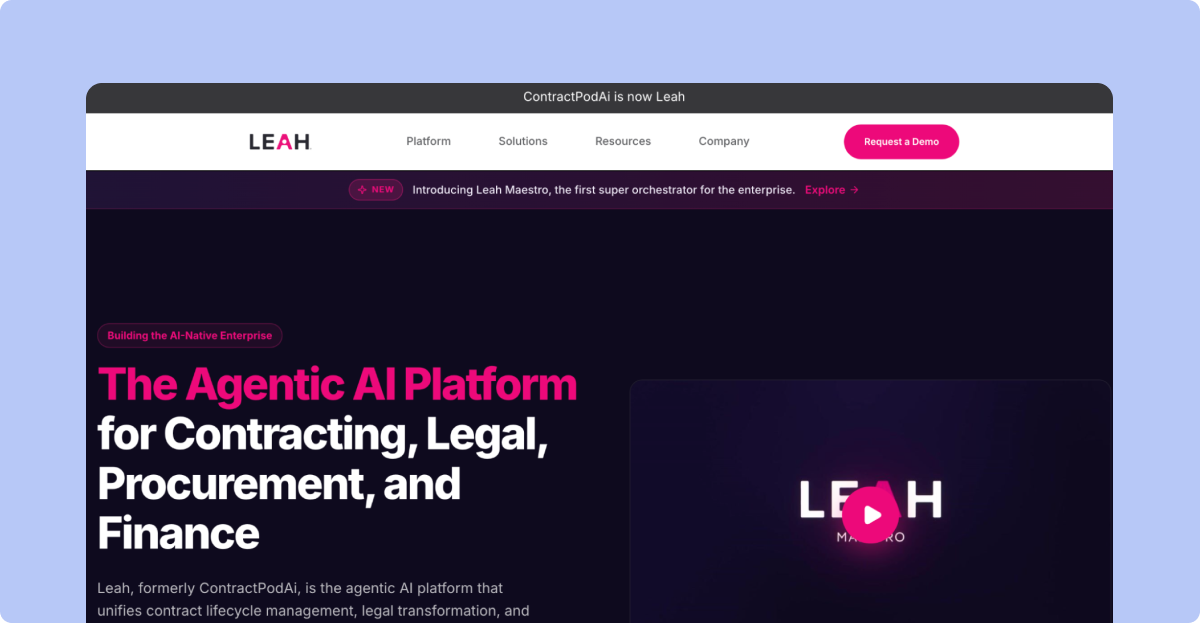
Leah, formerly ContractPodAi
Agentic contracting across Legal, procurement and finance
Rebranded from ContractPodAi in January 2026; Leah Contracting runs contracting through Leah Maestro.
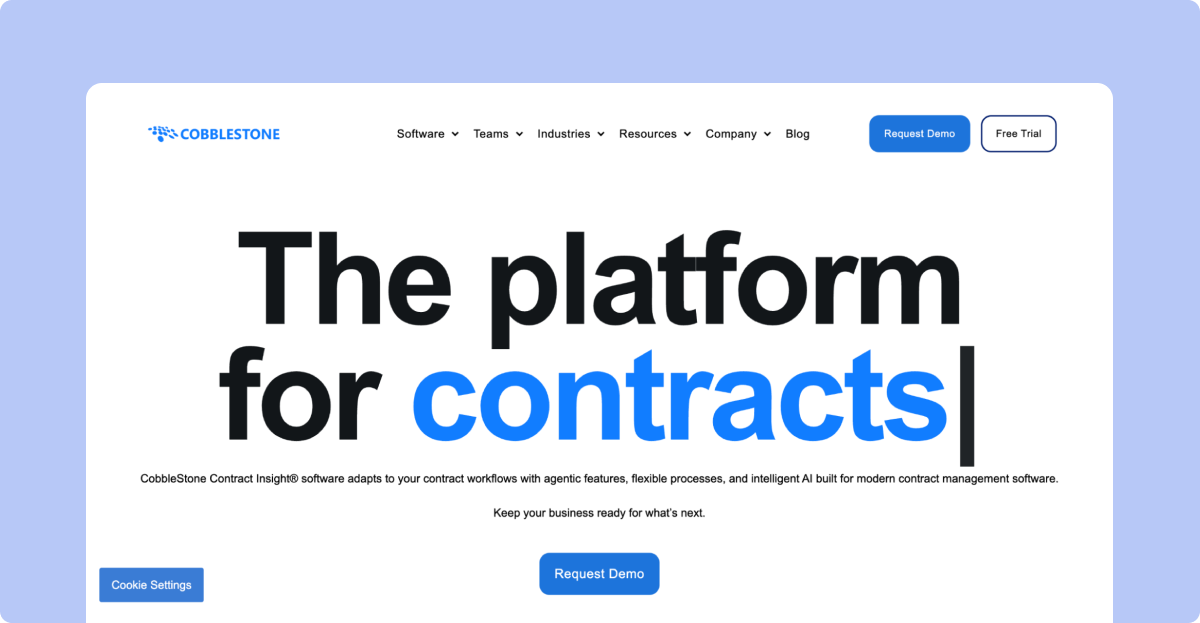
CobbleStone
Contract management tied closely to procurement
Combines CLM with sourcing, vendor management, purchase requests and procurement workflows.
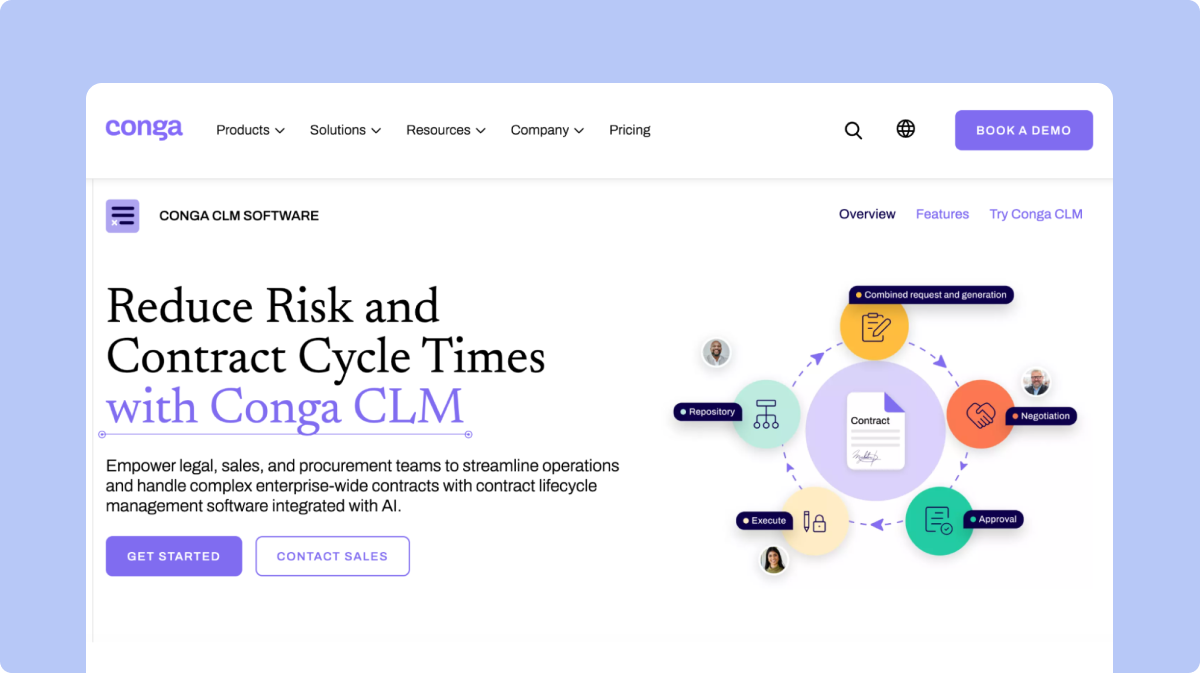
Conga CLM
Salesforce-centric contracting
Uses Salesforce objects, Word workflows, clause logic and edition-based functionality.
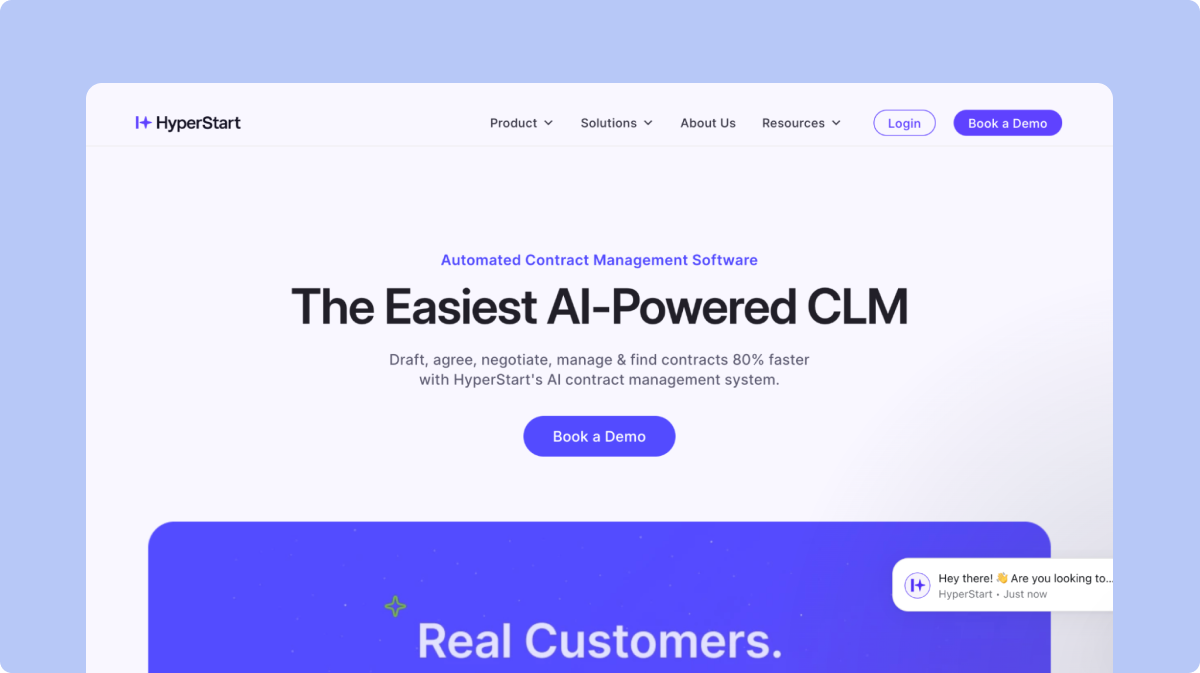
HyperStart CLM
Teams prioritizing a shorter vendor-stated deployment
States a 4–6 week implementation window and supports native signing alongside external eSignature integrations.
1. SpotDraft
SpotDraft is a CLM for in-house Legal teams that want contract creation, review, approvals, signing and post-signature management in one workflow. Its implementation team configures workflows and integrations, then migrates legacy contracts without a separate implementation fee.
Key features
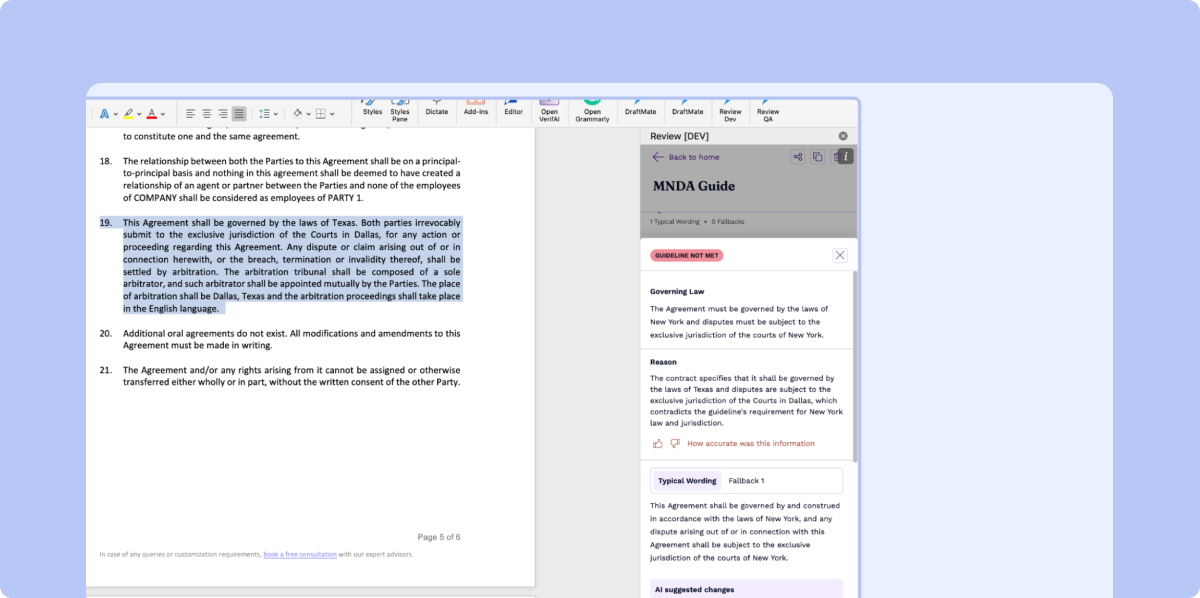
Reviews third-party contracts through VerifAI using Legal-defined Guides, typical wording and approved fallbacks inside Microsoft Word.
Routes agreements through conditional approvals and can reset approval when a version or relevant contract variable changes.
Edits contracts through SpotDraft's Contract Editor while preserving comments, redlines and version history.
Executes agreements through SpotDraft Sign, with signing order, audit logs, reminders and repository storage built into the CLM.
Extends Legal work through Sidebar, which can review agreements, query contract sets and monitor regulatory sources.
Pros
Includes in-house workflow setup, integrations, legacy migration, dedicated customer success and 24/7 support.
Keeps playbook-based contract review inside Microsoft Word instead of introducing a separate review interface.
Provides native eSignature while retaining integrations with DocuSign and Adobe Sign for teams that want to keep an existing provider.
Cons
Requires a sales conversation for exact pricing because rates depend on users or contract volume.
Limits VerifAI's Microsoft Word add-in to supported .docx files rather than legacy .doc files.
2. Ironclad
Ironclad organizes contracting around configurable workflows. Workflow Designer controls launch forms, contract generation, review, approvals and signature rules for each contract process.
Key features
Configures launch forms, approval logic and signature steps through Workflow Designer.
Applies AI Playbooks to specific workflow templates for contract review against Legal-defined positions.
Supports Ironclad Signature alongside external providers including DocuSign, Adobe Sign and Dropbox Sign.
Pros
Lets administrators change contract workflows without application code.
Supports up to 20 connected external eSignature providers in one company instance.
Offers flexible deployment options, including customer-led deployment, Ironclad legal engineers, and implementation partners.
Cons
Keeps exact subscription pricing behind a quote.
Charges separately for certain integrations, API access and additional instances.
Restricts workflow configuration and AI Playbook creation to users with the required administrative access.
3. Juro
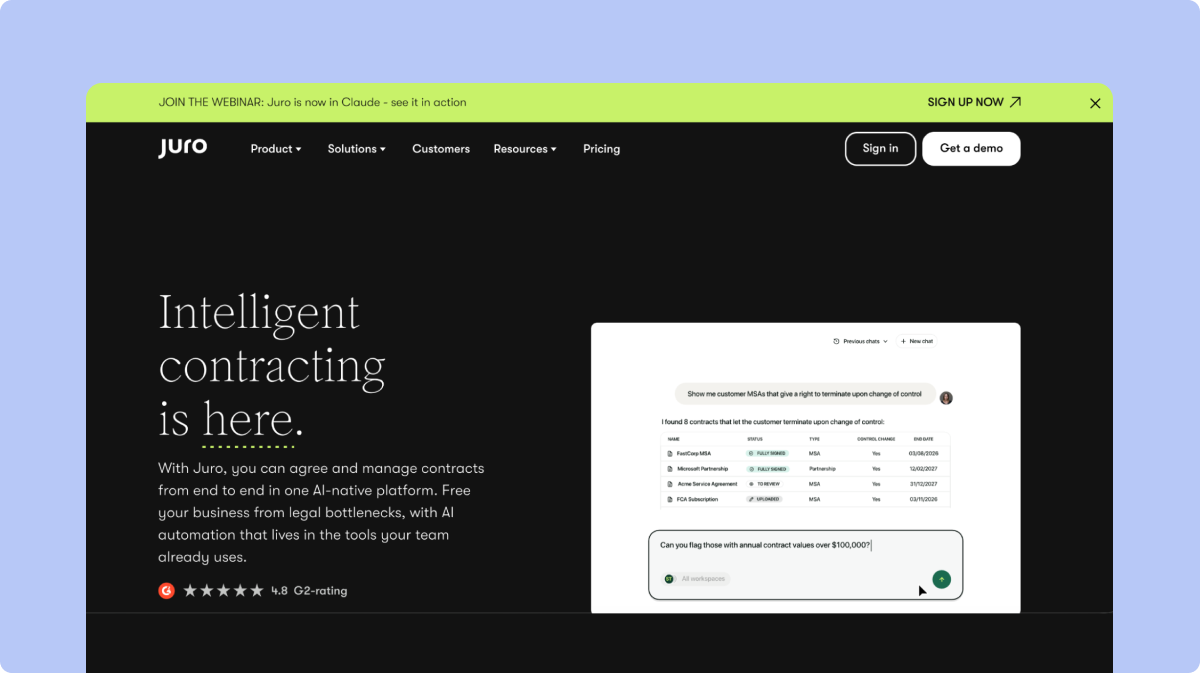
Juro connects its browser CLM with Microsoft Word. Contracts can move through creation, review, approval and signing while Word edits remain connected to the Juro record.
Key features
Reviews contracts against custom playbooks through AI Review in Juro and Microsoft Word.
Synchronizes Word edits, comments, redlines and versions back to Juro's workflows and repository.
Queries contracts through Operator and extracts contract fields through AI Extract.
Pros
Includes unlimited users, workflows and templates in its current pricing model.
Bases pricing on contract volume and integration complexity instead of user count.
Keeps Word-based negotiation linked with the corresponding CLM record.
Cons
Uses custom pricing instead of publishing fixed subscription rates.
Factors integration complexity into its custom pricing.
Applies AI limits, including 500 monthly Operator tasks and 10 AI Reviews per user every two hours.
4. LinkSquares
LinkSquares divides contract work between Finalize and Analyze. Finalize handles active contracting, while Analyze manages completed agreements and contract intelligence.
Key features
Manages drafting, approvals and negotiation through Finalize before execution.
Moves eligible completed agreements from Finalize into Analyze when both products are configured together.
Reviews agreements through AI Legal Assistant using playbooks, redlines and documented reasoning.
Pros
Connects active contract work with post-signature analysis when Finalize and Analyze are both deployed.
Explains AI-generated redline decisions alongside the suggested changes.
Supports repository reporting, event notifications and risk scoring within Analyze.
Cons
Requires both Finalize and Analyze to connect pre-signature workflows with post-signature intelligence.
Excludes XLSX agreements from Finalize-to-Analyze ingestion.
Leaves later Finalize information changes outside Analyze after the initial agreement sync.
5. Workday Contract Lifecycle Management, powered by Evisort AI
Workday now offers enterprise contract lifecycle management and Contract Intelligence powered by Evisort AI. The CLM product adds requests, drafting, negotiation and approvals to the contract-intelligence layer.
Key features
Automates contract intake, drafting, redlining and approvals through end-to-end workflows.
Extracts contract terms through AI and supports custom AI models across repository data.
Connects contracts with Box, SharePoint, Salesforce and external eSignature providers such as DocuSign and Adobe Sign.
Pros
Combines contract intelligence with pre-signature workflow management in the full CLM product.
Lets teams create custom AI models for contract terms that are specific to their organization.
Connects contract data with existing repositories and business systems through integrations and REST APIs.
Cons
Separates Contract Intelligence from the full Contract Lifecycle Management product.
Uses integrations with eSignature providers such as Adobe Sign and DocuSign for contract execution.
Publishes a 21-day average implementation only for Contract Intelligence, so buyers should not apply that figure to the full CLM rollout.
6. DocuSign CLM
DocuSign CLM extends contracting into templates, review, workflows and repository management. It is particularly relevant when the company already works heavily inside the DocuSign ecosystem.
Key features
Generates contracts through dynamic templates and data from systems such as Salesforce.
Routes contracts through configurable processes using more than 100 preconfigured workflow steps.
Reviews agreements through playbooks, AI-assisted review, comments and version control.
Pros
Connects agreement generation, CLM workflows and DocuSign signing inside the wider DocuSign environment.
Supports clause libraries and conditional review rules for non-standard terms.
Provides prebuilt connectors and APIs for surrounding business systems.
Cons
Requires a sales conversation because DocuSign CLM does not publish self-service subscription pricing.
Adds CLM-specific workflow and repository configuration beyond standalone eSignature.
Sits alongside DocuSign IAM offerings, so buyers should confirm whether the quoted scope covers CLM, IAM, or both.
7. Icertis
Icertis is an enterprise contract lifecycle management platform built around Contract Intelligence. Its 2026 Vera experience connects drafting and redlining with portfolio data, obligations and downstream business systems.
Key features
Reviews agreements through Vera Engage using AI-driven drafting, playbooks and targeted redlining.
Tracks contract obligations and fulfillment through Vera Obligations, with workflows, dashboards, and third-party integrations for post-signature monitoring.
Connects contract work with Microsoft, SAP, Salesforce and other enterprise systems.
Pros
Links contract commitments with operational and transactional systems after execution.
Supports Microsoft Word review while keeping contract information synchronized with enterprise systems.
Uses portfolio context, prior agreements and business rules to inform its Vera AI layer.
Cons
Requires a sales-led buying process because public subscription rates are not presented on the current product pages.
Connects obligation and contract-intelligence workflows with enterprise systems including Microsoft, SAP, Salesforce, and Workday, so buyers should confirm which integrations are in scope.
8. Agiloft
Agiloft centers its CLM around no-code configuration. Teams can change approval chains, data models and workflow logic while connecting contract data with a large integration catalog.
Key features
Configures workflows, approvals and contract data models without application code.
Connects contract data through more than 1,000 prebuilt connectors for CRM, ERP and sourcing systems.
Applies Astra AI to contract review, risk analysis, extraction and contract questions.
Pros
Gives approved administrators broad control over workflows and contract data structures.
Supports pre-signature work and post-signature obligations within the same CLM.
Provides a free Astra tier for teams evaluating its contract-AI layer before a wider deployment.
Cons
Provides broad no-code configuration across workflows and data models, so implementation scope depends on how much the buyer chooses to configure.
Keeps CLM pricing behind a quote.
Supports eSignature through integrations including DocuSign and Adobe Sign.
9. Leah, formerly ContractPodAi
ContractPodAi rebranded as Leah in January 2026. On September 17, 2026, Leah launched Leah Contracting, powered by Leah Maestro, to run work across intake, review, negotiation, approval, signature, obligations, and renewal.
Key features
Runs contract intake, review, negotiation, approvals, signature, obligations, and renewals through Leah Contracting.
Reviews and redlines contracts in Microsoft Word while applying contract playbooks.
Coordinates contracting with Legal, procurement and finance through Leah's broader agentic platform.
Pros
Covers the complete contract lifecycle alongside wider Legal and procurement workflows.
Keeps existing ContractPodAi customer contracts, integrations and workflows intact after the rebrand.
Connects contracting with broader agentic workflows through Leah Maestro.
Cons
Extends contracting into a broader Leah platform spanning Legal, procurement, and finance through Maestro.
Uses Leah branding for the current platform while historical documentation and reviews may still refer to ContractPodAi.
Keeps pricing sales-led rather than publishing a self-service CLM rate card on the current product pages.
10. CobbleStone Contract Insight
CobbleStone combines contract management with procurement. Its platform covers contract workflows alongside vendor onboarding, sourcing, purchase requests and procurement approvals.
Key features
Connects contract records with sourcing, requisitions, vendor activity and purchase orders.
Applies VISDOM AI to extraction, playbook checks, contract summaries and clause analysis.
Supports clause playbooks inside Contract Insight and its Microsoft Word add-in.
Pros
Combines procurement and CLM for teams that want supplier activity linked directly with governing contracts.
Offers a 30-day Contract Insight trial for buyers that want hands-on evaluation before purchase.
Provides separate VISDOM pricing tiers, including a free AI-processing tier.
Cons
Extends CLM into sourcing, vendor management, purchase requests, and procurement workflows.
Separates VISDOM AI processing into volume-based plans for teams requiring higher AI usage.
States that enterprise-wide VISDOM deployment is usually completed within 60 days, a timeline that applies to VISDOM rather than the full Contract Insight implementation.
11. Conga CLM
Conga offers CLM through its Advantage Platform and Contracts for Salesforce. Its Salesforce integration connects agreement data, Word-based negotiation, and approval logic directly with Salesforce records.
Key features
Creates contracts through guided requests, templates and conditional clauses.
Reviews agreements through Microsoft Word, redlining, version comparison and True-Up in Contracts for Salesforce.
Routes contract and clause changes through configured approval workflows.
Pros
Connects contracting with Salesforce objects and data for organizations already running commercial processes there.
Supports third-party paper while reconciling negotiated terms back into Salesforce fields.
Supports Conga Sign and external eSignature providers, with included Conga Sign entitlement depending on the edition and subscription.
Cons
Changes functionality by Salesforce edition. Clause Library begins in Business, while Clause Playbook sits in Enterprise.
Restricts the Contracts for Salesforce Clause Playbook to Composer-generated documents.
Uses Salesforce managed packages, objects, and permissions as part of Contracts for Salesforce configuration.
12. HyperStart CLM
HyperStart covers contract creation, approvals, negotiation, signing, repository management and renewals. The vendor currently states a 4–6 week implementation window.
Key features
Creates contracts through templates, intake forms and conditional fields.
Reviews contracts through AI suggestions, redlining, version control and a Microsoft Word integration.
Executes agreements through native OTP-based signatures or integrations with DocuSign, Adobe Sign and Zoho Sign.
Pros
States a 4–6 week implementation window and offers a seven-day free trial.
Connects with Salesforce, HubSpot, Pipedrive, Outlook, SharePoint, Slack and other common business systems.
Provides AI-based metadata extraction and repository search across uploaded agreements.
Cons
Uses custom pricing based on team size and contract volume.
Offers native signing methods such as hand-drawn, OTP, and Aadhaar alongside integrations with external eSignature providers.
How to Choose the Right Sirion Alternative
Before comparing vendors, define which parts of Sirion you need to preserve and which parts you want to simplify. Start with the workflows and operating requirements the replacement has to support. That usually comes down to six questions:
Admin capacity: How much workflow configuration and ongoing platform management can your Legal Ops team support?
Review model: Do lawyers need playbook-based review and redlining in Microsoft Word, or can negotiation stay inside the CLM?
Post-signature depth: Do you need standard renewal and obligation tracking, or deeper contract performance management and SLA monitoring?
System dependencies: Which CRM, ERP, procurement, and eSignature systems must remain part of the contract workflow?
Migration scope: Which contracts, metadata, templates, permissions, and workflow rules need to move from Sirion?
Governance: Do contracts span multiple legal entities or regions with different permissions and governance rules?
Those answers should determine which platforms make the shortlist:
Primary requirement
Platforms to evaluate
Lean Legal operations
SpotDraft, Juro, HyperStart
Word-based contract review
Juro, Icertis, SpotDraft
Complex workflow design
SpotDraft, Ironclad, Agiloft, Conga
Contract intelligence
LinkSquares, Workday CLM, Icertis
Enterprise governance
Icertis, CobbleStone, Conga
Agentic contract workflows
Leah, Icertis
Why Lean Legal Teams Should Consider SpotDraft as a Sirion Alternative
SpotDraft combines contract review, approvals, signing, repository management, and reporting in one CLM workflow. Its published pricing also includes in-house implementation, workflow and integration setup, and legacy-contract migration. For lean Legal teams comparing Sirion alternatives, that creates a different operating model from a platform with deeper supplier-performance and contract-performance workflows.
Workflow
SpotDraft approach
Contract review
VerifAI runs Legal's Guides against third-party paper in Microsoft Word, including standard positions and fallbacks.
Legal AI
A sidebar reviews contracts, answers questions and surfaces regulatory changes.
Editing and negotiation
Contract Editor supports redlining, comments, collaboration and version history, with Word workflows also available.
Signing
SpotDraft Sign is native to the CLM and keeps signing history with the contract. DocuSign and Adobe Sign can also be connected.
Approvals
Workflows route approvals by contract variables and can reset them after relevant changes.
Implementation
SpotDraft's team sets up workflows, integrations and legacy contract migration as part of its published pricing model.
The implementation model is an important distinction for lean teams. SpotDraft states that implementation is handled in-house, with no separate outsourcing requirement. Every customer also receives dedicated customer success and 24/7 support.
Review stays tied to Legal's own positions as well. VerifAI lets teams define detailed Guides and approved fallbacks. Sidebar extends AI work across contracts and legal questions. Those capabilities remain distinct, so buyers can assess exactly where each one fits.
Execution can remain in the same workflow through SpotDraft Sign when native eSignature is sufficient. Teams that already use DocuSign or Adobe Sign can keep those providers connected instead.
Exact subscription pricing still requires a quote. SpotDraft says pricing can be based on users or contract volume, while implementation and migration are included. See SpotDraft pricing details.
Frequently Asked Questions
What are the best Sirion competitors?
What is the difference between Sirion and Icertis?
How long does Sirion take to implement?
Is Sirion suitable for mid-market companies?
Can I switch from Sirion to a simpler CLM?
Related content
latest
Mastering Business Contracts: A Complete Guide
Learn what a business contract is, the key types and elements that make one binding, and how to use them to protect your business. Start with the basics.



![12 Top Sirion Competitors and Alternatives Compared [2026]](https://cdn.prod.website-files.com/5f2c07287a7a746048684529/6ab6351a2ac14e219c671a76_01_comparing_sirion_alternatives_1x.webp)