Employee Spotlight: Hemil Shah



From navigating the chaotic streets of Bangalore to helping scale SpotDraft’s engineering foundations, Hemil’s nearly four-year journey has been defined by a "safety net" leadership style, enabling the juniors, and a relentless focus on long-term code health. As a Senior Developer, he balances the urgency of delivery with the discipline of thinking through the consequences of every technical decision.
My role primarily revolves around ensuring projects are delivered on time and at high quality to keep product leadership happy. Beyond that, it’s about mentoring the team and safeguarding the long-term health of our codebase. I see myself as a "brake" sometimes—not to stop progress, but to make sure we think through the consequences of our decisions so they don't come back to bite us in six months or two years. I also strive to make the codebase approachable so that it’s never unnecessarily difficult for new engineers to join and contribute.
It started with my dad, who built environment monitoring instruments. I grew up around machines and assembly-level tinkering in a small workshop on our terrace. While I loved the physical aspect of building, getting our first computer changed everything. Realizing I could type a command into MS-DOS and make the machine do exactly what I wanted was a revelation. I started programming in school, and by then, I knew I wanted to be around computers for the rest of my life.
I studied a mix of Humanities and Engineering during my undergrad, and later pursued Applied Quantitative Research (sociology meets statistics) at NYU. My professors opened my eyes to the idea that technology isn't just about what you build; it’s about who uses it and the impact it has on people. That interdisciplinary perspective completely changed how I approach problem-solving and work-life balance today.
Before SpotDraft, I worked at startups like Blinkit (formerly Grofers) and even had a stint at a high-frequency trading firm in the US. I moved back to India during the pandemic and took a short break—the longest I’d been home since high school. When I interviewed at SpotDraft, I loved that they focused on real-world problems over abstract data structures. Funnily enough, I actually blanked completely during my last interview. I took a walk to clear my head and tried a hail-mary by sending a long follow-up email explaining how I’d solve the problem in a real-world scenario. They called me the next day and the rest as they say is history. They valued the thought process over a "perfect" performance and it’s become one of my favorite stories.
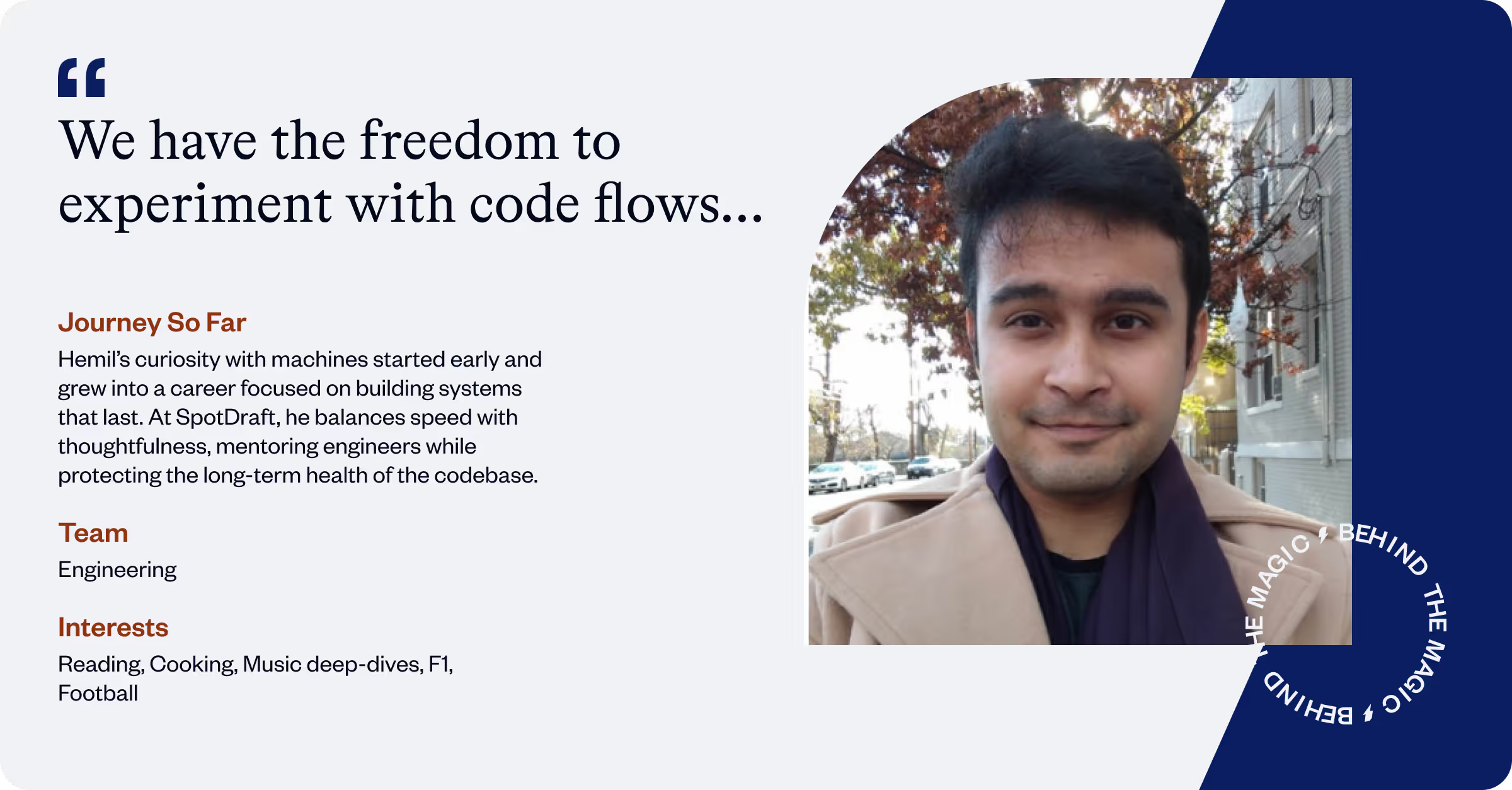
The "hidden complexity" of legal tech. On the surface, people think we’re just storing and signing contracts. Underneath, there’s immense complexity. I’m motivated by the ownership we get here. You have the freedom to experiment with code flows, explore experimental solutions and given permission to fail and learn. It’s a rare environment where you aren't just "babysitting" code; you’re building things.
I’d use the acronym "WHY-PHY": Work Hard Yes, Play Hard Yes (a nod to the movie 21 Jump Street). It’s an environment where people are almost pathologically built to help one another. If you have a question, someone will sit with you for an hour to solve it, even if they’re busy. It’s an open playground—if you see something, you say something, and leadership actually listens.
I’m a big reader—it’s how I transport myself to different worlds and philosophies. I also love learning in "spikes." One week, I might obsessively watch documentaries on undergrad physics, and the next, I’m diving deep into a specific music genre. I also enjoy cooking and watching F1 and football.