Limitation of Liability Clause: Definition, Examples, and How to Negotiate One

Huzaifa Sultana is a Marketing Associate at SpotDraft focusing on Organic Growth through SEO and AEO.


No matter how carefully you draft a contract, you can't account for every scenario. A limitation of liability clause won't eliminate risk, but it caps how much your business could owe if things go wrong. Get it wrong, though, and you may find it unenforceable exactly when you need it most. This guide covers what the clause actually does, how it's different from the unrelated concept of "limited liability" as a business structure, what a real clause looks like, and how courts decide whether to enforce one.
A limitation of liability clause is a contract provision that caps the amount one party must pay the other for damages arising from a breach, performance failure, or other specified event. It lets both sides agree in advance on the maximum financial exposure they're willing to accept.
Example: A software vendor and a retail chain agree that if the vendor's inventory system malfunctions and causes losses, the vendor's liability is capped at the fees paid in the prior 12 months, unless the failure results from gross negligence or willful misconduct.
That last part matters. If a vendor misrepresents the software's capabilities or acts recklessly, the cap often won't apply. That carve-out is called an exclusion, and it's one of the most important parts of the clause to negotiate correctly.
No, and this is one of the most common points of confusion in contract law searches.
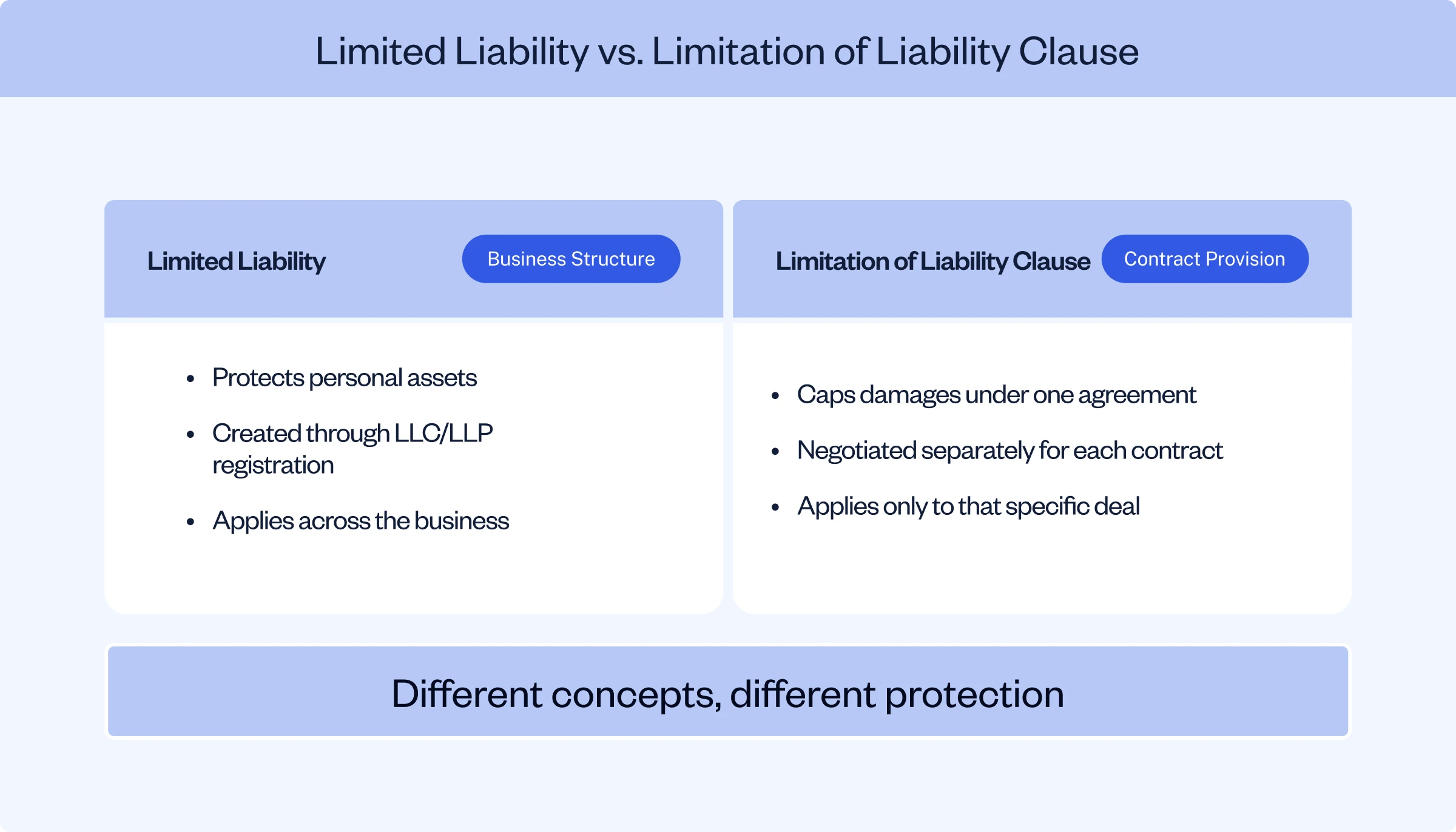
Limited liability describes a business entity structure, like an LLC (limited liability company) or LLP, that legally separates an owner's personal assets from the company's debts and legal obligations. If the company is sued or goes bankrupt, the owner's personal finances stay protected; that's what "limited liability" refers to when people ask what an LLC is.
A limitation of liability clause, by contrast, is a specific provision written into a single contract that caps how much one contracting party owes the other for damages under that particular agreement. It has nothing to do with business entity formation. A sole proprietor with unlimited personal liability as a business structure can still negotiate a limitation of liability clause into a specific contract, and a fully incorporated LLC can sign a contract with no liability cap at all and face uncapped exposure under that agreement regardless of its entity protection.
In short: limited liability is about protecting your personal assets from your business's obligations generally. A limitation of liability clause is about capping exposure under one specific contract. You can have either, both, or neither; they're independent legal tools.
"If someone said you can only work on one section of a contract, I would always pick the section dealing with indemnification, limitation of liability, and warranty... the 'Big Three.'"
— Sterling Miller, CEO and Senior Counsel, Hilgers Graben PLLC
A typical mutual clause in a SaaS or services agreement follows this general structure (adapt the specifics to your deal and always have counsel review the final language:
Notice this clause is doing two separate jobs at once: it excludes entire categories of damages (indirect, consequential, punitive) regardless of amount, and separately it caps the dollar amount of whatever damages survive that exclusion. Treating these as the same mechanism is one of the most common drafting mistakes, missing one while negotiating the other leaves a real gap.
It depends entirely on how the clause is drafted, and this is one of the most heavily negotiated points in the entire agreement.
Courts generally view mutual clauses more favorably because they reflect balanced risk allocation rather than one party unilaterally shielding itself. In most negotiated B2B agreements, mutuality has become the standard expectation, and a buyer pushing back on a one-sided cap is usually on solid ground asking for it.
The negotiation often comes down to how much risk each side is willing to accept. The American Bar Association notes that the party providing protection generally wants a lower limit while the protected party wants greater coverage, making the appropriate cap highly dependent on the transaction and its risks.
Limitation of liability is not just a boilerplate provision. World Commerce & Contracting's 2024 Most Negotiated Terms report found that limitation of liability remained one of the most negotiated contract terms globally, alongside price and indemnification.
Financial protection. It caps exposure to a predictable amount instead of an open-ended claim, which matters most in high-risk industries or for businesses with limited resources.
Encourages deal-making. Capped risk makes counterparties more willing to sign agreements they might otherwise consider too risky.
Faster dispute resolution. With a pre-agreed cap, there's less to argue about if a claim arises, which saves time and legal fees.
Balances risk and reward. A vendor might accept a lower cap in exchange for a longer warranty or better payment terms, similar to how a warranty clause is often negotiated alongside liability limits.
These two clauses are often confused.
They're frequently negotiated together, and a cap on liability can sometimes apply to indemnification obligations too, so review both clauses as a pair during contract negotiation. The relationship between the two clauses matters during negotiation. The American Bar Association notes that limitation-of-liability provisions can materially affect indemnification risk, making it important to evaluate both provisions together rather than in isolation
Manually checking every limitation of liability clause against your playbook doesn't scale once contract volume grows. VerifAI reviews contracts against your established guidelines, flags non-compliant liability language, explains why it's a risk, and suggests redlines, so your legal team spends less time hunting for the exposure and more time negotiating it. It's part of the same AI-assisted contract review approach many legal teams are adopting to keep pace with deal volume and pairs well with a standing contract review checklist.
Book a demo to manage these clauses at a scale.