Mastering Business Contracts: A Complete Guide

Huzaifa Sultana is a Marketing Associate at SpotDraft focusing on Organic Growth through SEO and AEO.


Signing your first business contract can feel intimidating. The language is dense, the stakes feel high and one missed clause can cost you real money.
Here's the good news: you don't need a law degree to understand the basics. This guide breaks down business contracts in plain English, so you can read, write and sign them with confidence.
You'll learn what a business contract is, what makes one legally binding, and the main types you'll run into. We'll also walk through the contracting process step by step, cover the laws that apply, and flag the mistakes to avoid.
This guide is for small business owners, founders, and anyone who handles agreements without a legal team behind them. No jargon, no theory you can't use. Just the practical stuff that protects your business.
Ready? Let's start with the basics.
A business contract is a legally enforceable agreement between two or more parties that spells out each side's rights and obligations. In plain terms, it's a promise the law will back up.
Every contract has one job: to set clear expectations. It protects both sides and lowers the chance of a costly dispute later.
Contracts are everywhere in business. You sign them with customers, vendors, employees, and partners, often without thinking twice.
Not every handshake deal counts, though. Understanding the difference between an agreement vs contract tells you when your deal is actually enforceable.
Contracts do more than record a deal. They prevent misunderstandings, manage risk, create legal recourse, and build trust with the people you work with.
The cost of getting this wrong is real. According to World Commerce & Contracting, the average business loses almost 9% of value annually through poor contract management costs.
The wider legal system is expensive for small firms, too. A Brattle Group study for the U.S. Chamber ILR found small businesses bear 48 percent of commercial tort costs, roughly $160 billion in 2021.
The pressure is growing. SpotDraft's 2025 Contracting Efficiency Benchmarking Report found 77% of organizations saw a jump in contract volume this year.
The same report found 56% of legal teams can't execute standard contracts within a week.
For a contract to hold up in court, it needs a few key ingredients. Miss one, and your agreement may not be enforceable.
Together, these elements form a legally binding contract. Mutual assent simply means everyone understood and agreed to the same thing.
Oral agreements can be binding, too. The catch? They're hard to prove when memories differ.
Once these elements are in place, you can explore the many types of business contracts that fit different situations.
Businesses rely on many kinds of contracts. Grouping them by what they do makes it easier to spot which one you need.
Here's a closer look at fifteen contracts you'll likely run into, what each one covers, and when to reach for it.
A sales contract sets the terms when one party sells goods to another. You'll use one whenever money changes hands for products.
Example: A retailer signs a business sale agreement defining unit price, delivery dates, and payment obligations.
A service agreement defines the terms when one party provides a service to another. Reach for it when you hire or offer work like consulting, design, or marketing.
Example: A studio signs a service agreement outlining deliverables, revision rounds, and a monthly retainer.
A vendor agreement sets the terms between your business and a supplier. Use one to lock in pricing and expectations with suppliers you buy from regularly.
Example: A restaurant uses a vendor agreement template to set weekly delivery windows, pricing, and quality standards with a food supplier.
An MSA sets the baseline terms for an ongoing relationship, so you don't renegotiate from scratch each time. Individual projects then run under shorter statements of work.
Example: An agency and client sign an MSA, then follow a master service agreement checklist to add a statement of work per campaign.
An NDA protects confidential information that two parties share. Use one before you reveal trade secrets, financials, or product plans.
Example: Two startups exploring a merger sign an NDA, using a guide to NDAs to protect their financial data during talks.
An employment contract defines the relationship between you and a full- or part-time employee. Use one to set pay, role, and expectations from day one.
Example: A tech company signs an employment contract setting a software engineer's salary, equity, and notice period.
An independent contractor agreement defines the terms when you hire a contractor instead of an employee. Use one to make clear the worker isn't on your payroll.
Example: A marketing team uses an independent contractor agreement template to hire a freelance writer for a three-month project.
A partnership agreement sets the terms between two or more people running a business together. Use one when you start or formalize a partnership.
Example: Two founders use a partnership agreement template to define equal ownership, shared duties, and how they'll split profits.
A licensing agreement grants one party the right to use another's intellectual property, like software, a brand, or a patent. Use one to earn or pay royalties for that use.
Example: A software vendor signs a licensing agreement letting a reseller distribute its app for an annual fee.
A lease agreement lets a tenant, or lessee, use property or equipment for a set period in exchange for rent. Use one when you rent office space, a warehouse, or machinery instead of buying it.
Example: A startup signs a lease agreement for office space, setting monthly rent, a security deposit, and who handles repairs.
A distribution agreement lets a supplier hand off its products to a distributor to sell, often within a set territory. Use one when you want a partner to move your goods to market.
Example: A beverage maker signs one of its distribution agreements to give a regional distributor exclusive rights to sell its drinks in three states.
A purchase and sale agreement sets the terms for buying and transferring goods, assets, or an entire business. Reach for one in bigger or staged deals where the handoff needs conditions before it closes.
Example: A buyer and seller sign a purchase and sale agreement to transfer a small manufacturing business once financing and inspections clear.
An indemnity agreement has one party agree to cover certain losses, damages, or liabilities for another. It's often called a "hold harmless" arrangement because it shifts financial risk from one side to the other.
Example: A contractor signs an indemnity agreement promising to cover a property owner's costs if a subcontractor's work causes damage.
A franchise agreement lets a franchisor grant a franchisee the right to run a business under its brand and system for fees or royalties. Use one when you buy into an established brand instead of building your own.
Example: A new owner reviews the franchising contracts before opening a franchised coffee shop under a national brand.
A joint venture agreement lets two or more businesses team up on a shared venture while staying separate companies. Use one when you combine resources for a specific project without merging.
Example: Two tech firms sign a joint venture agreement to build a product together, splitting the costs and the profits down the middle.
Here's a quick reference to match each contract to its parties and purpose:
Whichever type you're signing, the strongest contracts share the same core building blocks. Here's what to include.
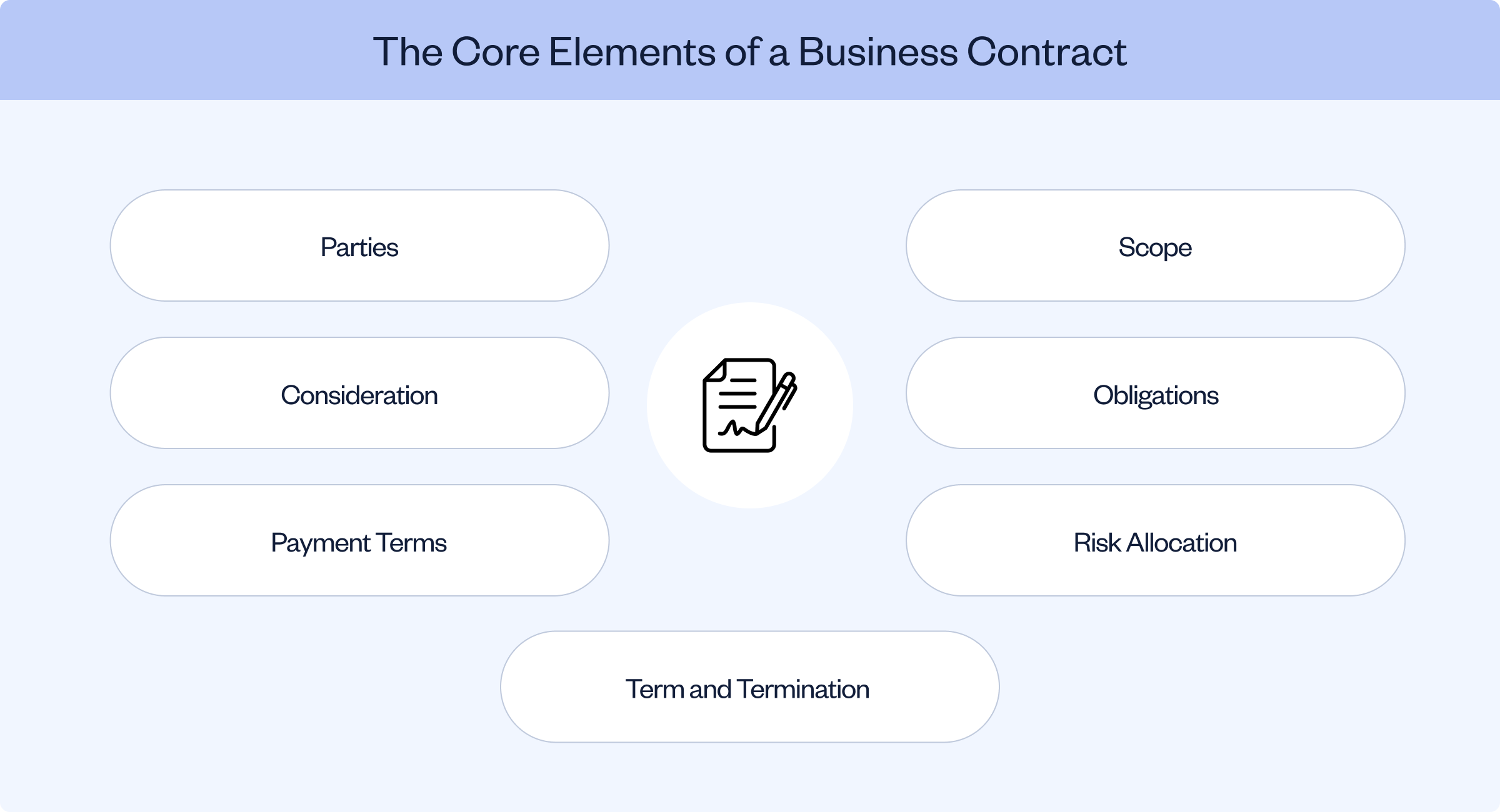
A strong contract is built from standard building blocks. Here's what to cover when you write a business contract agreement.
Not every contract needs all twelve. But the more you include, the fewer surprises you'll face.
Every contract follows a lifecycle, from first idea to final signature. Understanding these phases helps you move faster and avoid mistakes.
The stages are simple: contemplate the deal, draft it, negotiate, approve, sign, and store. Let's walk through them.
#1 Contemplate the deal. Get clear on what you want first. Know your terms, budget, and deal-breakers before you write anything.
#2 Draft the contract. Start from a vetted template written in plain language. Templates help you streamline contract creation and avoid reinventing the wheel.
#3 Negotiate and redline. Both sides mark up the draft until the terms work for everyone.
#4 Approve. Route the contract to the right people for sign-off. Automated contract workflows keep approvals from stalling in someone's inbox.
#5 Sign. Both parties sign to make the deal official.
#6 Store. Save the signed contract somewhere safe and searchable.
Speed matters here. SpotDraft's 2025 Contracting Efficiency Benchmarking Report found manual contracting takes about 19 days on average.
The most automated teams move faster. The same report found they get standard contracts down to as low as three to six days.
Yes. An electronic signature (or e-signature) is a digital way to sign a document, and it's legally valid in most business deals.
In the US, the ESIGN Act gives e-signatures the same legal weight as ink. The EU's eIDAS regulation does the same across Europe.
An e-signature is enforceable when both parties intend to sign and the signing is recorded. Using secure electronic signatures also speeds up execution, since no one waits on the mail.
A signed contract isn't the finish line. You still need to track renewals, deadlines, and obligations, and find the document when you need it.
Too many teams store contracts poorly. SpotDraft's 2025 Contracting Efficiency Benchmarking Report found 49% of teams still manage contracts with email and shared folders.
That's risky. Miss a renewal date and you could auto-renew a bad deal or lose a key protection.
A searchable contract repository keeps every agreement in one place, so nothing slips through the cracks.
You don't need to memorize contract law. But knowing the basics tells you when a deal must be in writing.
Most business contracts fall under common law, the body of rules built from court decisions. The Uniform Commercial Code (UCC) governs the sale of goods.
Some contracts must be written to be enforceable. The Cornell Legal Information Institute explains one key rule.
Under the Statute of Frauds, contracts for the sale of goods worth $500 or more must generally be in writing. This also covers land sales and deals lasting over a year.
State laws vary, so check your local rules. For international sales, the CISG treaty may apply.
Not every contract is worth signing. Watch for these warning signs before you commit.
These gaps add up to a bigger problem. In contract effectiveness research from World Commerce & Contracting and Deloitte, only 39% of legal and contract professionals believe contracts are achieving their intended goals.
A breach happens when one party fails to keep its promise. Not all breaches are equal.
A material breach is serious, like not paying or not delivering. A minor breach is small and doesn't defeat the deal's purpose.
When a breach happens, you have options:
One note: punitive damages generally aren't available for a simple breach.
The stakes can be high. Lex Machina reported $13 billion in contract damages awarded from 2021 to 2023 in US federal district courts.
Enforcing a contract doesn't always mean court. You usually have several paths, from friendly to formal.
Each step up costs more time and money. Weigh the value of the dispute against the business relationship you may want to keep.
When the stakes are high, involve an attorney early.
How much should you spend on a contract? It depends on what's at stake.
A vetted template can be free or low-cost. Attorney fees vary widely, often running hundreds of dollars per hour.
The rule of thumb? Spend on legal review in proportion to the risk.
How Can Businesses Manage Different Types of Contracts?
Managing contracts effectively matters beyond simply keeping documents organized. World Commerce & Contracting research found that businesses experience average contract value erosion of 8.6%, while almost 90% of business users say they find contracts difficult or impossible to understand.
A contract lifecycle management platform is what typically ties these practices together across every contract type a business handles, rather than managing each type in a separate system.
Businesses manage many contract types, and each one can come with different templates, clauses, workflows, approval requirements and metadata. Managing all of that manually gets harder as volume grows.
SpotDraft brings this together through a centralized contract repository, reusable contract templates, a managed clause library, and workflow automation for approvals. SpotDraft AI applies playbook-based review across contract types, flagging where a draft deviates from approved language. Native e-signature and contract analytics round out the process from signature through reporting.
Legal defines the templates, playbooks and approval rules. Business teams then handle routine contracts within those guardrails, without needing legal to touch every standard agreement.
Business contracts are the backbone of every deal you make. They protect your business, set clear expectations, and give you recourse when something goes wrong.
But a contract is only as good as how you create, sign, and store it. The right elements and clauses matter, and so does managing the whole lifecycle.
Want to run your contracts from draft to signature without the chaos? Request a demo and see how SpotDraft can help.