What Is a Contract? Definition, Elements and Types Explained

Huzaifa Sultana is a Marketing Associate at SpotDraft focusing on Organic Growth through SEO and AEO.


Suppose you're renting an apartment. You'd want the rent amount, due date, and what it covers, like maintenance or utilities, written down. That's what a contract does: it removes ambiguity so everyone knows exactly what's expected of them.
Contracts show up everywhere in business, from vendor agreements to employment terms. According to World Commerce & Contracting's benchmark research on contracting practices, most legal and commercial disputes trace back to ambiguity in a document that was signed without anyone fully agreeing on what it meant. This guide covers what makes something a contract, the elements that make it enforceable, the many ways contracts get classified, and why the distinctions matter for legal teams managing them at volume.
A contract is a legally binding agreement between two or more parties that creates mutual, enforceable obligations. Merriam-Webster's dictionary defines it more simply still as a binding agreement between two or more persons or parties, especially one that's written and enforceable by law.
In the US, contract law comes primarily from common law, developed through centuries of court decisions, supplemented by statutes like the Uniform Commercial Code (UCC), which governs commercial and secured transactions. Cornell Law School's Legal Information Institute defines a contract as a promise or set of promises for the breach of which the law provides a remedy, or the performance of which the law recognizes as a duty. That "remedy" part is what separates a contract from a casual promise: courts can actually do something about it.
This trips people up constantly. All contracts are agreements, but not all agreements are contracts.
An agreement is simply a mutual understanding between two or more parties about something. Agreeing to meet a friend for lunch is an agreement, but it isn't a contract because it's missing the legal elements below and neither side expects a court to get involved if the other cancels.
A contract is a specific kind of agreement, one that includes the elements that make it legally enforceable. The distinction matters most when something goes wrong: you can't sue over a broken lunch plan, but you generally can sue over a broken vendor agreement.
Also Read: Agreement vs. Contract
An agreement only becomes an enforceable contract when it includes these six elements:
Missing any one of these can make an agreement unenforceable, which is why contract drafting checklists typically start here.
Meeting the six elements above doesn't automatically mean a contract survives every legal challenge. Contracts fall into four categories depending on their legal standing:
Valid contracts meet every legal requirement and are fully enforceable by either party.
Void contracts have no legal effect from the start, typically because the purpose itself is illegal. A contract to sell stolen goods is void regardless of how carefully it's worded.
Voidable contracts are enforceable unless one party chooses to cancel it, usually due to fraud, misrepresentation, or one party lacking legal capacity when they signed. A contract signed under duress is a common example.
Unenforceable contracts may otherwise be valid but can't be upheld in court due to a procedural failure, a missing signature, an expired statute of limitations, or a requirement (like the Statute of Frauds) that certain contracts be in writing.
The distinction matters practically: a void contract was never binding, but a voidable one stays binding until someone actively challenges it, which changes what a legal team actually needs to do about a problematic agreement already in circulation.
Written contracts spell out terms clearly and are the most enforceable and defensible in court. Best for high-stakes agreements like vendor contracts or employment terms.
Verbal contracts are legally binding in many cases but hard to prove without a written record. If a dispute happens, it turns into a "he said, she said" argument over exact terms, deadlines, and payment, which is nearly impossible to resolve with certainty.
Implied contracts arise from conduct rather than words. Ordering food at a restaurant implies you'll pay for it; no one signs anything, but the obligation is real and enforceable.
Written contracts are generally preferred for professional agreements because they reduce disputes and hold up better under scrutiny. Even so, some agreements are enforceable purely on the strength of reasonable reliance: a party that reasonably relied on a verbal promise may be able to recover damages under the legal doctrine of promissory estoppel, even without a signed document.
Bilateral contracts involve mutual promises from both sides. A seller promises to deliver; a buyer promises to pay. Most commercial contracts, including sales contracts, fall into this category.
Unilateral contracts involve one party's promise, fulfilled only if the other performs an action, like a reward for returning lost property. The other party isn't obligated to act, but if they do, the promisor is bound.
Express contracts state terms clearly, in writing or verbally, leaving little room for misinterpretation.
Implied contracts are inferred from behavior or circumstances rather than explicit terms.
Beyond form and structure, contracts in procurement, construction, and consulting are often classified by how cost and risk get split between the parties. This distinction shows up constantly in project-based work, even though it's easy to overlook in a general contracts overview.
Fixed-price contracts. A provider delivers at an agreed price regardless of actual costs incurred. Low risk for the buyer, higher risk for the contractor if costs run over.
Cost-reimbursement contracts. The buyer covers actual costs incurred by the contractor, plus an agreed fee. Common where the full scope of a project isn't clear upfront.
Cost-plus contracts. A variation on cost-reimbursement where the contractor's profit is a set percentage or fixed fee added to actual costs.
Time and material contracts. Billing is based on hours worked and materials used, best suited to projects with evolving scope, like consulting or ongoing development work.
Unit pricing contracts. Pricing is set per measurable unit of work, common in construction and manufacturing, where quantity varies but the per-unit cost doesn't.
Choosing the wrong structure here isn't just an academic distinction. A fixed-price contract on a project with genuinely undefined scope tends to produce disputes over what counts as "in scope," while a time-and-materials contract on well-defined work can leave a buyer with no real cost ceiling.
Contracts can also be classified by the industry or business context in which they are used. The terms and obligations can vary depending on what the parties are buying, selling, providing or managing.
They create clarity. Clear terms reduce ambiguity and make resolving contract disputes easier when they arise.
They provide legal protection. A well-drafted contract gives legal teams the tools to enforce rights without expensive litigation, backed by clear remedies for breach of contract.
They build trust. Explicit mutual obligations signal good faith and support long-term business relationships.
They manage risk proactively. Provisions like force majeure, limitation of liability, and dispute resolution protect against the unexpected.
A vague or overly rigid contract can quietly work against the business it's meant to protect. In a widely cited Harvard Business Review analysis of a long-running supplier relationship between Dell and FedEx, repeated attempts to lower costs through contract terms ended up eroding value for both sides rather than creating it, a reminder that a contract optimized purely for one party's short-term leverage can undermine the relationship it's supposed to secure.
On the other end, better contract data has shown the opposite effect: one McKinsey analysis of procurement teams found that digitally enabled negotiations, backed by better contract data, helped increase realized savings by 281% compared to teams without that visibility, though the same research notes that 21% of procurement leaders still report low data infrastructure maturity, meaning less than 70% of spend data is centrally stored.
For legal teams handling a high volume of standard agreements, getting basic contract hygiene right, consistent language, a searchable contract repository and clear ownership of renewals tends to matter more day to day than any single clause.
UrbanVault's legal team felt this directly once contracts stopped living across scattered folders. Arti Singh, from UrbanVault's founder's office, described the shift plainly: "Contracts are signed within minutes, with better data security and tracking."
Formation happens in three stages:
Termination can happen through:
For a deeper look at closing out agreements properly, see our guide to the contract termination process.
Also Read: How To Review Different Types Of Contracts
Contracts can take many forms, from sales agreements and MSAs to licensing agreements, leases and industry-specific contracts. Each comes with different obligations, deadlines and risks.
But identifying the right type of contract is only the first step. Managing what happens after signing is just as important. Teams need to know where agreements are stored, when they renew, what obligations are due and who needs to take action.
.webp)
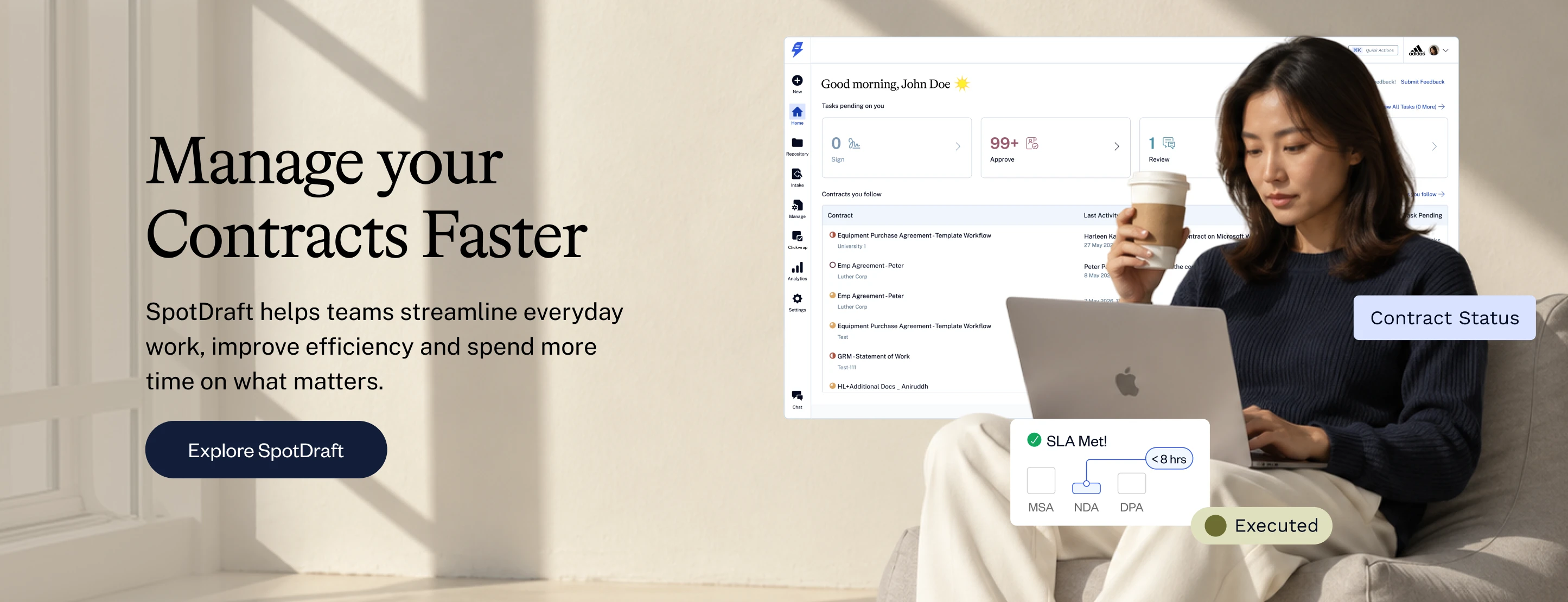
This is where SpotDraft helps. Its contract management platform brings contracts into one place and helps teams manage them across the lifecycle, from drafting and review to signing, tracking and renewal. SpotDraft AI can also review contracts faster by identifying key clauses, surfacing potential issues and helping legal teams quickly understand what's in an agreement. Teams can use automated workflows, centralized contract data and renewal reminders to reduce manual tracking and keep important obligations visible.
Customer stories show how teams use SpotDraft to manage contracts at scale:
Open had 600–700 contracts when it began using SpotDraft. The team moved its existing contracts and metadata onto the platform in 2–3 weeks and gained greater visibility into contract stages and upcoming deadlines.
Gameskraft uses SpotDraft to manage contract requests, metadata and workflows. Its legal team reported saving more than 10 hours a week and increasing contract lifecycle management efficiency by 70–75%.
SpotDraft helps teams move beyond simply storing contracts. It gives them a structured way to review contracts faster, manage different agreements, track what matters after signing and keep the right people informed when action is needed.
Explore SpotDraft, compare it with other CLM platforms or book a demo to see how it can fit into your contract workflows.


