Escrow Agreement: Meaning, Types and How it Works

Huzaifa Sultana is a Marketing Associate at SpotDraft focusing on Organic Growth through SEO and AEO.
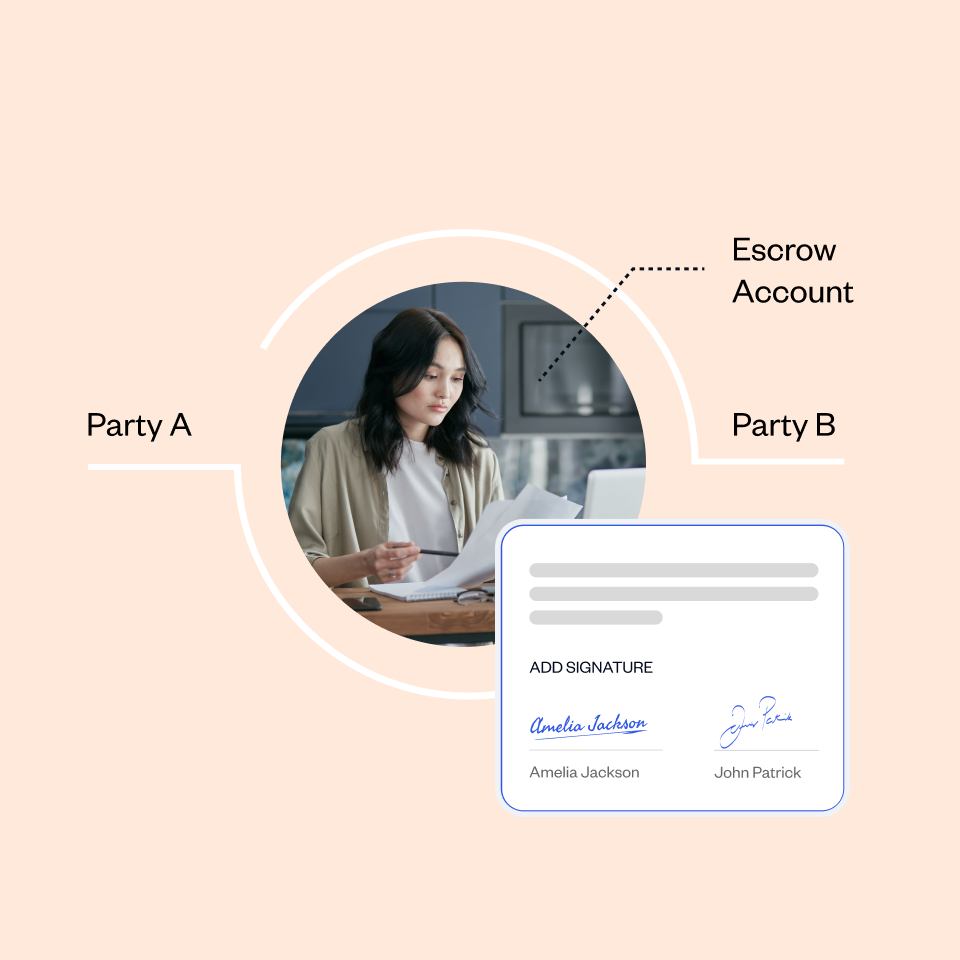
An escrow agreement is a contract where a neutral third party, the escrow agent, holds funds, assets, or documents until specific conditions are met.
It's a protective tool used across very different kinds of deals, real estate purchases, M&A transactions, software licensing, and more. The core idea is always the same: someone independent holds the thing until both sides agree the deal is done. But the mechanics shift depending on the deal. Real estate escrow and M&A escrow don't work the same way.
This article covers how escrow works step by step, who's involved, the main types (real estate and software escrow get their own closer look), the clauses that actually matter, a downloadable template, and how to tell if your deal needs one.
One quick note before we get into it: the escrow agreement is the contract. The escrow account is where the money or assets actually sit while the conditions are being met. Different things, often used interchangeably, worth keeping straight.
According to Cornell Law's Wex, an escrow agreement is a contract entered by two or more parties under which an escrow agent is appointed to hold in escrow certain assets, documents, and/or money deposited by such parties until a contractual condition is fulfilled.
In plain terms: one party hands something over, a neutral third party holds onto it, and it only gets released once agreed conditions are met.
Three roles are involved.
Escrow exists because deals often need money or documents to move before either side is ready to fully trust the other. It turns that trust problem into a funded, neutral arrangement instead.
One thing worth flagging before we go further: "escrow agreement," "escrow clause," and "escrow account" all describe different pieces of the same setup. The agreement is the contract. A clause is when escrow terms sit inside a larger contract rather than standing alone. The account is where the money actually sits. More on how these fit together shortly.
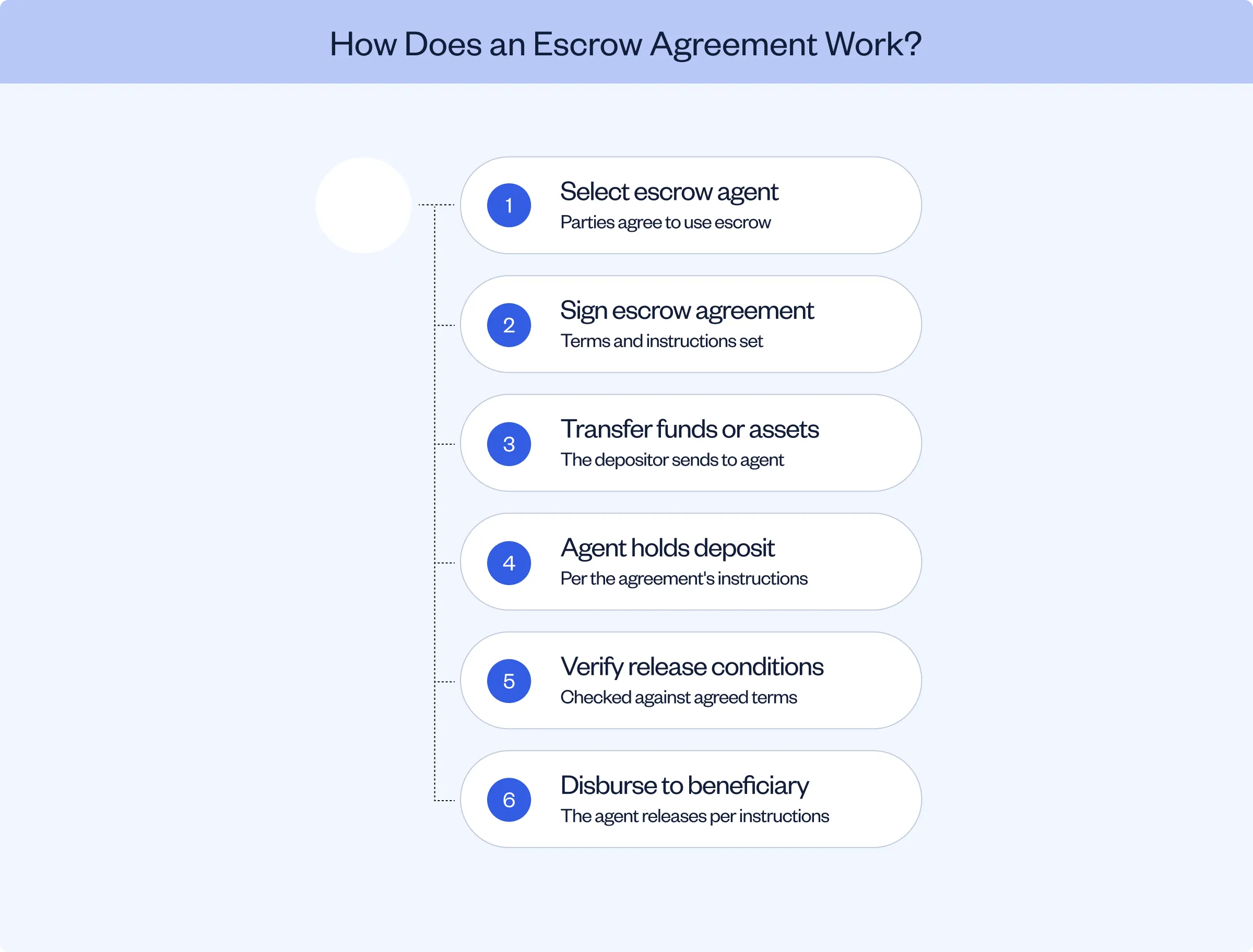
The process looks the same at a high level no matter what type of deal it is. The parties pick an agent, sign the agreement, the depositor sends funds or assets over, the agent holds them, someone checks whether the conditions have actually been met, and then the agent releases the deposit to whoever the agreement says should get it.
One thing worth being clear on: the escrow agent isn't a mediator. Their job is ministerial. They follow the instructions in the agreement, they don't referee disputes. If the buyer and seller disagree on whether a condition has been satisfied, the agent generally doesn't decide who's right. The funds just sit in escrow until the parties resolve the disagreement themselves or a court tells the agent what to do. That's a common source of frustration for people who assume the agent will step in and settle things. They won't. This is where a clear dispute resolution clause in the underlying agreement matters.
Three parties are involved.
The depositor is the buyer or payer, putting money or assets into escrow. The beneficiary is the seller or payee, who receives it once conditions are met. The escrow agent holds it in between and doesn't take sides.
The agent is usually licensed or regulated, and who that is depends on the deal. Real estate escrow runs through a title company. M&A escrow runs through a bank or law firm. Software escrow runs through a specialized provider that holds source code.
Example: a buyer puts down a $10,000 earnest money deposit on a home. The title company holds it, not the seller. If the deal closes, it goes toward the buyer's costs. If it falls apart for a reason the contract protects, like a bad inspection, the buyer gets it back. If the buyer just walks away, the seller may keep it.
Real estate escrow agreements Holds the earnest money deposit, sometimes the deed or title. Typically 1% to 3% of the purchase price, higher in competitive markets. Released at closing, or back to the buyer if a contingency fails. Outside the US, similar protections exist under different rules, like India's RERA requiring developers to escrow buyer payments. For more on how these deals are structured, see types of real estate contracts.
M&A / business acquisition escrow agreements Holds a slice of the purchase price: an indemnity escrow (covers false reps and warranties) or an adjustment escrow (covers post-closing adjustments). Per Seyfarth's 2024/2025 Middle Market M&A Survey: The median indemnity escrow for non-insured deals is around 9% of purchase price, versus about 1% for insured deals. Releases when the indemnification period expires or claims get resolved. This is the most heavily negotiated escrow type, both in size and in release schedule.
Software and source code escrow agreements Holds source code, build instructions, and documentation, or for SaaS, code plus data and infrastructure access. Releases on vendor insolvency, bankruptcy, abandonment, or material breach. SaaS deploys continuously, so deposits need updating far more often than traditional periodic software licensing agreements.
Online transaction / marketplace escrow Holds payment for goods like domain names or vehicles. Releases once the buyer confirms the goods arrived as described.
If you're drafting or reviewing one, these are the clauses that actually matter.
That's the skeleton. For a full walkthrough of what to look for in each clause, see reviewing an escrow agreement clause by clause.
You likely need one when:
Example: a vendor delivers office furniture for $5,000, paid on delivery. No escrow needed, payment and performance happen at the same time, and the amount at stake is too low to justify it.
Compare that to an M&A deal where a buyer pays $20 million for a company. The seller's representations about the business might turn out to be wrong, and the buyer won't find out for months. Large price, real post-closing liability. That's exactly the situation escrow is built for, and why a solid contract risk assessment matters before signing.
A single escrow agreement isn't hard to keep track of. The problem shows up when a legal or finance team is running dozens of them at once, an M&A holdback here, a SaaS source code escrow there, and several vendor deposits in between, each with its own release date, renewal trigger, and disbursement condition.
At that point, the question stops being "what does this escrow agreement say" and becomes "which of our forty active escrow agreements needs attention this month, and can I prove we handled the last one correctly."
A few things matter once you're managing escrow at that scale:
Can you find the terms without digging? If release conditions are buried in PDFs scattered across email threads and shared drives, someone has to remember to go looking before a deadline passes. A centralized contract repository solves this.
Do you get alerted before dates matter, not after. Release dates, renewal triggers, and expiration windows need to surface on their own instead of relying on someone's calendar reminder, which is why teams set up contract reminders proactively.
Is there a clean audit trail for approvals. When funds get released, you want a record of who approved it and when, especially if the release ever gets questioned later.
Can recurring escrow language be templated? Standard SaaS escrow clauses shouldn't get redrafted from scratch every time a new vendor contract comes through, which is where a clause library helps.
This is where a CLM like SpotDraft fits in, though it's worth being precise about the role. SpotDraft doesn't hold funds and isn't an escrow agent. It's the system that keeps track of the paperwork and deadlines around your escrow agreements, not the bank or title company doing the actual holding.
In practice that means storing every escrow agreement in a centralized contract repository so terms are searchable instead of buried in inboxes, and using automated renewal and deadline tracking so release dates and renewal triggers surface before they're missed rather than after.