An MSA is a contract that establishes a general structure of legal relationships and responsibilities between two parties. In this contract, parties establish their intentions concerning a long-lasting cooperation with each other without having to sign new legal documents at each step of it.
What are the differences between an MSA and an SLA?
An MSA sets the overall legal relations between parties, while the SLA deals with certain issues of service agreement, such as availability rate, response rate, etc.
What are typical items in a master services agreement?
Items that must be included in an MSA are the following: scope of work; payment schedule; confidential treatment obligations; intellectual property ownership; limitation of liability; dispute resolution; termination clauses; warranties; indemnifications; and force majeure clauses.
Why would companies want to implement an MSA?
MSAs allow companies to save time, eliminate unnecessary negotiations and standardise all legal relationships between organisations.
Master Service Agreement (MSA): Meaning, Checklist and Free Template
By
Kshitija Agrawal
•
Sep 16, 2026
•
15 min. read
•
Updated
Oct 6th, 2026
Kshitija Agrawal is an Ex-Senior Content Marketing Manager at SpotDraft, specializing in B2B SaaS and AI marketing. She has a proven track record of driving engagement and boosting session durations on SpotDraft's blog through effective content strategies and editorial expertise.
TL;DR
An MSA (Master Service Agreement) is a contract that sets the terms, conditions, and responsibilities governing a long-term business relationship, so you don't renegotiate from scratch for every new project.
MSAs and SLAs aren't the same thing. The MSA is the parent framework; the SLA defines specific performance standards within it.
MSAs and SOWs work together too. You sign one MSA, then multiple SOWs, one per project, that reference back to it.
A complete MSA covers scope, payment, term and termination, confidentiality, IP ownership, warranties, indemnification, liability caps, dispute resolution, and force majeure.
Public examples exist. Salesforce publishes its Master Subscription Agreement online, and IBM's MSA with ProQuest is publicly filed with the SEC.
MSAs carry real risks too, mainly scope creep and cost overruns that fall outside what the MSA anticipated, which is exactly what SOWs and change orders exist to contain.
What is a Master Service Agreement (MSA)?
MSA stands for Master Service Agreement. It's a contract that sets the agreed terms, conditions, and responsibilities between two parties for their current and future business dealings. Since it governs every project across the relationship, it cuts down on repeated back-and-forth negotiation and lets you execute new work with the same client or vendor faster.
How do you manage a long-term business relationship in practice? Do you draft and negotiate a fresh contract for every new requirement, or control the variables with one MSA? If it's the former, you're wasting time and exposing your organization to avoidable risk. An MSA creates a framework for every transaction across a long-term partnership, so you don't need to renegotiate from scratch each time a new requirement comes up.
According to Thomson Reuters' overview of the contract lifecycle management process, MSAs are especially valuable for entities with multiple agreements pertaining to the same client, since establishing the basic terms upfront lets every subsequent agreement move faster.
MSA vs. SLA: what's the difference?
An MSA and an SLA are closely related but not interchangeable.
Factor
MSA
SLA
Purpose
Establishes the overall legal framework for the relationship
Defines specific service expectations and performance standards
Scope
Covers payment terms, IP rights, dispute resolution, and termination
Covers uptime, response time, error rates, and escalation
Relationship
The parent document
Often sits inside or references the MSA
An SLA is more granular. If an IT support company signs an MSA with a client, the MSA covers payment and confidentiality, while the SLA covers response times and acceptable error rates for the actual support work.
MSA vs. SOW: what's the difference?
An MSA sets the general terms of the relationship. A Statement of Work (SOW) defines the specific tasks, deliverables, and timelines for one project under that relationship. You typically sign one MSA and then multiple SOWs as new projects come up, each referencing the MSA's general terms instead of repeating them. For a full breakdown, see our detailed comparison of MSA and SOW contracts.
Why do businesses use an MSA?
Legal. Helps parties identify risk early and establish liability and indemnification obligations upfront.
Business. Removes the need to redraft and renegotiate terms every time a new project launches, which saves time and operating costs.
Sales and procurement. Cuts down on the back-and-forth between legal and the deal team, so future project-specific contracts close faster.
The core clauses stay largely similar across industries, though specifics shift. A finance services MSA might cover much higher damages caps than an HR services MSA, which tends to focus more on protecting sensitive employee data.
What does a real MSA look like?
Most companies don't publish their MSAs, but a few do, and it's worth actually reading one before you draft your own.
Salesforce publishes its Master Subscription Agreement publicly, covering everything from fee terms to data security warranties to termination rights, and it's a genuinely useful reference for what a SaaS MSA looks like at scale. On the enterprise services side, a Master Service Agreement between ProQuest Company and IBM is publicly filed with the SEC, and it shows how an MSA establishes what the filing calls a "contractual framework" that subsidiaries and business units then implement through individual service agreements underneath it.
Neither is a template you should copy directly since both were negotiated for a specific relationship, but both are useful for seeing how the components above actually get worded in practice.
What contracts fall under an MSA?
An MSA is a parent contract. Specific transactions get executed as child contracts underneath it, including:
SLA, expanding on service quality requirements
SOW, outlining tasks and deliverables for one project
NDA, addressing confidential information beyond what the MSA already covers, see our full guide to NDAs
Change order, requesting or authorizing modifications
Purchase order (PO), authorizing a specific purchase under the MSA's terms
License agreement, granting specific IP usage rights
Professional Services Agreement (PSA), laying out terms for ongoing consulting or professional work
At Wingify, this structure runs directly through the sales team's CRM. Their legal team's integration lets sales "create NDAs, MSAs and Order Forms directly from Salesforce records," with terms auto-populated from the same fields the deal already lives in, instead of legal re-keying data into a separate document every time a new child contract is needed.
What are the common risks of an MSA?
An MSA isn't risk-free just because it's comprehensive. The most common failure point is scope: an MSA that doesn't clearly anticipate cost overruns or scope changes that leaves those items to be negotiated separately anyway, which defeats some of the point of having a parent agreement in the first place.
Termination can also get complicated when there's active work in progress under a SOW tied to the MSA. Ending the parent agreement while a child SOW is mid-delivery raises questions about what happens to that work, which is why termination clauses in a well-drafted MSA usually address in-flight SOWs explicitly rather than leaving it ambiguous.
The other common gap is around dispute resolution and liability. Because an MSA is meant to be a broad framework, it's tempting to leave liability caps and dispute mechanics generic. That generality is exactly what turns into a costly argument later if a specific project goes wrong in a way the MSA didn't clearly address.
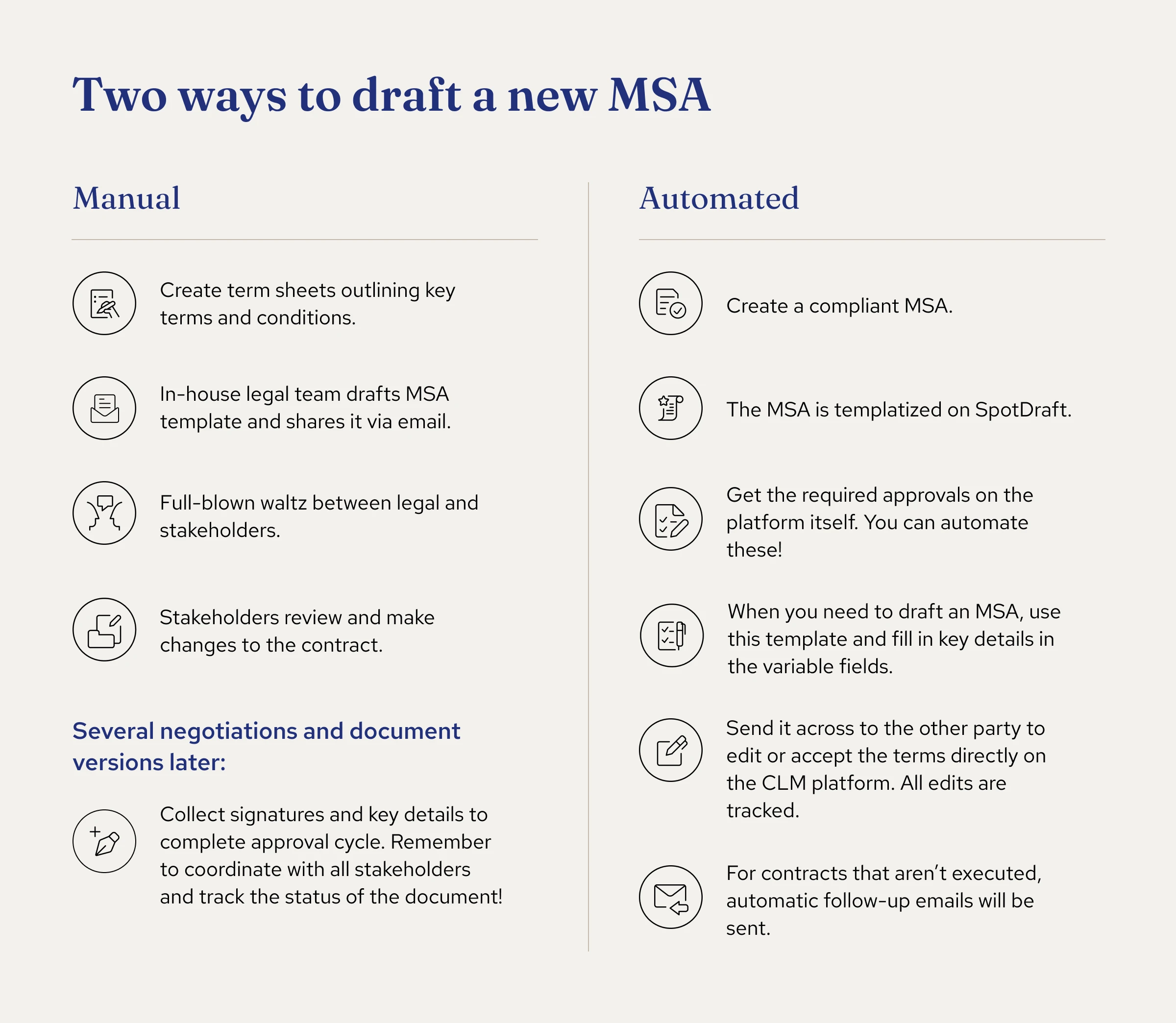
How do you draft an MSA: manual vs. automated
Manual drafting works fine for a small or early-stage company. It gets overwhelming fast once volume grows and legal bandwidth gets stretched.
With a platform like SpotDraft, drafting an MSA means starting from a pre-approved template, filling in variables like party names, duration, and governing law, routing it for approval, and sending it to the counterparty for edits or acceptance directly on the platform. Unexecuted contracts get automatic follow-up reminders.
"Leveraging a CLM has been key because it has reduced a lot of friction from handoffs between legal and business. Rather than going back and forth over email, Slack, Word, Zoom, and DocuSign, the CLM acts as a single source of truth." — Jonathan Franz, Head of Legal, Crunchbase
Automation also gives you a reliable audit trail and a centralized contract repository to track child contracts like SOWs and change orders against the parent MSA, instead of hunting through email threads. For a deeper look at structuring these documents well, see our guide to creating an MSA playbook.
Master Service Agreement (MSA) Checklist
1. Deliverables
Defines what the service provider is actually required to deliver.
It should cover:
Scope of work
Specific outputs or milestones
Delivery timelines
Acceptance criteria
Performance standards
Example: A software development MSA might specify that the provider must deliver a working mobile application by a particular date.
2. Geography
Defines where the services will be provided or used.
This can matter for:
Where employees or contractors perform the work
Countries where services are available
Data storage or processing locations
Local laws and regulations
3. Commercials
Covers the financial terms of the relationship.
This usually includes:
Pricing and fees
Payment timelines
Taxes
Invoicing
Expenses
Price increases
Discounts or volume-based pricing
4. Quality Control
Sets the quality standards the service provider must meet.
This could include:
Service levels
Quality benchmarks
Testing requirements
Inspection rights
Reporting requirements
Corrective action when standards aren't met
5. Intellectual Quality Control
This wording is a little unusual. If the intended point is Intellectual Property (IP) / IP quality control, it would cover ownership and protection of intellectual property created or used during the engagement.
This can include:
Who owns work product
Ownership of pre-existing IP
Licenses
Third-party IP
Open-source software
Restrictions on using the customer's materials
If the source specifically means "Intellectual Quality Control," that should be clarified because it isn't a standard MSA heading.
6. Confidentiality
Determines what information must be kept confidential and how it can be used.
It typically covers:
Confidential information
Permitted disclosures
Security obligations
Exceptions to confidentiality
How information must be returned or destroyed
How long confidentiality obligations survive termination
7. Warranty
Defines the promises the service provider makes about its services or deliverables.
For example:
Services will be performed professionally
Deliverables will meet agreed specifications
The provider has the right to provide the services
Software will function according to agreed requirements
It should also explain what happens if a warranty is breached.
8. Limitation of Liability
Sets the maximum financial exposure of each party if something goes wrong.
It often addresses:
Liability caps
Excluded types of damages
Exceptions to the cap
Whether the cap applies to particular claims differently
For example, a contract might limit general liability to fees paid during a specified period while treating confidentiality breaches or IP infringement separately.
9. Dispute Resolution
Explains how disagreements will be handled.
A typical escalation could be:
Business representatives try to resolve the issue
Senior management gets involved
Mediation
Arbitration or litigation
It may also specify the governing law and courts or arbitration venue.
10. Indemnification
Determines when one party must protect the other from certain third-party claims, losses or expenses.
Common indemnities cover:
IP infringement
Third-party bodily injury or property damage
Certain breaches of law
Employment-related claims
Data or confidentiality issues, depending on the deal
The clause should also explain the process for handling an indemnified claim.
11. Termination
Explains when and how either party can end the agreement.
It can cover:
Termination for convenience
Termination for material breach
Cure periods
Insolvency
Repeated service failures
What happens after termination
For example, the customer may have the right to terminate if a material breach isn't fixed within 30 days.
12. Insurance Coverage
Specifies what insurance the service provider must maintain.
Depending on the services, this could include:
General liability insurance
Professional liability / errors and omissions insurance
Cyber insurance
Workers' compensation
Product liability insurance
The MSA may also specify minimum coverage amounts and require proof of insurance.
13. Change Control
Defines how changes to the agreed scope, pricing or deliverables are approved.
A good change-control process makes sure that neither party can casually change the original agreement.
Controls whether either party can transfer the contract to another entity.
For example, the MSA might restrict assignment without consent but allow it during:
A merger
Acquisition
Corporate restructuring
Sale of substantially all assets
15. Subcontracting
Controls whether the service provider can hire other companies or individuals to perform the services.
It can address:
Customer consent
Approved subcontractors
Provider responsibility for subcontractors
Confidentiality obligations
Data protection requirements
Security standards
Who needs a master service agreement?
Any business expecting an ongoing relationship with a vendor, client, or partner, rather than a single one-off transaction, benefits from an MSA. If you're currently redrafting substantially the same terms every time a repeat client or vendor comes back with new work, that's usually the clearest sign it's time to put an MSA in place.
The bottom line
An MSA earns its value the second project in, not the first. The upfront work of negotiating scope, liability, IP, and dispute terms once pays off every time a new SOW, change order, or purchase order gets executed under it without reopening the same negotiation from zero.
Ready to put this into practice? Request a demo to see how SpotDraft streamlines your end-to-end MSA and CLM process.
Frequently Asked Questions
What is an MSA?
What are the differences between an MSA and an SLA?
What are typical items in a master services agreement?
Why would companies want to implement an MSA?
Related content
latest
Mastering Business Contracts: A Complete Guide
Learn what a business contract is, the key types and elements that make one binding, and how to use them to protect your business. Start with the basics.
“Before using SpotDraft, executing a contract would take up to weeks. Now, contracts are signed within minutes, with better data security and tracking. The whole process takes us less than a day!”
Arti Singh
Founder’s Office, Growth, UrbanVault
“Before using SpotDraft, executing a contract would take up to weeks. Now, contracts are signed within minutes, with better data security and tracking. The whole process takes us less than a day!”