Mutual NDA: What It Is, When to Use One, and What to Include

Sreshtha Das is an Ex-Senior Content Marketing Manager at SpotDraft with over seven years of experience creating and leading content strategies for startups and enterprises.
You're about to share your product roadmap and pricing with a potential partner. They'll share theirs back. Before anyone opens a deck, someone will ask, "Can we get a mutual NDA in place?"
A mutual NDA, or two-way NDA, is usually the first contract in any partnership. It's also the one Legal touches most. When every request lands in the same inbox, a routine document can hold up a deal for days.
This guide is for founders, sales and partnerships teams, and in-house counsel. By the end, you'll know when a mutual NDA fits and what to put in it.
You'll also learn which clauses are worth a fight and which legal guardrails no NDA can override. Finally, you'll see how to keep NDAs from piling up in Legal's queue.
A mutual NDA, or two-way NDA, is a contract where both parties share confidential information and agree to protect it. Each side can use the other's information only for an agreed purpose and can't share it with outsiders.
Cornell's Legal Information Institute defines a non-disclosure agreement (NDA) as a contract where "parties agree that certain information will remain confidential." Old Dominion University's two-way NDA guidance calls the mutual version a "mutual or bilateral" NDA, for when "both parties are receiving confidential information." You'll also see it shortened to MNDA, for mutual non-disclosure agreement.
Say two software companies are exploring an integration. One shares its API plans, and the other shares its data model.
Every NDA has a disclosing party (the side sharing information) and a receiving party (the side getting it). In a mutual NDA, each company plays both roles.
That's the mutual NDA meaning in a nutshell: the same duties apply both ways. Some teams call it a two-way confidentiality agreement.
The difference comes down to direction. A mutual NDA protects information flowing both ways, while a one-way NDA, also known as a unilateral NDA, protects information flowing in only one direction.
Weighing MNDA vs. NDA on a request form? Ask one question: who's actually sharing?
If information flows only one way, a one-way non disclosure agreement keeps obligations proportionate. For example, a company selling itself in an M&A process usually wants the buyer bound and nothing more.
Defaulting to mutual "just to be fair" can backfire. You'd accept restrictions on information you may never see.
A multilateral NDA covers three or more parties under one agreement. Think consortiums, joint bids, or a 3 way NDA with a shared vendor.
Here's a quick recap of the three types:
Here's how a mutual NDA compares with related contracts:
For more detail on the first row, see our guide on NDA versus confidentiality agreement differences.
When you sign an MSA with a company that's already under NDA, check which confidentiality terms control. The NDA vs. MSA question matters most when the two define confidential information differently.
Use a mutual NDA when both sides will put something sensitive on the table:
Not sure? Run this quick 3-question test:
A mutual NDA typically protects:
Standard exclusions carve out information the receiving party can use freely:
Use the clauses below as a starting point, then compare any draft against our NDA review checklist.
The residuals clause is often the most negotiated term, so decide your position in advance. Our free NDA negotiation playbook gives you ready-made fallback positions for residuals and other tough clauses.
Also Read: Most Negotiated Clauses in a Contract
A mutual NDA has two clocks. The disclosure period is the window when parties can share information, and the confidentiality period is how long they must protect it.
Choose a fixed confidentiality term that matches how long your information stays sensitive. Reserve open-ended protection for trade secrets, which you'll want covered for as long as they stay secret.
Match the term to how fast the information goes stale. Not sure what term fits your deal? Ask counsel before you default to "forever" for ordinary business information.
To give your mutual NDA the best chance of holding up, keep three things tight: clear scope, reasonable duration, and a real business purpose.
As of April 2026, the FTC Noncompete Rule page says the federal rule "is not in effect and it is not enforceable." That leaves state rules, which differ. For example, California's non-compete statute voids, with limited exceptions, contracts restraining anyone "from engaging in a lawful profession, trade, or business."
An NDA is a contract, so state contract law and the governing law you choose shape how it's read. State trade secret law matters too.
Vanderbilt Law tracks Uniform Trade Secrets Act adoption: the UTSA "has been adopted in some form in 49 states." Adoption also extends to "D.C., Puerto Rico, and the U.S. Virgin Islands." New York is "the only jurisdiction to rely exclusively on its common law framework."
The federal Defend Trade Secrets Act (DTSA) adds a federal claim for trade secret theft. According to Vanderbilt Law's summary of Prof. Daniel Gervais's chapter, "the DTSA supplements, instead of preempts, state trade secret law."
Signing a mutual NDA with an individual consultant? Check the DTSA whistleblower immunity notice rule. Without the notice, "the employer may not be awarded exemplary damages or attorney fees" against that individual.
The statute says "employee" includes "any individual performing work as a contractor or consultant." It doesn't address company-to-company NDAs, so ask counsel to review your notice language.
Some laws limit what any confidentiality clause can do. Treat them as guardrails for your template rather than rules specific to mutual NDAs.
SEC Rule 21F-17(a) bars any action "to impede an individual from communicating directly with the Commission staff about a possible securities law violation." The SEC enforces it. In its September 2024 release on SEC whistleblower rule penalties, seven public companies "agreed to pay more than $3 million combined in civil penalties."
Those cases involved employment and separation agreements, not mutual NDAs. Still, the lesson applies: your confidentiality language shouldn't appear to block reporting.
The Speak Out Act adds another limit. Under the Speak Out Act text, pre-dispute nondisclosure clauses aren't "judicially enforceable" in sexual assault or sexual harassment disputes.
The good news is the fix is simple. Add a carve-out stating that nothing in the NDA restricts legally protected reporting to government agencies.
The injured party can sue for breach of contract and recover damages for its losses. But money often arrives too late once a secret is out.
That's why your NDA may include a clause acknowledging that a breach could cause "irreparable harm." This language backs a request for injunctive relief, a court order that stops further use or disclosure.
Cornell's Wex entry on NDAs says a party enforcing one "may be able to receive a preliminary injunction." The court still decides, and under the irreparable harm standard, the movant "usually has to prove that they will suffer irreparable harm."
If the information is a trade secret, federal remedies may also apply.
Per Defend Trade Secrets Act remedies, courts may "award exemplary damages in an amount not more than 2 times the amount of the damages awarded." That's only for willful and malicious misappropriation. A DTSA action also "may not be commenced later than 3 years after" the misappropriation is discovered.
Some NDAs also include liquidated damages, a preset amount owed if a breach occurs.
Your NDA can also set the dispute path. The Western District of Virginia's federal court ADR guidance describes arbitration and mediation as "alternatives to civil litigation." Both sides usually must agree to arbitration in advance, so add the clause before you sign.
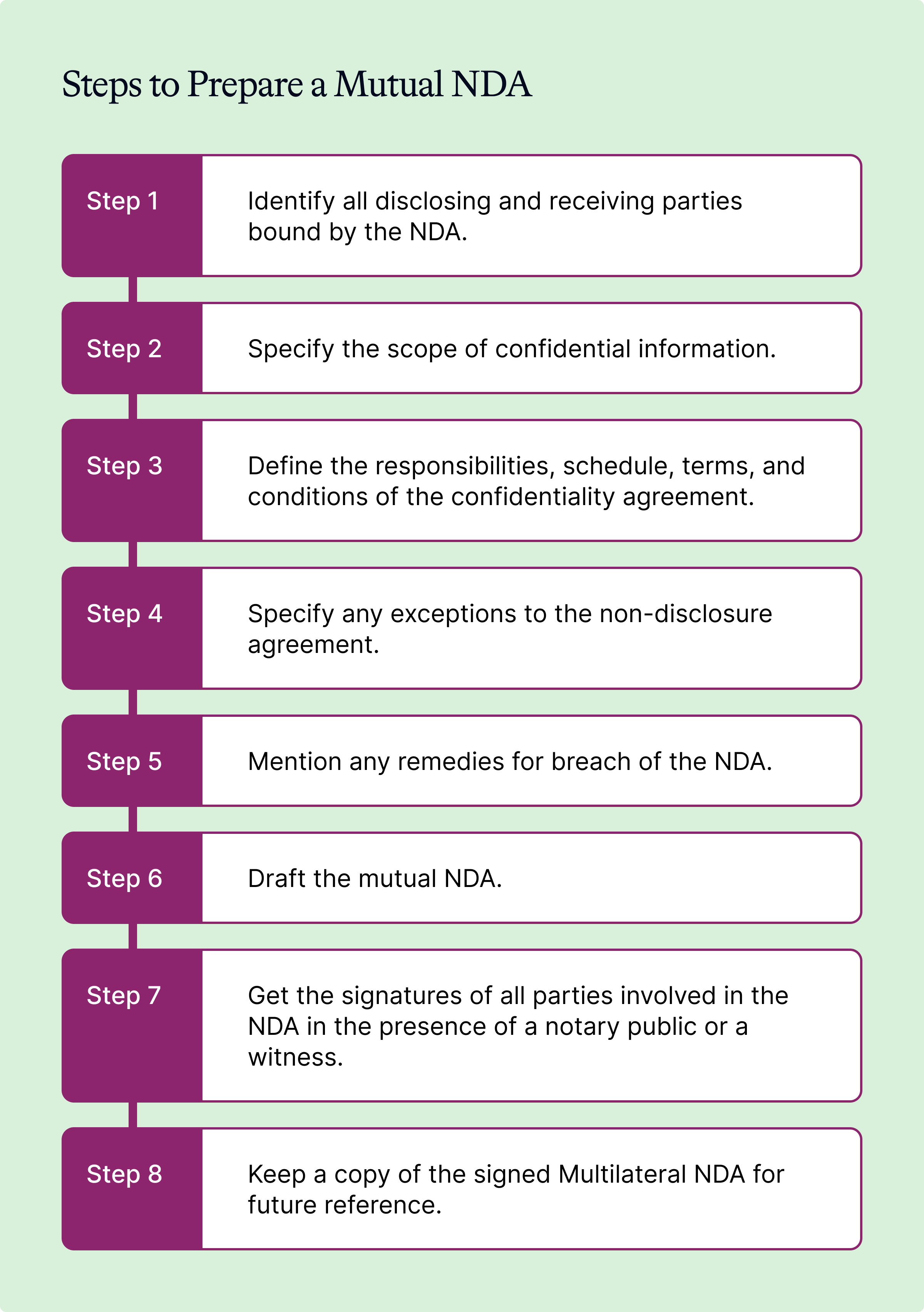
Here’s a quick step-by-step process to draft your first mutual NDA hassle-free.
“In my opinion, it’s best to mediate as soon as possible, especially if there is a real chance to resolve the dispute. I say this primarily because, having been involved in many disputes in my career, I find the litigation process to be incredibly expensive, uncertain, corrosive and wasteful of everyone’s time and energy”
~Sterling Miller, CEO and Senior Counsel Hilgers Graben PLLC
Ten Things: Getting The Most Out of Mediation
Understand the duties and responsibilities that all parties must fulfill before entering into a multilateral NDA with another party.
So, your legally binding NDA must properly define terms and roles for all parties involved. But let’s look into when and where you will need a mutual non-disclosure contract.
A well-drafted mutual NDA document not only defines obligations but also secures sensitive information from breaches of confidentiality. So, follow these best practices to draft a contract that protects your confidential information.

Always draft your confidential NDA in simple language to minimize potential loopholes, misunderstandings, or legal disputes. You should detail exactly which information must be protected under the NDA, as ambiguity can lead to inadvertent disclosure.
Properly identify the interested parties in the legally binding document at the outset of any transaction and negotiation. Ensure that the legal names, addresses, and contact details of all parties involved are included to enforce the obligations outlined in your NDA.
You must also clearly mention who is disclosing and receiving confidential information in the multilateral NDA document.
Firstly, specify the start date of the NDA terms in your contract. Depending on the nature of the information and the parties involved, you should also clearly define the duration of the agreement for which it’ll remain effective.
When you include contract termination provisions, all parties can end the agreement if it’s no longer needed or if there’s a breach. A provision detailing how the disclosed information would be handled at the termination should also be included. So, outline in your NDA whether you want such information destroyed or returned.
Your multilateral NDA must also specify the consequences of unauthorized disclosure of the information, such as injunctive relief or monetary damages. It’ll ensure signatories adhere to their rights and responsibilities and foster compliance.
Also read: How to Handle and Resolve Breach of Contracts
If managing and storing mutual NDAs is difficult, SpotDraft's Contract Lifecycle Management (CLM) system can streamline your process. You can set reminders to receive automatic notifications about upcoming important dates and obligations, which helps you avoid breaches and stay compliant.
SpotDraft’s CLM system also has encryption and access control features, adding an extra security layer for your critical agreements. You can maintain the confidentiality and integrity of your NDAs by providing access to sensitive information only to the duly authorized representative.
“We are able to draft and redline contracts inside the CLM tool. Therefore, we no longer need to rely exclusively on tools such as MS Word and Google Docs. Now, all stakeholders can view and access just one true version of the contract.”
~Igor Poroger, the Director of Legal (EMEA) at Vectra AI
One mutual NDA is easy, but fifty a quarter is where things break. Across all contract types, WorldCC contract value erosion research found "the average business loses almost 9% of value annually through poor contract management."
SpotDraft's 2025 Contracting Efficiency Benchmarking Report found teams with automated workflows "routinely complete standard contracts like NDAs and MSAs in just 1-3 days." Teams relying on "manual processes and scattered tools often take a week or more—and sometimes as long as 30 days."
The same SpotDraft report found "1 in 3 legal teams take over 15+ days to complete standard contracts." Much of that delay comes from Legal hand-drafting agreements that should be routine.
Fix it by having Legal approve one mutual NDA template with pre-approved clause fallbacks. Then business teams generate NDAs themselves through simple intake forms. With automated contract creation software, Legal controls the language while sales and partnerships teams self-serve.
"Before SpotDraft, every contract required legal hand-holding. Now, teams create and send NDAs themselves. I only step in when it really matters."
— Arzu Hasanova, Legal Counsel, Circularise
When the other side sends its own paper, triage it. Triage means sorting incoming NDAs by risk so standard ones move fast.
Check each draft against your playbook positions. Route standard mutual NDAs for quick approval, and escalate anything with a residuals clause, a non-solicit, or unusual governing law.
AI-powered NDA review can flag deviations from your playbook directly in Microsoft Word. In an illustrative example from SpotDraft's Legal AI Simplification Playbook, automated triage meant "Standard NDAs now processed in 1 day vs. 5 days."
Once terms are agreed, don't export to a separate signing tool and chase PDFs over email. A built-in eSignature tool keeps signing in the same workflow, with status tracking and reminders.
Speed adds up at volume. SUN Mobility moved routine contracts like NDAs from a 2-day process to 10 minutes. Learn how SUN Mobility cut NDA turnaround with a connected workflow.
Signing isn't the finish line. Each mutual NDA has a term end date, a survival period, and return or destruction duties you'll need to honor.
Spreadsheets fall out of date fast. Store every signed NDA in a searchable contract repository so you can find any agreement, see when duties end, and spot NDAs that need renewal.
A mutual NDA protects information flowing both ways, so use one when both sides share. Define confidential information clearly, set a reasonable term, and carve out legally protected reporting.
Then make it repeatable: standardize one template, triage counterparty paper, sign in one workflow, and track every agreement.
Ready to take NDAs off Legal's plate? Request a demo to see how SpotDraft handles mutual NDAs from draft to signature.