Agiloft Pricing in 2026 and the Key Cost Factors

Huzaifa Sultana is a Marketing Associate at SpotDraft focusing on Organic Growth through SEO and AEO.
If you are trying to estimate Agiloft pricing in 2026, you will not find a standard CLM rate card on its website. Agiloft asks buyers to contact its sales team for pricing, so the final Agiloft cost depends on what is included in the quote. G2 also says vendor pricing and plans are not publicly listed.
There are still a few useful numbers for budgeting. Vendr currently reports a median annual Agiloft contract value of $67,132, while AWS Marketplace lists a specific 12-month Core Platform configuration at $25,000 for 20 Power User licenses and one Admin license. These figures cover different buying scenarios, so neither represents a standard Agiloft list price.
For large enterprises evaluating CLM software for a complex enterprise deployment, the annual license is only the starting point. Implementation, workflow configuration, migration, integrations, support, and ongoing administration can all add work around the deployment. This Agiloft pricing guide separates those areas so you can understand the total cost of ownership before comparing the quote with other CLM platforms.
Agiloft pricing does not follow one standard annual CLM rate or public base pricing. Its pricing structure requires buyers to request a quote, so the final amount comes from an individual commercial proposal. Procurement and marketplace data can still give buyers a few reference points.
Here is what is publicly available today:
The $25,000 AWS price is useful because it shows what one actual configuration contains. AWS describes it as a common commercial-size deployment with 20 Power Users and one Admin. Buyers who need a different license count or configuration have to request a tailored quote. AWS also notes that additional AWS infrastructure costs can apply.
Vendr's $67,132 median answers a different question. It is a procurement benchmark, not evidence of what the average Agiloft buyer pays. Use it as an external reference when reviewing Agiloft pricing, not as the price your company will necessarily receive.
That is why the scope behind the number needs to be clear. Compare licenses, administrators, workflows, implementation, integrations, support, and additional products so you can identify costs or services that may sit outside the quoted scope before making a direct comparison.
For more context on what belongs in a CLM budget, SpotDraft's guide explains how the stages of contract lifecycle management connect from creation through post-signature work.
Because Agiloft pricing is custom, the quote needs to define the licenses, capabilities, products, and implementation work included in the CLM tool your organization is buying. Agiloft does not publish fixed CLM packages with prices, so the commercial proposal becomes the document to check for scope.
The main areas to separate are license structure, CLM functionality, Astra, and implementation.
Agiloft pricing can include different user and administrative access requirements, but Agiloft does not publish a standard rate for each license type.
AWS Marketplace provides one concrete example. Its $25,000 annual Core Platform configuration contains:
AWS directs buyers who need different license counts to request a tailored quote.
Agiloft's own documentation also distinguishes Power Users and End Users across roles and permission groups. Those technical access categories do not establish the commercial price of each license, so avoid calculating an assumed per-user rate from the AWS bundle.
Instead, ask the sales team to document:
This gives Finance and Legal a cleaner baseline for estimating how access requirements can affect future cost.
The quote should show which Agiloft CLM capabilities are included in the proposed deployment. Its current platform supports contract workflows, dashboards, integrations, post-signature management, AI capabilities, and no-code configuration across the contract lifecycle.
Agiloft's no-code architecture is a central part of its product model. Teams can use no-code workflow automation to configure processes, approvals, data structures, and rules without conventional software development. The commercial question is how much of that configuration Agiloft or an implementation partner will complete and how much your team will maintain later.
Before comparing Agiloft pricing quotes, define the core features needed at launch and ask whether contract volume affects the commercial scope:
Agiloft also supports natural language search through capabilities such as ConvoAI and Astra Assistant. Its current Astra material says users can ask questions across contracts in natural language to surface risks, obligations, trends, and opportunities.
If predictive analytics is important to your buying case, confirm the exact functionality included in your proposed deployment. Agiloft discusses predictive analytics as an emerging CLM capability in its own content, but that does not establish that every quoted Agiloft configuration includes the same predictive features.
Agiloft Astra has its own public pricing, separate from Agiloft's quote-based CLM pricing. Agiloft made Astra generally available in July 2026 as a contract AI platform for Legal, Procurement, Finance, and Sales teams.
The current Astra pricing is:
Agiloft says contract review and redlining in Microsoft Word do not consume credits. Credits apply to contract-analysis activities, so teams planning heavier portfolio analysis should estimate that usage separately.
Astra also brings data extraction and analysis into the AI workflow. Agiloft describes it as turning contract information into structured data that teams can query and analyze, while Astra Assistant supports natural-language questions across the portfolio.
If agentic AI is part of your longer-term roadmap, keep that evaluation separate from basic contract-AI pricing. Some enterprise CLM vendors now position a broader agentic AI platform across business functions; Leah/ContractPodAI is one example. Astra's current public positioning centers on contract AI, analysis, review, and intelligence, so compare the exact workflows each product is expected to handle instead of grouping all AI products together.
Implementation needs its own scope because Agiloft offers several rollout models and the work varies by deployment. Agiloft's current implementation approach covers Discovery, Readiness, Design, Configure, testing, training, go-live, and hypercare.
Agiloft supports different ways to structure implementation, including:
Its implementation page shows a typical rollout reaching go-live in week 14, while noting that complexity, integrations, and data migration can change the timeline.
So the implementation statement of work deserves as much attention as the annual license number. Confirm which workflows, templates, integrations, migration work, testing, and training are included before comparing first-year Agiloft pricing.
The software license may not represent the entire deployment scope. Implementation, migration, integrations, support, administration, and training may be included in the commercial proposal or scoped separately, depending on the customer's agreement. Buyers should confirm how each item is treated when estimating total cost.
The important question is whether each item is included in your quote and who is responsible for it.
Implementation and professional services can create a separate project scope around the software license. Agiloft offers its own Professional Services and recommends working with its team or a certified partner for initial implementation.
Its published typical implementation timeline runs for 14 weeks:
Agiloft says the actual timeline depends on complexity, integrations, and migration requirements. G2 separately reports a five-month average implementation time based on user-review pricing insights.
The implementation plan deserves the same scrutiny as the software license. User feedback shows that flexibility and integrations can be strengths, but one customer found onboarding harder than the sales demonstration and said Professional Services lacked a straightforward project plan, with added services extending the project. Before kickoff, get ownership, milestones, change control, and the process for adding services documented in the SOW.

Also read: SpotDraft's CLM implementation guide covers the work teams should define before rollout.
Legacy migration can become a substantial workstream even when it is included in an implementation plan. Existing agreements often need to be collected, cleaned, mapped, imported, and validated before Legal can rely on the new repository. Agiloft itself says data-migration requirements can affect implementation timelines.
Before implementation starts, clarify:
The validation step is especially important. Teams need to know whether the extraction captured the dates, parties, obligations, renewal terms, and other fields they plan to use for search, reporting, and downstream automation.
Agiloft's own AI materials describe automated extraction as a way to convert contract information into structured data and improve portfolio visibility.
If migration is a major part of the project, SpotDraft's guide to legacy contract migration covers how to prepare agreements before moving them into a new CLM.
Agiloft supports integrations with CRM, ERP, productivity, e-signature, BI, and other enterprise systems, including documented connections such as Adobe Sign. Every required connection still needs an owner. Its current platform materials reference integrations across categories including ERP, CRM, communication tools, e-signature, business intelligence, IT service management, and cloud storage.
Agiloft's documentation also shows that integration requirements can include licenses and administrator access outside the CLM itself. Its Services Agreement notes that customers may need to obtain access to third-party services separately when using integrations.
For each business-critical integration, establish:
Agiloft's flexibility can be useful for large companies connecting contracts with several business systems. The budget should still focus on the integrations the team actually needs at launch.
Agiloft offers three support tiers, so support coverage should be included in the commercial comparison. Standard Support is included with the subscription at no additional cost, while Gold and Platinum are Enhanced Support plans with fees defined in the applicable Order.
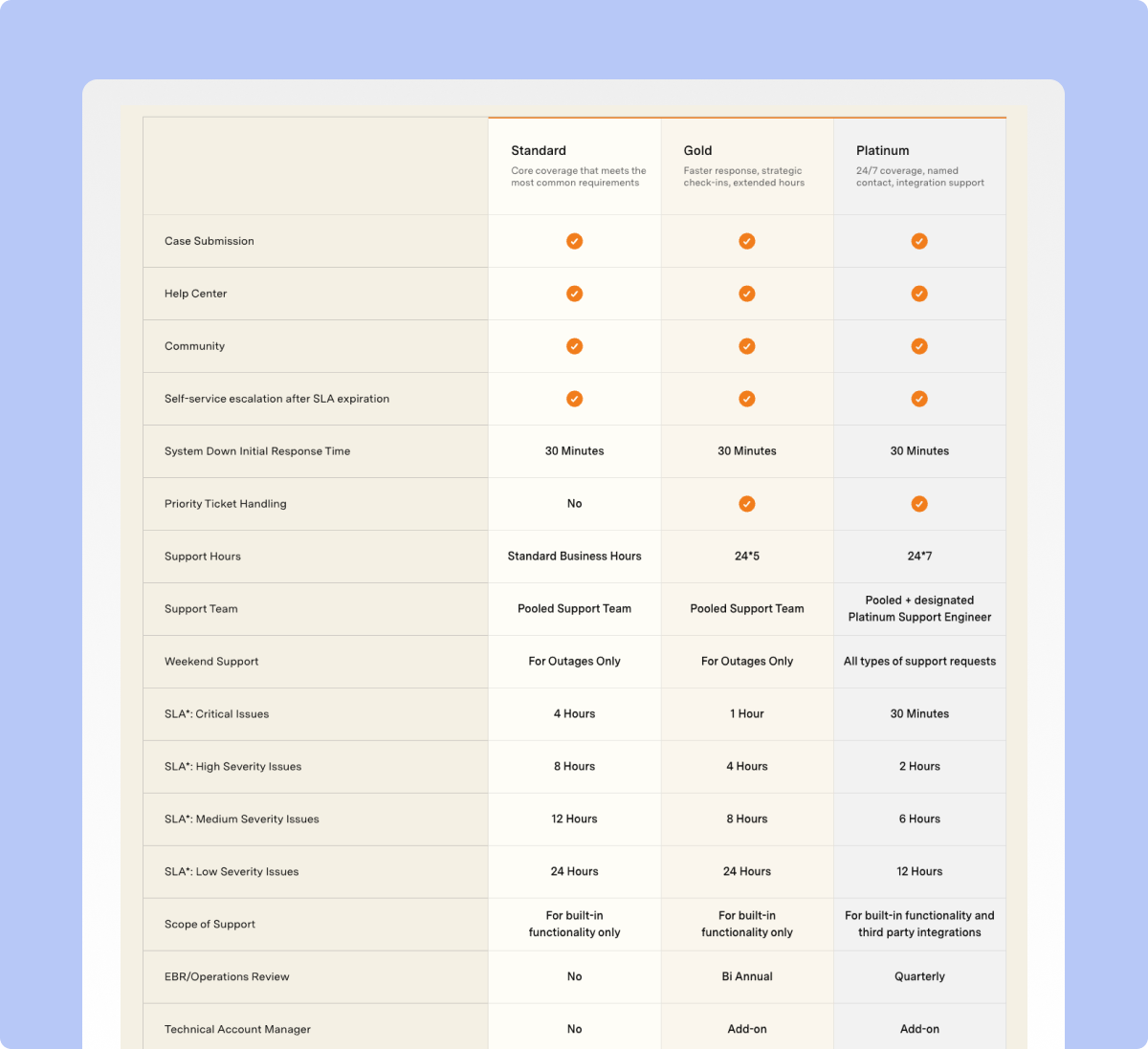
The current coverage differs by tier:
Agiloft also offers Admin on Demand. This is separate from technical support and provides fractional administration for tasks such as user management, troubleshooting, contract-template management, reporting, and post-upgrade testing.
Technical support and ongoing platform administration are different scopes.
That ownership question continues after go-live. Another customer valued how much the platform could be configured but said a small, non-technical team faced a steep learning curve in becoming self-sufficient and recommended planning for specialist support from the beginning. Have the future administrator change a workflow, update a field, and build a report during evaluation.

Training is part of Agiloft's implementation methodology, but ongoing enablement still needs an owner after go-live. Its published rollout includes training and cutover preparation in week 13, followed by go-live and hypercare.
The quote should explain what training is included for:
If the system is configured around your internal processes, training should cover that specific setup and not stop at the standard user interface.
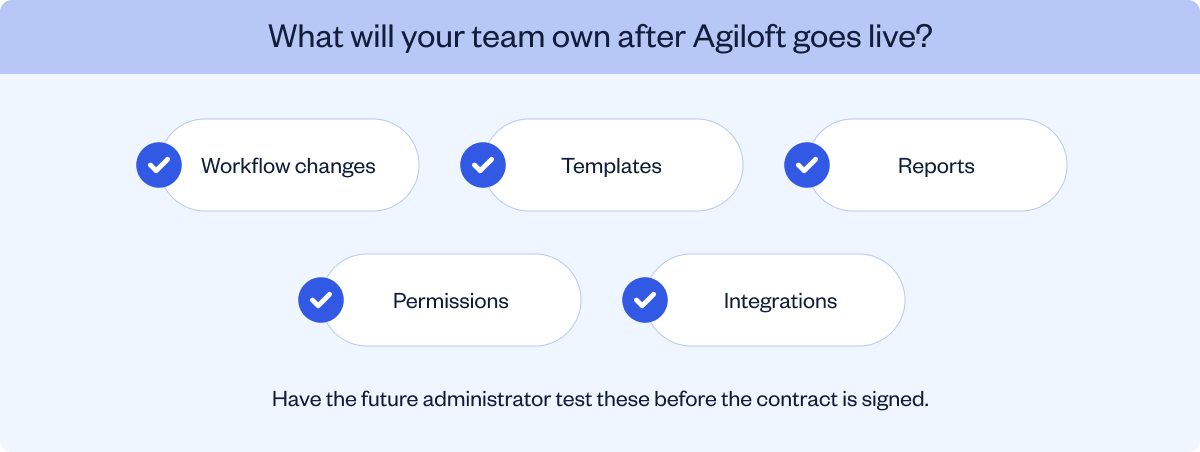
When reviewing Agiloft pricing, the quote should make the software, implementation, support, and ongoing operating requirements visible before you compare the final number. A lower annual license amount can represent a very different scope if another proposal includes more migration, implementation, support, or administrative work.
Use this checklist when reviewing the quote:
The same checklist can help when comparing Agiloft alternatives such as Icertis, Ironclad, and DocuSign CLM. When comparing Agiloft pricing across vendors, keep the scope behind each quote consistent. The useful comparison is the scope behind each quote and the work your team will own after launch.
G2 also provides review-derived reference points based on real users. It currently reports a five-month average implementation time, 14-month average ROI period, and 13% average discount for Agiloft. These are G2 aggregates based on reviewer pricing insights, not Agiloft commitments.
The Agiloft pricing quote itself should remain the source of truth. If an integration, implementation service, support tier, or administrative responsibility affects the buying decision, get it documented before comparing the final Agiloft cost.
Also read: Compare the wider market in SpotDraft's guide to contract management software platforms.
For teams comparing CLM software, SpotDraft publishes an in-house implementation model that includes workflow and integration setup and legacy migration. This gives buyers a different implementation model to compare with Agiloft's full-service, guided, phased, and rapid deployment options.
Agiloft's configurability can be useful for organizations that want to shape detailed workflows and data models around their requirements. The customer feedback above gives one example of the administration question worth testing: buyers should assess how much specialist knowledge their own team will need to become self-sufficient.
For Legal teams comparing the two, the practical question is how much setup and ongoing platform work they want to own.
SpotDraft lets Legal build reusable templates that business users complete through structured questionnaires. Responses populate the agreement and can trigger conditional logic, while approval workflows route the resulting contract to the appropriate stakeholders.
DraftMate also lets administrators create and maintain SpotDraft templates in Microsoft Word. This keeps contract creation connected to the workflows Legal has already approved without requiring business users to rebuild an agreement from scratch.
The result is a more controlled starting point for repeat contracts such as NDAs, MSAs, employment agreements, or vendor contracts.
SpotDraft's Workflow Manager lets teams configure contract creation, reviews, and approvals without technical expertise. Templates can adjust based on questionnaire responses, and conditional workflows route agreements to the relevant stakeholders.
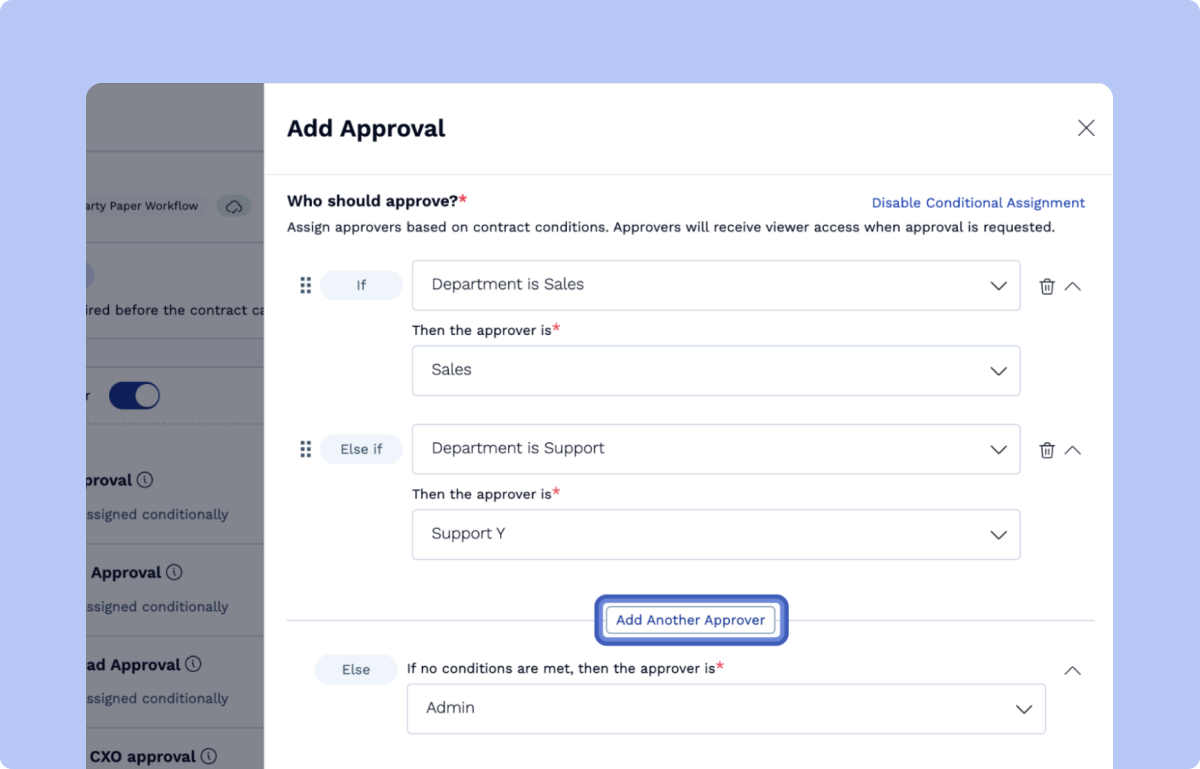
This gives Legal a way to establish the approval process once and let business teams follow it as contracts move forward.
If workflow design is central to your evaluation, SpotDraft's guide to contract management workflows can help map the process before comparing vendors.
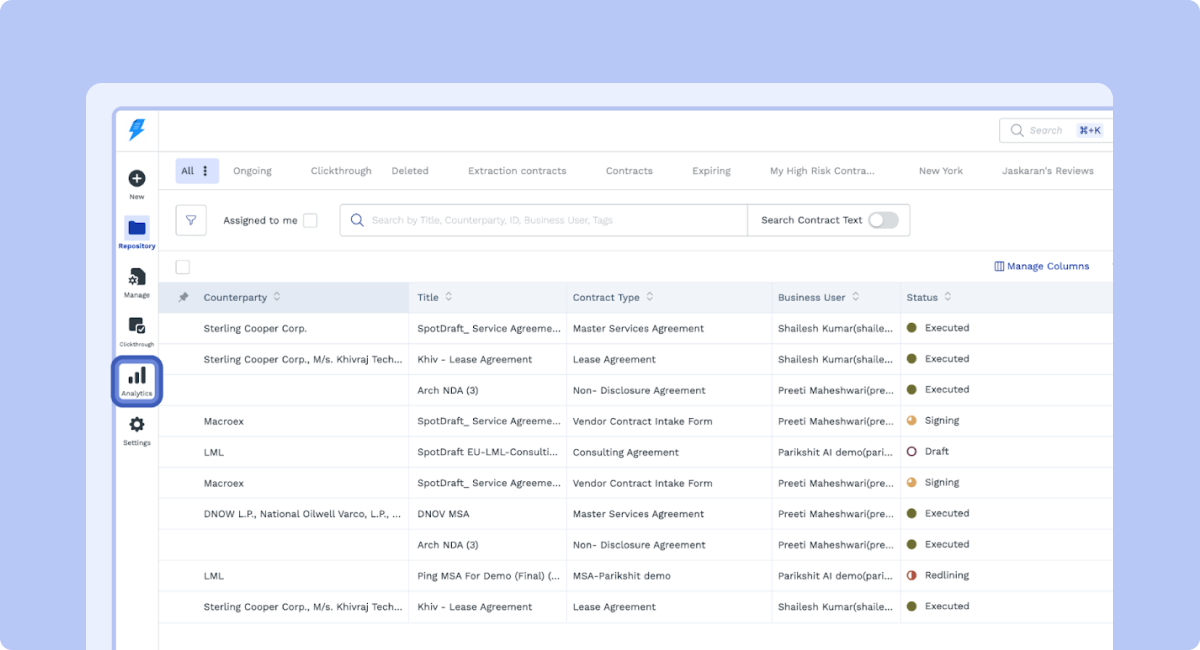
SpotDraft centralizes executed and uploaded agreements in a searchable repository. The platform extracts more than 1,000 metadata properties, supports full-text search and metadata filters, creates saved views, and links related contracts such as master agreements, amendments, and addenda.
Saved views can also power one-time or recurring reports, so contract information can move to Finance, Procurement, Sales, and other stakeholders without recreating the same spreadsheet each time.
That gives teams more visibility into contract data while reducing the amount of manual reporting required after signature.
SpotDraft separates repository reporting from process analytics. Repository views support scheduled reporting on contract data, while Contract Analytics provides dashboards with more than 30 metrics covering lifecycle activity, approvals, review, and turnaround times.
Legal teams can use those metrics to understand where contracts slow down, which workflows carry the most volume, and how workloads are changing over time.
That reporting layer also gives teams something concrete to compare with Agiloft during a demo: build the actual report your Legal or Finance team needs and see how much configuration is required to produce it.
SpotDraft's published pricing model includes in-house implementation, workflow and integration setup, and legacy-contract migration with no extra implementation fee.
Agiloft publishes four implementation approaches: full-service, guided, phased, and rapid deployment. Its support model also separates Standard, Gold, Platinum, and Admin on Demand services.
That creates a useful commercial comparison. Ask how much configuration your Legal team will own after go-live, who handles future workflow changes, whether specialist administration needs a separate budget, and what support is available when the team needs help.
SpotDraft also uses custom pricing and publicly lists several implementation inclusions before a buyer requests the final quote.
Also read: See how these requirements compare across contract lifecycle management software.