Icertis Pricing in 2026 With Cost and Implementation Analysis

Huzaifa Sultana is a Marketing Associate at SpotDraft focusing on Organic Growth through SEO and AEO.

If you are comparing Icertis pricing in 2026, you will not find a public rate card or starting price on its website. Icertis uses custom enterprise quotes, so the amount you pay depends on the products, users, services, and deployment scope included in your agreement.
The subscription is only one part of the overall Icertis cost. Under Icertis’s current U.S. agreement, SaaS access is defined in the Order Form, while consulting, implementation, configuration, and other Professional Services can be scoped separately through a Statement of Work (SOW). The Order Form can also set user limits and specify the products included in the subscription.
That means estimating Icertis CLM pricing requires looking at the full commercial setup, including implementation, support, expansion, and renewal terms. This guide breaks down the available pricing benchmarks, first-year costs, ongoing expenses, and contract terms so you can get a more realistic view of the total cost of ownership.
Icertis CLM pricing is not published as a standard rate, so teams looking for transparent pricing still need a custom quote. A current third-party benchmark gives enterprise buyers a starting point for planning, but the figures are not Icertis list prices and should not be treated as a market average.
Here are the available 2026 estimates by deployment size:
The same benchmark places first-year implementation at $500,000–3 million+. These figures are external market-reference estimates, not prices published or guaranteed by Icertis.
The Icertis pricing range becomes easier to understand once the deployment scope is clear. A team managing 10,000 contracts with a limited integration footprint is buying a different setup from an organization managing a much larger number of contracts across several entities, countries, and business systems.
The distinction between active contracts, historical records, amendments, and other documents can also become important if contract volume affects the quote. Icertis's own product pages describe enterprise-wide visibility across active contracts, but its public terms do not publish standard contract-volume tiers.
Before comparing Icertis with other CLM platforms, separate the software subscription, user licenses, additional products, implementation services, support level, and usage assumptions. If the Icertis quote comes in at a higher price point than another vendor, compare the work included in each proposal before drawing conclusions about value.
Also read: Best contract management software in 2026
Icertis pricing is defined through custom commercial agreements, not public pricing tiers. The SaaS subscription sits in an Order Form, while Professional Services can be scoped through an SOW. Named-user limits and additional products can also form part of the final agreement.
The quote is easier to assess when you separate it into three areas: the base platform subscription, user access, and additional products or modules.
The base subscription covers the SaaS listed in the Order Form. Icertis does not publish standard subscription tiers, so the key question is what the quoted amount actually includes.
Third-party pricing data associates Icertis cost with factors such as contract volume, organizational complexity, entities, geographies, languages, and integration scope. Those are external benchmark inputs, not an Icertis-published pricing formula.
This is why two Icertis pricing quotes can look similar on price while covering different deployments. Compare the number of contracts, users, business units, products, and integrations behind each figure before comparing the totals.
Icertis licenses SaaS access to named Authorized Users, with the limits defined in the Order Form. Its current agreement says both the number and type of Authorized Users can be limited, and excess use can be invoiced. Icertis does not publish a standard public rate for its different user licenses.
The agreement defines Authorized Users as employees or contractors of the subscriber or its affiliates and says Authorized Users cannot be provisioned as external user types.
That makes the actual Order Form more useful than generic third-party user categories. Ask how many named users are included, whether different user types carry different commercial terms, and what happens when access needs grow.
Additional Icertis products can expand the commercial scope beyond the core ICM Platform. Icertis currently organizes its portfolio across Engage, Operate, and Analyze, while Vera sits across its AI capabilities. Its site describes Vera as the AI layer supporting contract intelligence and automation across the platform.
Buyers may sometimes refer to these capabilities as modules, but the current Icertis website presents them as distinct products and product areas. Icertis does not publish a standard public price for each one.
This is worth checking closely during the sales process. If contract analytics, obligations, AI-supported work, or another capability is central to the business case, ask for the exact product name and entitlement to appear in the quote.
Icertis supports contract creation, negotiation, approval, execution, renewal, workflow automation, and post-signature management across its platform.

Icertis implementation can be purchased separately from the SaaS subscription, so implementation costs can make first-year spend much higher than the annual software fee. Its current agreement defines Professional Services as consulting, implementation, configuration, and other services documented in an SOW.
That makes the implementation scope just as important as the subscription when comparing first-year Icertis pricing. The main areas to define are setup, delivery ownership, legacy migration, and integrations.
The Icertis implementation scope depends on the work documented in the SOW. The agreement does not prescribe one standard implementation package, so buyers need the project deliverables written into their own commercial documents.
A useful SOW should show exactly what the implementation team will deliver. Here are the main areas to confirm:
This detail makes first-year quotes easier to compare. A lower implementation figure does not tell you much if it covers fewer integrations, less migration work, or a narrower configuration scope.
SpotDraft publishes a different model. Its pricing page says in-house implementation is included, with its team handling workflow and integration setup plus migration of legacy contracts. Dedicated customer success and 24/7 support are also included.
Also read: How to choose a CLM solution that works for you
An Icertis deployment can involve Icertis Professional Services, an implementation partner, or both. Icertis has a certified partner ecosystem covering new implementations, upgrades, expansions, and ongoing application management, while its standard agreement also allows customers to engage Icertis directly for Professional Services.
The practical issue is ownership. If Icertis, a systems integrator, and your internal Legal Ops or IT teams all take part, the implementation plan should say who owns configuration, migration, integrations, testing, rollout, and post-launch changes.
That also gives Finance a clearer first-year budget because partner services and internal resourcing can be considered alongside the software quote.
Legacy migration needs a clearly defined scope because Icertis places responsibility for validating uploaded legacy data on the subscriber. Its Support Schedule says Icertis is not required to correct errors in legacy contract data, relationships, files, or mappings and says the subscriber must verify the completeness and accuracy of that data before it is loaded.
Icertis does support bringing legacy and third-party agreements into a centralized repository. Its current ICM page says Discover can ingest those agreements and convert unstructured contract documents into structured, searchable information.
So the migration discussion needs to go beyond a yes/no question. Here are the areas to define:
SpotDraft states that its in-house implementation team handles legacy-contract migration along with workflow and integration setup.
Icertis supports a broad set of enterprise integrations, but buyers still need to define who configures and maintains each connection. Current integrations include SAP, Microsoft, Salesforce, Workday, Adobe Sign, DocuSign, and API-based connections.
The CRM workflow is a good example. Icertis can connect with Salesforce CRM and Microsoft Dynamics so sales and contract data stay synchronized, while its sales material also references HubSpot integration. That can move contract creation closer to the tools the sales team already uses.
Icertis also supports Microsoft 365 workflows. Its current product material describes reviewing and redlining in Word so teams can reduce version conflicts and email back-and-forth.
The commercial boundary still needs attention. Icertis's Standard Support does not include implementation change requests, integration or customization work, custom software development, training, or subscriber-specific configuration changes.
For every business-critical CRM, ERP, or productivity integration, confirm who handles the following work:
SpotDraft states that integration setup is included in its in-house implementation.
Also read: Ironclad pricing in 2026
Also read: DocuSign CLM pricing and costs
Icertis pricing can continue to change after implementation as the number of contracts, users, products, support requirements, and configuration needs grow. Some ongoing work also sits outside Standard Support, so the subscription price alone does not show the full total cost of ownership.
The main areas to watch after launch are contract growth, product expansion, support, and ongoing administration.
Contract volume should be defined upfront if it affects your commercial agreement. The external pricing benchmark used earlier shows higher estimated subscription ranges as contract volumes rise, but Icertis does not publish standard public volume tiers.
If pricing changes with the number of contracts, clarify the definitions before signing. Here are the questions worth asking:
Those answers make it easier to model growth instead of discovering the commercial impact later.
Adding more users, products, or support coverage can increase the commercial scope. User limits can be written into the Order Form, and Icertis offers Standard and Platinum support tiers.
Standard Support provides 24x5 availability. Platinum Support is an add-on with 24x7 coverage, a Named Support Champion, phone support, more authorized support contacts, and monthly support reviews. Icertis does not publish the price of Platinum Support in its Support Schedule.
If the deployment expands, ask for each new user entitlement, product, support upgrade, and related service to appear as a separate commercial item. That keeps changes in the total cost easier to trace.
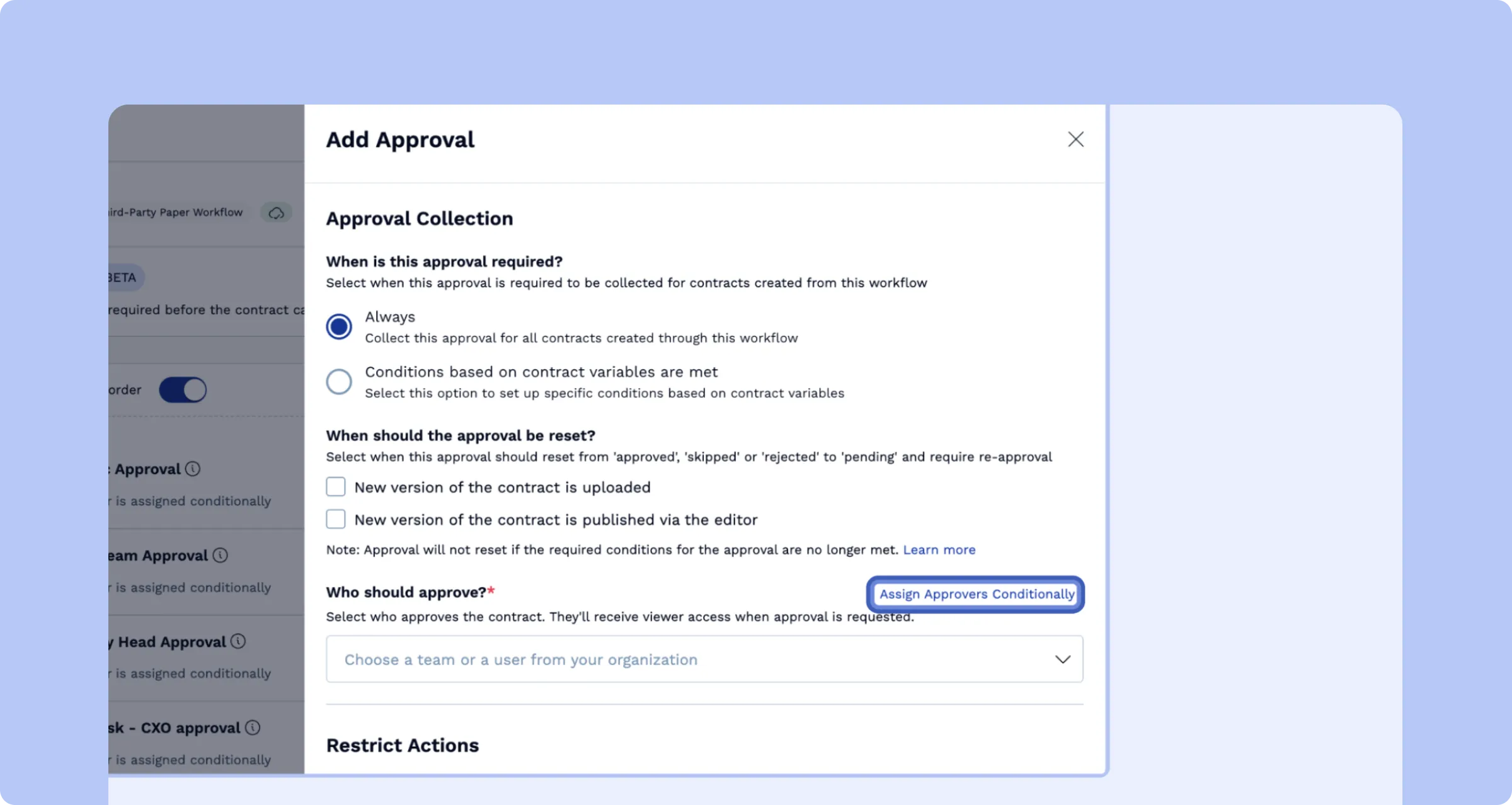
Some Functionality and Ongoing Administration work sits outside Icertis Standard Support. The current Support Schedule excludes Professional Services, implementation change requests, integrations, customizations, training, and several subscriber-specific configuration activities. Customers are also responsible for supporting or procuring support for their own configurations and customizations.
That makes ownership important after go-live. Legal Ops and IT need to know who will maintain workflows, templates, integrations, user access, release testing, and training.
For Icertis customers, post-launch administration is where the configuration question becomes practical. One enterprise customer valued Icertis's customization across buy-side and sell-side contracting, but said customizations were difficult to maintain through upgrades and that implementation and onboarding required substantial support. During evaluation, have the future administrator change a workflow or template and ask what happens to that configuration after an upgrade.
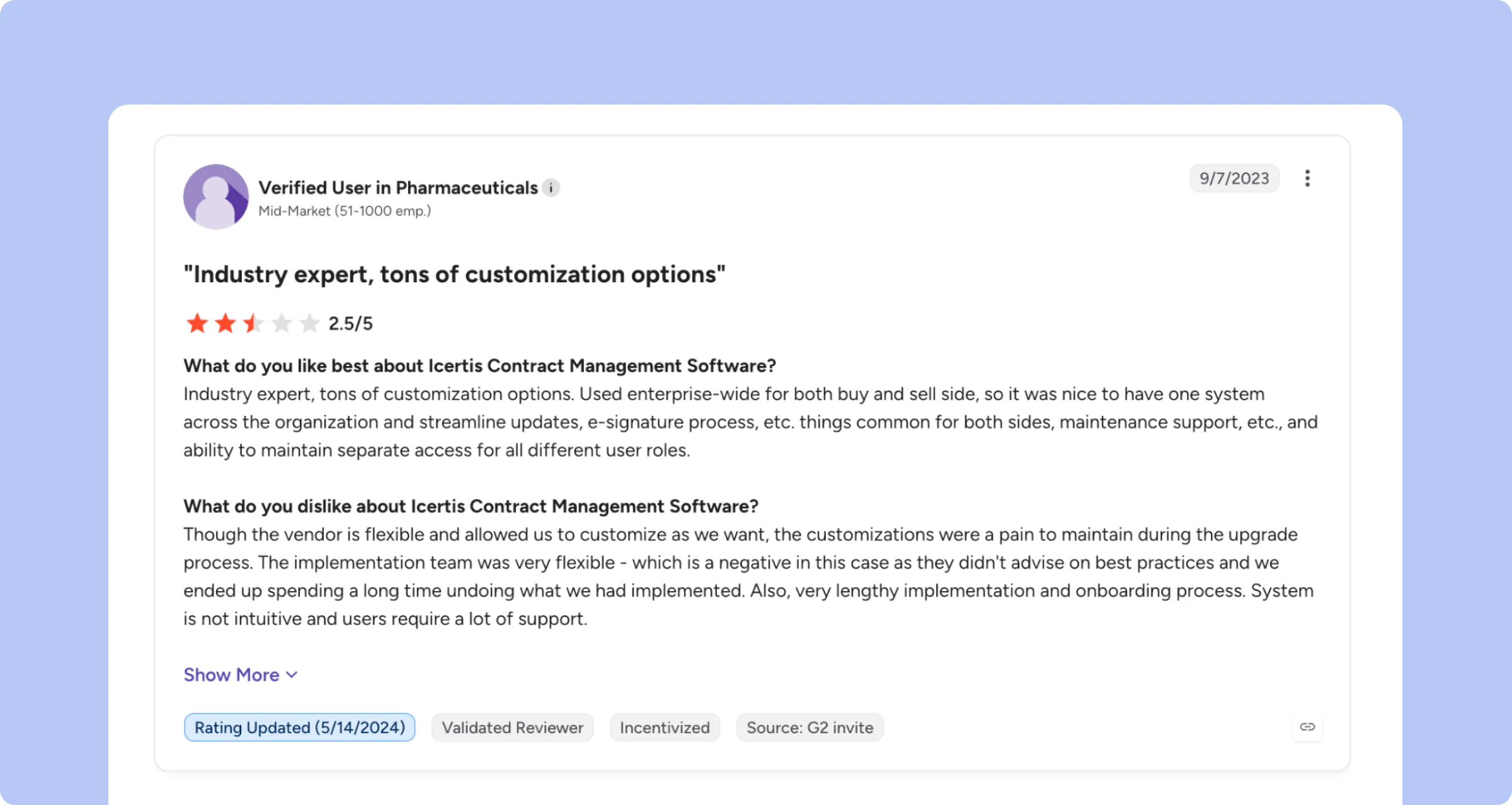
That makes the user interface worth testing with actual work. Ask Legal and business users to create a contract, update a template, find an active agreement, change an approval flow, and complete a search. A polished demo does not show how those tasks will feel after six months of use.
Icertis does not publish one standard contract term or universal renewal increase. Its current SaaS agreement says each Order Form and SOW starts and ends on the dates written into that document, so the renewal mechanics need to be checked in the customer's own agreement.
That becomes important when estimating the total cost of ownership over three or five years. A first-year subscription can change as users, products, support requirements, Professional Services, or contract volumes change.
Before Legal, Finance, and procurement build a long-term estimate, confirm the following terms in writing:
Exit support also has a defined commercial boundary. Icertis says additional assistance requested after termination can be provided at its then-current list rates. Subscriber Data can be returned in its current format at no additional fee if the request is made in writing within 30 days after termination. If no request is made during that period, Icertis may destroy the data.
So, if Icertis carries a higher price point in your shortlist, compare the full multi-year scope before deciding what that difference means. The same applies when evaluating Ironclad, DocuSign CLM, or other enterprise CLM platforms. Subscription price, implementation, support, integrations, and ongoing administration all contribute to the final cost.
Also read: How to compare CLM pricing and total cost of ownership
SpotDraft gives Legal teams an end-to-end contract management platform with implementation, workflow and integration setup, legacy migration, dedicated customer success, and 24/7 support included in its published model.
Icertis has a broad enterprise CLM footprint of its own. Its ICM Platform covers centralized contract storage, contract authoring, workflows, search, post-signature management, automation, and integrations with systems such as SAP, Microsoft, Salesforce, and Workday. Icertis also positions the platform for high-volume, complex contracting across large enterprises and regulated organizations.
That means the comparison should focus on how each platform fits the team's actual process. Legal teams need to understand what it takes to configure the system, how business users move contracts forward, what support covers, and how much ongoing administration stays with internal teams.
SpotDraft connects the entire lifecycle through a smaller set of core workflows. Here is how those pieces fit together:

SpotDraft also integrates with tools used across Legal and business teams, including Salesforce, HubSpot, Microsoft Word, Gmail, Outlook, Slack, Microsoft Teams, SAP, and other systems. Its current pricing page lists more than 30 integrations and states that integration setup is included in implementation.
The implementation model creates a clear point to compare. Icertis Standard Support excludes several integration, customization, training, configuration, and change-request activities. SpotDraft says its in-house team handles workflow and integration setup and legacy migration, with dedicated customer success and 24/7 support included.
Icertis can still make sense for organizations that need deep enterprise-system coverage and highly configurable contracting at enterprise scale. SpotDraft gives Legal teams another model to compare when they want the full contract lifecycle connected without separating implementation, migration, workflow setup, and support into multiple workstreams.
Also read: Best contract lifecycle management software in 2026