Yes, if you have a small number of contracts and one person keeps the sheet current. Once you have several owners, frequent renewals or audits, a spreadsheet can't send alerts or show who changed what.
What Is the Difference Between Contract Tracking and Contract Management?
Contract tracking focuses on signed contracts, including storage, dates, obligations and reporting. Contract management covers the full lifecycle, including drafting, negotiation, approval and signature.
Is There Free Contract Tracking Software?
Yes, some free plans and open source tools work for small contract sets. As you grow, expect to trade license savings for manual setup, data entry and upkeep.
How Long Does It Take to Implement Contract Tracking Software?
It depends on your contract volume, integrations and how much legacy data you migrate. SpotDraft follows a structured path from discovery in Week 1 to a live system by Week 6.
Can AI Track Contract Obligations Accurately?
AI can extract obligations, dates and clauses fast, but accuracy varies by tool, so test it on your own contracts. Have a person review high-value contracts before you rely on the output.
What Should Contract Renewal Tracking Software Alert Me About?
It should alert you before notice deadlines, auto-renewal terms, price changes and key obligation dates. Each alert should reach both the contract owner and Legal.
Contract Tracking Software: Features, Costs and How to Choose
By
Huzaifa Sultana
•
Nov 10, 2026
•
12 mins read
Huzaifa Sultana is a Marketing Associate at SpotDraft, specializing in organic growth, SEO, and AEO. Her work focuses on content optimization, keyword research, and developing strategies to improve search rankings and organic visibility.
TL;DR
Definition: A contract tracker stores signed contracts in one place, extracts key dates and obligations, and alerts the right people before deadlines hit.
Must-have features: Look for a searchable repository, contract renewal tracking software alerts, AI extraction, obligation tracking, audit trails and reporting.
Tracker vs. CLM: A tracker covers post-signature work only. A full CLM also handles drafting, negotiation, approval and signature.
Cost drivers: Price depends on users, contract volume, AI, integrations, implementation and migration. Free tools often cost more in staff time.
How to evaluate: Test contract obligation tracking software on your own contracts. Name alert owners, then confirm security and time to go live.
A vendor contract renewed itself last Tuesday. The notice date sat in row 214 of a spreadsheet nobody opened, and now you're locked in for another year. If that sounds familiar, it's time to look at contract tracking software.
We wrote it from the buyer's side of the table. SpotDraft is an AI-native contract lifecycle platform, but you can use this framework to judge any vendor.
Want to see tracking on your own contracts? Request a demo and we'll show you how it works.
What Is Contract Tracking Software?
Contract tracking software is a tool that stores your signed contracts in one central place. It pulls out key data, like renewal dates, notice periods and obligations. Then it sends automated alerts before deadlines pass, so your team knows what's due and who owns it.
Why does it matter? Untracked contracts leak money. WorldCC and Deloitte research, published by Deloitte in 2023, put average value erosion at 8.6% of contract value.
The best performers in that research lost a little over 3%. The worst lost more than 20%.
Here's the catch: tracking is only as good as the data behind it. If your contract expiration tracking software reads the wrong renewal date, the alert fires on the wrong day. Extraction quality matters as much as the alert itself.
How Does Contract Tracking Software Work?
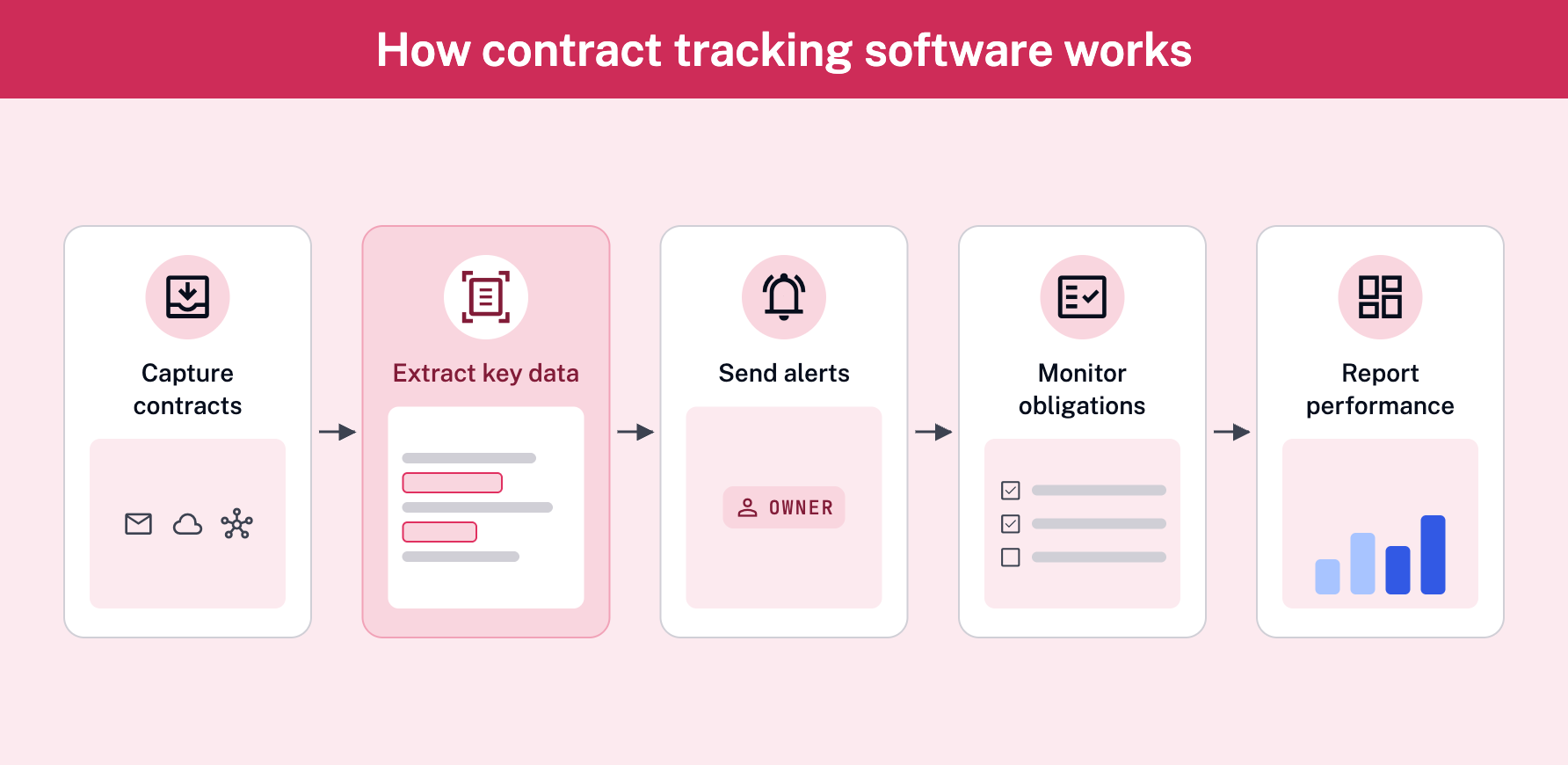
Most tools follow the same five-step flow. The real difference between vendors is how much of it they automate for you.
Capture: You upload contracts or sync them from email, cloud drives or your CRM, so every file lands in one hub.
Extract: AI reads each contract and pulls out metadata, which is structured data like parties, values, renewal dates and notice periods.
Alert: The system reminds the people who own each key date, which is where contract management software deadline tracking earns its keep.
Monitor: You track obligations, service level agreements (SLAs) and milestones after signing.
Report: Dashboards and scheduled reports show what's renewing, what's at risk and how your team performs.
Good tools also double as contract tracking software document management, so each file and its data stay together. That matters most at step two. SpotDraft's contract visibility playbook explains the shift from traditional search to Smart Data Capture.
Here's an illustrative example. Traditional search answers one question at a time, such as when a single lease expires. Structured data lets you set a rule instead, like an alert 90 days before any lease with an auto-renewal over $50k expires.
Do You Need Contract Tracking Software? 5 Signs You've Outgrown Spreadsheets
Spreadsheets work when you have a few dozen contracts and one person who keeps them current. They break as volume, teams and risk grow.
You're not alone if you're still there. In Deloitte's 2026 global study, 61% of organizations surveyed said they still rely on manual processes to surface critical agreement insights.
Run this quick test. If two or more signs apply, it's time to evaluate software.
You've missed a renewal: A contract auto-renewed, or a price increase slipped through, because nobody saw the notice date in time.
Your contracts live in 3+ places: Agreements sit across shared drives, inboxes and local folders, so no copy is the source of truth.
No one owns deadlines: Dates exist in a sheet, but no named person gets the alert or has to act on it.
You can't say what you're obligated to do: When leadership asks about SLAs or payment terms, someone has to reread the contract.
Audits turn into scrambles: Pulling every contract with a specific clause takes days of searching instead of one filtered view.
What about contract tracking software free plans or open source tools? They can work for a small, stable set of contracts. But they often lack AI extraction, owner-based alerts and audit trails, so the manual work returns as you grow.
Must-Have Features in Contract Tracking Software
Not every feature on a vendor's list matters. These six do, especially if you want contract tracking software with automated renewal tracking that people trust.
Use them as your shortlist filter. If a tool is weak on any of the six, expect your team to fill the gap by hand.
#1 A Centralized, Searchable Repository
Everything starts with one source of truth. A centralized contract repository stores every signed agreement with its metadata, so you search instead of dig.
In SpotDraft, you can find contracts by party, date and status. You can also filter by expiry date, revenue and counterparty.
Migration doesn't have to drag on, either. Open imported all of its contracts into SpotDraft within 2 weeks.
"Our most striking breakthrough with SpotDraft has been how much it helped during our investment rounds. The usually time-consuming legal due diligence process became seamless. We were able to filter and share contracts at the click of a button!"
Arjun David Alexander
VP, Legal, Open
Look for custom views by department or contract type. They let each team find its own answers without waiting on Legal.
#2 Automated Renewal and Expiration Alerts
Alerts are why most teams buy contract renewal tracking software. But the date that matters most usually isn't the expiration date.
The notice deadline is the last day you can cancel or renegotiate before a contract auto-renews. If the notice period is 60 days, your real deadline falls 60 days before expiration.
SpotDraft suggests reminders at 90, 60 and 30 days before the notice deadline. Here's how to avoid missing renewal dates with that cadence.
Alerts also need owners. Software for tracking contract expiration dates only helps if the right people get the message and know they have to act.
Beamery learned this the hard way before switching tools:
"Before we had SpotDraft, auto renewals for vendors were extremely chaotic and they were missed all the time. We lost money on several occasions, I can't even think of one because there were so many."
Lizzy Gagan
Senior Legal Counsel, Beamery
The result, in Beamery's words: "Renewals are no longer missed."
Dual email alerts now go to Legal and the relevant business owner ahead of every vendor renewal.
#3 AI Data Extraction
Manual data entry is where tracking usually breaks. AI extraction reads each contract and fills in the fields for you.
SpotDraft's AI-powered metadata extraction, called Smart Data Capture, pulls 1,000+ metadata types. Examples include payment terms, renewal dates and indemnities.
SpotDraft runs on a model-agnostic AI platform, so it isn't tied to a single model. Ask every vendor how they measure extraction accuracy and how often they retest.
Keep a human in the loop, though. Have someone review extracted fields on high-value contracts before alerts go live. Any tool you shortlist should make that review quick.
#4 Obligation and Compliance Tracking
Dates are only half the story. Obligations are the promises inside a contract, like SLAs, reporting duties, audit rights and payment terms.
This is often the hardest part to manage. In 2022 data from a WorldCC benchmark study, respondents named obligation tracking the single biggest point of friction in their organization. In that same data, 53% hadn't implemented a CLM solution at all.
Good contract obligation tracking software gives each obligation an owner and a due date. Contract compliance tracking software then flags anything that slips.
Milestones need the same treatment. Use contract tracking software for contract milestones, like delivery dates and phased payments, and follow these contract tracking tips to keep them on schedule.
#5 Version and Change Tracking With Audit Trails
Contracts keep changing after signing. Amendments, renewals and side letters can quietly override the original terms.
Contract change tracking software links each amendment to its parent agreement. It keeps an activity log of who changed what and when, while access controls decide who can view or edit each file.
Ask vendors to show you a real audit trail during the demo. If they can't, assume you'll rebuild history by hand.
#6 Analytics and Reporting
Tracking data tells you more than what's due next. It also shows how your contracts and your legal team perform.
With contract analytics dashboards, you can track renewal pipelines, cycle times and risk exposure. SpotDraft's analytics cover 30+ metrics across the contract lifecycle.
Many legal leaders aren't there yet. In an October 2025 Gartner survey of general counsel, 37% of the 104 GCs surveyed reported relatively low confidence using advanced contract analytics.
That's where contract analytics tracking software helps. Use it to track contract performance, like vendors that miss SLAs, and contract savings, like renewals worth renegotiating.
Then share what you find. Set up automated contract reporting to send scheduled reports to leadership, so nobody has to ask for an update.
Contract Tracking Software vs. CLM: Which Do You Need?
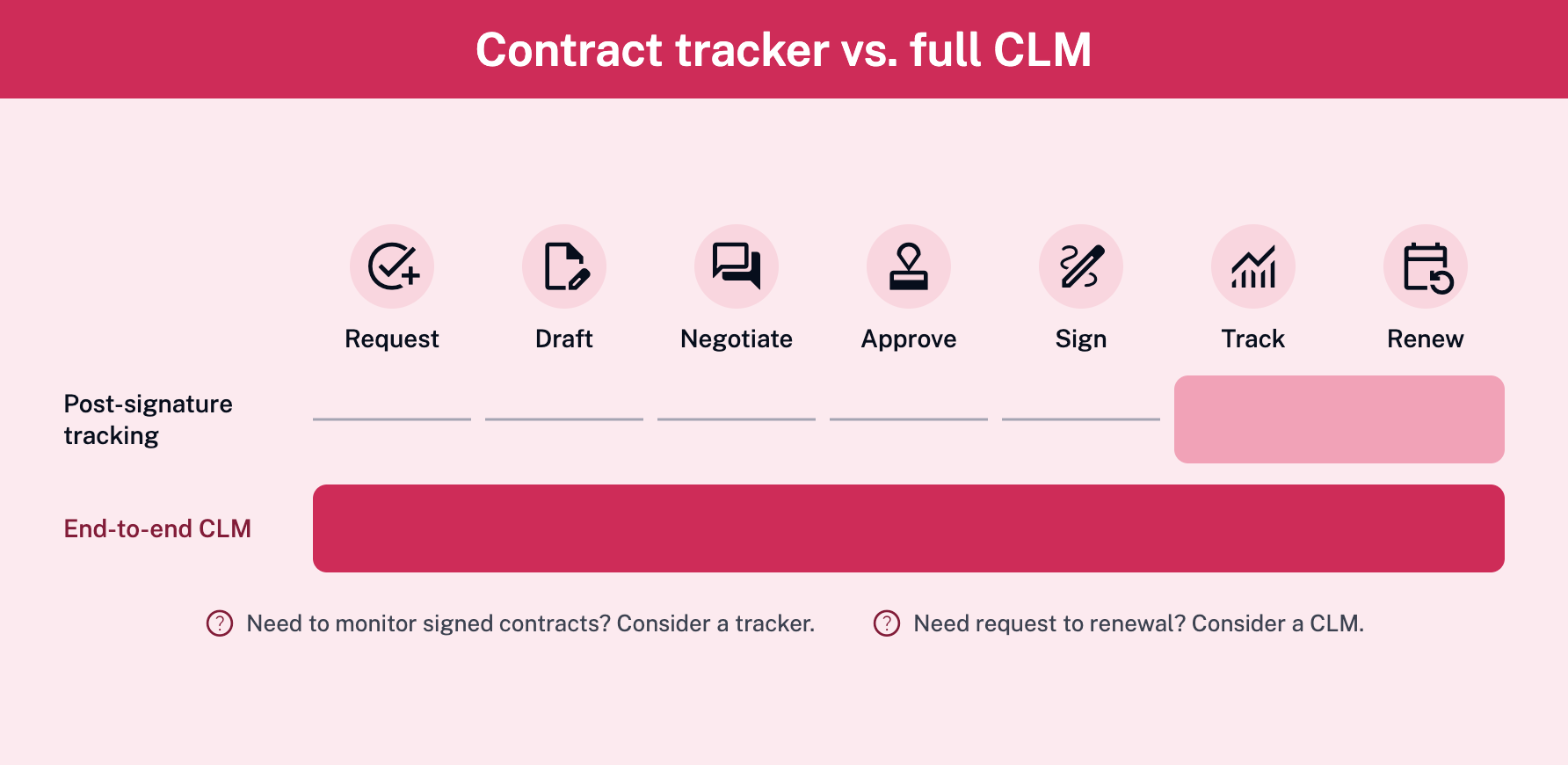
A contract tracker handles what happens after signature. Full contract lifecycle management (CLM) covers the whole process, including request, drafting, approval, signature and renewal.
Capability
Contract tracker
Full CLM
Lifecycle coverage
Post-signature only
Request to renewal
How data gets in
Uploads plus extraction
Captured at creation, plus extraction for legacy files
Renewal and expiration alerts
Yes
Yes
Obligation tracking
Varies by tool
Tied to contract data from day one
Templates, drafting and approvals
No
Yes
Negotiation and redlining
No
Yes
E-signature
Usually a separate tool
Often built in
Best fit
Small, stable contract sets
Growing teams with volume and complexity
So which one fits? Choose a tracker if you only need visibility into signed contracts and your volume is low.
Choose a CLM if contracts start in many teams. Data that's structured when a contract is created flows straight into tracking, with no re-keying.
When you run a contract tracking software comparison, check whether the vendor can grow with you. Switching later means a second migration and a second round of training.
Best Contract Tracking Software in 2026: 6 Platforms Compared
The best contract tracking software depends on how many agreements you manage, which deadlines you need to monitor and whether you need visibility beyond signed contracts. Some platforms focus on document storage and renewal alerts, while others offer AI-powered tracking alongside drafting, approvals and contract lifecycle management.
Here are six contract tracking platforms worth considering in 2026.
Software
Best for
SpotDraft
Growing legal teams that need end-to-end contract management
Ironclad
Enterprise legal teams managing complex workflows
LinkSquares
Teams analyzing large volumes of existing contracts
Juro
Startups and growing businesses
Sirion
Enterprises managing complex supplier and customer agreements
ContractWorks
Teams primarily looking for post-signature tracking
1. SpotDraft
SpotDraft is an AI-native contract lifecycle management platform for legal teams that want to manage contracts from creation through post-signature tracking.
Its Smart Data Capture technology extracts 1,000+ metadata types, including contract values, renewal dates, payment terms and indemnities. Legal teams can use this structured data to search agreements, create saved views and monitor important deadlines.
Key features:
AI-powered metadata extraction across 1,000+ data types
Automated renewal and expiration reminders
Contract repository with advanced search and filters
Contract analytics across 30+ metrics
Scheduled reporting and integrations with tools like Salesforce, Slack and Google Drive
Best for: Growing in-house legal teams that need contract tracking alongside drafting, negotiation, approvals and e-signature.
2. Ironclad
Ironclad is a contract lifecycle management platform designed for legal teams managing complex contract workflows. It combines contract creation, negotiation, approvals and post-signature management in one system.
Its repository and workflow capabilities help teams organize agreements, monitor contract progress and maintain visibility into contract activity.
Key features:
Centralized contract repository
Automated contract workflows and approvals
Contract search and reporting
Collaborative contract editing and negotiation
Contract lifecycle visibility and analytics
Best for: Enterprise legal teams that need configurable workflows and centralized contract management across departments.
3. LinkSquares
LinkSquares focuses on contract analysis and post-signature intelligence. Its platform helps legal teams extract information from existing agreements, search contract terms and understand their contract portfolios without manually reviewing every document.
Its AI-powered analysis capabilities are particularly useful when organizations have large repositories of legacy contracts.
Key features:
AI-powered contract data extraction
Search across contract clauses and terms
Contract repository and reporting
Renewal and obligation tracking
Contract analytics and risk insights
Best for: Legal operations teams that want to analyze existing contract portfolios and improve visibility into contractual commitments.
4. Juro
Juro is a browser-based contract management platform that helps businesses create, negotiate, sign and manage agreements. It focuses on making contract workflows accessible to Legal and business teams without requiring extensive technical setup.
Teams can use its repository and automated reminders to keep track of signed agreements and upcoming deadlines.
Key features:
Centralized contract repository
Automated reminders for important dates
Browser-based contract creation and editing
Contract templates and approval workflows
E-signature and contract search
Best for: Startups and growing businesses looking for an accessible platform to manage standard contracts and track key dates.
5. Sirion
Sirion is an enterprise contract lifecycle management platform with a strong focus on post-signature contract performance. It helps organizations monitor obligations, supplier commitments and service-level agreements across complex contract portfolios.
Its analytics and obligation management capabilities help procurement and legal teams understand whether parties are meeting their contractual commitments.
Key features:
Automated obligation extraction and tracking
Contract milestone monitoring
Supplier and vendor performance management
Renewal and compliance tracking
Contract analytics and reporting
Best for: Large enterprises and procurement teams managing complex supplier agreements, contractual obligations and performance commitments.
6. ContractWorks
ContractWorks focuses on post-signature contract management. It provides a centralized repository where teams can store agreements, organize documents and monitor important dates without adopting a full contract lifecycle management platform.
Its tracking capabilities are particularly relevant to businesses that primarily need visibility into existing signed contracts.
Key features:
Centralized contract repository
Automated renewal and expiration alerts
Document search and tagging
Custom reporting
Role-based access controls
Best for: Small and mid-sized teams that need a straightforward way to organize signed contracts and monitor important deadlines.
How to Choose Between These Contract Tracking Platforms
Before making a decision, consider how much of your contract lifecycle you want to manage.
A repository-focused tool may be sufficient if you only need to store signed agreements and receive renewal reminders. However, if your team also manages contract creation, negotiation, approvals and ongoing obligations, a full CLM platform may offer better long-term value.
Evaluate each vendor against your contract volume, AI extraction accuracy, integration requirements, implementation costs and reporting needs. Most importantly, test the platform using your own contracts rather than relying entirely on vendor demonstrations.
Contract Tracking Software for Different Teams and Industries
Every team tracks different things. Use this table to match features to what your team needs most.
Provider agreements, business associate agreements (BAAs), credentialing dates
Obligation tracking and access controls
Government
Deliverables, funding periods, reporting duties
Milestone tracking and audit trails
Investment firms
Side letters, fee terms, consent rights
Linked amendments and clause search
Talent and entertainment
Term dates, options, exclusivity, royalties
Expiration and option-date alerts
Legal contract tracking software leans on clause-level search. Healthcare contract tracking software and government contract tracking software lean harder on obligations and audit trails.
Contract tracking software for investment firms needs to link side letters to the main agreement. Contract tracking software for talent contracts lives or dies on option and term dates.
Industry rules vary, so confirm any regulatory needs with your vendor and your own compliance team.
How Much Does Contract Tracking Software Cost?
Cost depends on what you need the software to do. Vendors rarely publish one flat price, so focus on the drivers you control.
Users: More seats, or a mix of full and view-only users, changes what you pay under per-user plans.
Contract volume: Larger repositories and higher upload volumes can move you into a higher tier.
AI features: Extraction, review and analytics may come bundled or as paid add-ons.
Integrations: Native connectors are often included, while custom API work can add cost.
Implementation: Setup, configuration and training may carry a one-time fee.
Migration: Importing and tagging legacy contracts is often the biggest hidden cost.
Pricing models also shape your total cost. Here's how the two common ones compare.
Pricing model
How it works
Watch out for
Per-user
You pay for each seat
Costs climb as more business users need access
Platform
You pay a set fee for the platform, often tiered by volume or features
Tier limits on contracts, AI or integrations
Don't pay to migrate junk. Before you migrate, sort active contracts from expired ones so you don't pay to move years of agreements you'll never use.
Sort contracts into active and dead first, then migrate only what you must track.
What about free and open source tools? You skip license fees, but you pay in setup time, hosting, security reviews and manual data entry. Someone also has to maintain the tool when the person who built it leaves.
Want a price based on your real contract volume? Get a custom quote and see SpotDraft on your own contracts.
How to Choose Contract Tracking Software in 5 Steps
Demos all look polished. These five steps help you see past the script and pick the contract software tracking tool that fits your team.
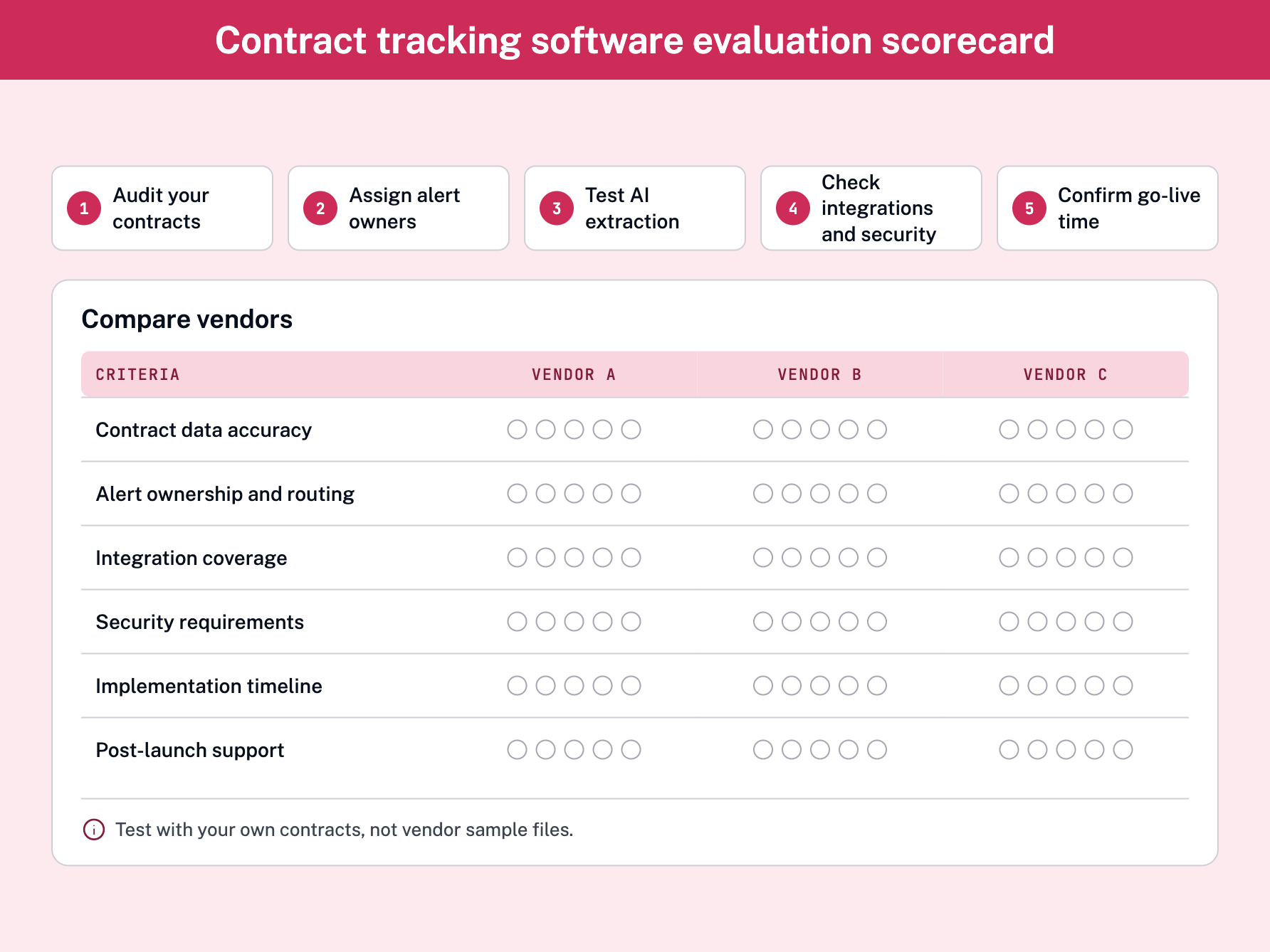
#1 Audit Your Contracts and List the Dates You Must Track
Start with your own data. Make a list of the dates you must track, such as renewals, price adjustments and audits.
Also note which contracts are active and which are dead. Then ask yourself whether you're missing renewal dates and paying for software you don't use.
#2 Define Who Owns Each Alert
Decide who gets each alert before you buy. Map every date type to a business owner and a Legal backup.
Then check that the tool can route alerts to both people. Ask whether alerts arrive by email only or also in tools like Slack and Teams.
#3 Test AI Extraction on Your Own Contracts
Don't judge extraction on a vendor's sample files. Bring 10 to 20 of your messiest contracts, including scans and amendments.
Compare the output to what you already know is in each contract. Score accuracy on the fields from your step #1 list.
#4 Check Integrations and Security
Tracking data should flow into the tools your teams already use, like your CRM, cloud storage and chat. Ask which integrations are native and which need custom work.
For security, ask for SOC 2 and ISO 27001 reports. If you handle EU personal data, confirm GDPR support too.
#5 Confirm Time to Go Live
Ask for a week-by-week rollout plan with named owners on both sides. SpotDraft runs a structured path, from discovery in Week 1 to a live system by Week 6.
Also ask who supports you after launch. Adoption problems usually show up in month two, after the kickoff energy fades.
Print the scorecard and fill it in during each demo. Weight the rows to match your priorities before the first call.
“Before using SpotDraft, executing a contract would take up to weeks. Now, contracts are signed within minutes, with better data security and tracking. The whole process takes us less than a day!”
Arti Singh
Founder’s Office, Growth, UrbanVault
“Before using SpotDraft, executing a contract would take up to weeks. Now, contracts are signed within minutes, with better data security and tracking. The whole process takes us less than a day!”