Wet Signature: What It Means & When You Need One

Huzaifa Sultana
By 
Huzaifa Sultana
Sep 2, 2026
7mins
Wet Signature: What It Means & When You Need One

TL;DR

  • A wet signature is a handwritten signature made with ink on a physical document.
  • Wet signatures are generally legally binding, but some documents have additional signing, witnessing or notarization requirements.
  • Most commercial contracts can be signed electronically, depending on the applicable law and document type.
  • Wills, certain real estate documents, court filings and government forms may still require specific execution formalities.
  • If your contracts are eligible for e-signatures, moving away from paper can make signing, tracking and managing agreements faster and easier.

As technology rapidly evolves, the ways we sign agreements and contracts are also changing drastically. Ink on paper has traditionally been the primary method for signing contracts, and it remains in use in many contexts today. In this guide, we will explore what a wet signature is, how it differs from electronic and digital signatures, its legal enforceability, and when legal teams should transition from wet signatures to e-signatures or digital signatures.

What Is a Wet Signature?

A wet signature is a physical signature written by hand using pen and ink on a paper document. Key details include:

  • Physical ink: Created using liquid ink that requires time to dry on paper. That’s why its called “wet ink."
  • In-person presence: Requires the signer to be physically present with the paper document
  • Legal commitment: Serves as traditional proof of consent and binds the signer to the agreement terms
Contract Lifecycle Management Demo page

Wet Signature vs. Electronic Signature vs. Digital Signature. What's the Difference? 

Wet Signature Electronic Signature Digital Signature
What it is Handwritten mark in pen/ink on physical paper Any electronic sound, symbol, or process indicating agreement (broad legal category) A cryptographically secured electronic signature using PKI/digital certificates
Legal basis (US) Common law / UCC ESIGN Act, UETA ESIGN Act, UETA (as a subtype of e-signature)
How it's created Pen or stamp on paper Typed name, click-to-sign, drawn signature, etc. Certificate-based cryptographic signing
Typical use case Wills, deeds, notarized docs, some court filings Most commercial contracts, NDAs, leases, approvals High-assurance transactions, regulated industries
Verification method Handwriting comparison, witness testimony, notarization Audit trail (timestamp, IP address, email verification) Cryptographic proof of signer identity and document integrity
  • Wet signature: ink on paper. Nothing digital involved anywhere in the act of signing itself.
  • Electronic signature: the catch-all. Any electronic action that is meant to be a signature counts. This includes typing your name into a box, clicking “I agree," or drawing your signature with a mouse or finger. It does not need to be encrypted or have special security to be legally valid. 
  • Digital signature: a particular, more technical form of electronic signature. It uses cryptography (a digital certificate that is linked to your identity) to lock the signature to the exact document, so any tampering after the signing will be detectable. A digital signature is just one type of electronic signature, and not all electronic signatures are electronic signatures.
Also read: Wet Ink vs. E-Signatures

Is a Wet Signature Legally Binding?

Yes, wet signatures are generally legally binding when they demonstrate a party’s intent to sign. However, some documents may have additional requirements, such as witnesses, notarization or specific execution formalities.

The FTC confirms that wet-ink and electronic signatures are both acceptable for certain filings, including HSR certifications and affidavits.

  • In the U.S., the E-SIGN Act generally prevents a contract or signature from being denied legal effect solely because it is electronic. 
  • In the EU, eIDAS similarly provides that an electronic signature cannot be denied legal effect solely because it is electronic, while a qualified electronic signature has the same legal effect as a handwritten signature.

For businesses, different types of electronic signatures can therefore provide a legally recognized alternative to wet signatures while making contracts easier to execute, track and store.

Which Documents Still Require a Wet Signature?

Although electronic signatures are now widely accepted, some documents may still require a wet signature, notarization, witnesses or other specific execution formalities. The exact requirements depend on the document, jurisdiction and applicable law.

Wills, trusts and estate planning documents

Wills can have strict signing and witnessing requirements that vary by state. However, electronic wills are permitted in some jurisdictions under the Uniform Electronic Wills Act

Real estate deeds, mortgages and title transfers

Real estate documents can have specific recording, notarization and witnessing requirements. Whether an electronic signature is sufficient depends on the jurisdiction and the particular transaction.

Court filings and legal pleadings

Many courts accept electronic signatures through systems such as CM/ECF. However, some courts or specific filings may still require an original or retained wet signature.

Notarized documents

A document requiring notarization may still need additional authentication even when signed electronically. Remote online notarization (RON) is available in many jurisdictions, but its availability and requirements vary by state.

Certain government, immigration and financial forms

Some government, immigration and financial documents may specify how signatures must be provided. Always check the requirements of the relevant agency or institution before relying on an electronic signature.

Document type Wet signature required? Common 2026 exception
Wills Sometimes Electronic wills permitted in some states
Real estate documents Varies Electronic recording and e-signatures permitted in many jurisdictions
Court filings Usually not for e-filings Other approved electronic signatures
Notarized documents Not necessarily Remote online notarization where authorized
Government/financial forms Varies Agency-specific electronic signature systems

How to Get a Wet Signature When You Can't Meet in Person

If a document requires a wet signature and the signer cannot meet in person, you typically have two options:

  1. Mail the document: Send the document to the signer, have them sign it in ink and return it by mail or courier. Use tracking if the original is important.
  2. Use remote notarization: If notarization is required and the applicable jurisdiction permits it, remote online notarization (RON) can allow the signer to complete the notarization remotely using audio-video technology. The Uniform Law Commission's Revised Uniform Law on Notarial Acts recognizes remote online notarization.
Question Decision Next step
Does the document require a wet signature? No Use an electronic signature.
Does the document require a wet signature? Yes Can the signer be physically present?
Can the signer be physically present? Yes Sign the document in person.
Can the signer be physically present? No Mail the document and track its return, or use RON if legally permitted.

How Do You Know If a Contract Can Move to E-Signature?

Most commercial contracts can be signed electronically, but you should check the document type, applicable law and any specific signing requirements before switching from wet signatures. The U.S. E-SIGN Act generally gives electronic signatures the same legal validity as handwritten signatures, subject to certain exceptions.

Example: Vendor NDA: A standard NDA between businesses can typically be executed entirely through e-signature.

Example: Mortgage closing: A mortgage transaction may involve a mix of electronic and physical documents depending on state law, lender requirements, notarization and recording rules.
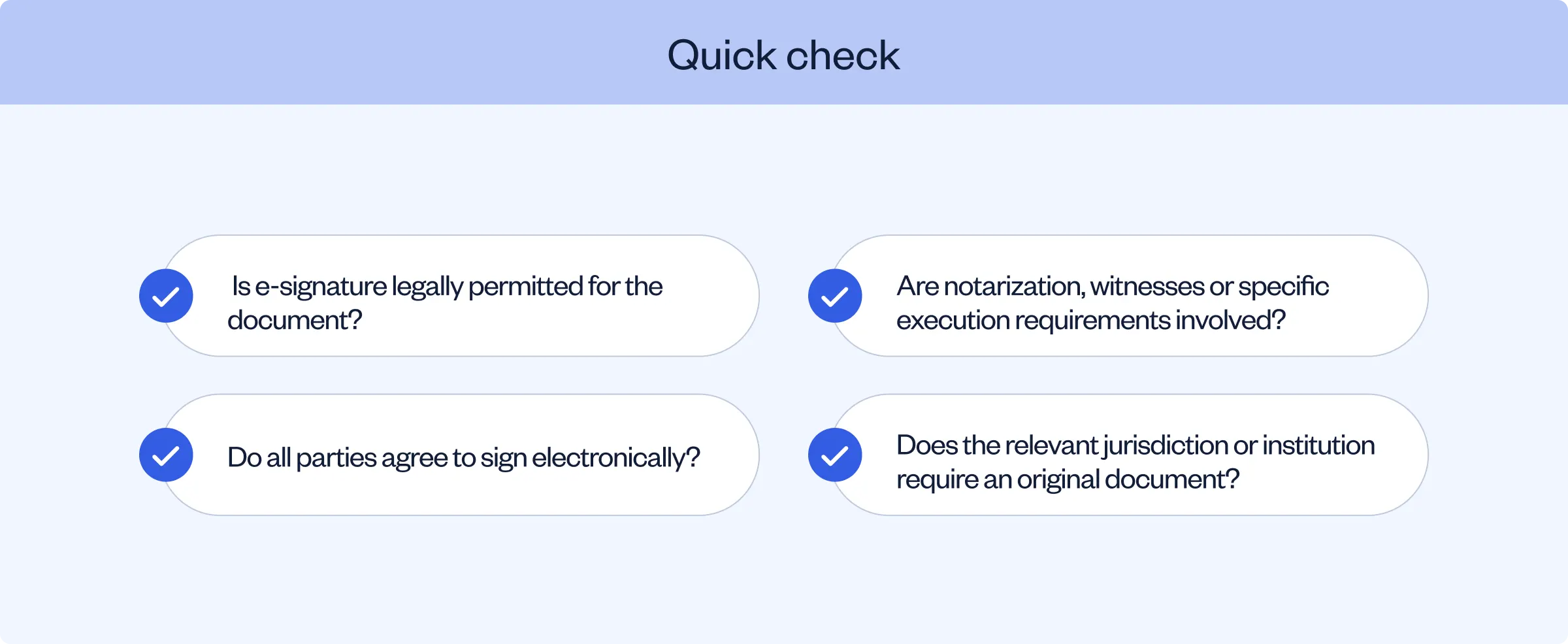
Checklist to see if you want to move a contract from wet signature to esignature.

If all requirements are met, the contract can generally move to e-signature.

When Should Your Team Move Away from Wet Signatures?

Wet signatures can still make sense for documents that require them, but they can create unnecessary delays when used for routine commercial agreements. If your team regularly prints, scans, mails or manually tracks signed contracts, it may be time to consider e-signatures.

Staying with wet signatures Moving to e-signatures
Documents legally require an original signature Routine commercial contracts
A counterparty specifically requests a wet signature High volume of agreements
Notarization or other formalities require physical execution Teams work across locations
Physical originals must be retained You want faster signing and easier tracking
Signing happens infrequently You need a searchable record and audit trail

Recent SpotDraft reviews support the shift toward digital execution. A July 2026 G2 reviewer highlighted SpotDraft's built-in signature platform for easy contract execution, while another recent review praised the platform for streamlining contracts from drafting through execution. 

"A Reliable Backbone for Modern Contract Lifecycle Management" Shajahan L. Head - Legal & Compliance

Make Contract Signing Faster and Simpler with SpotDraft

Wet signatures still have a place when a document requires them, but they can slow down routine contract workflows. For agreements that can be signed electronically, moving away from paper can make signing faster, easier to track and simpler to manage.

A CLM platform like SpotDraft brings e-signatures into the broader contract workflow, so your team can manage contracts from intake and drafting through approval, signing and renewal in one place.

Ready to move beyond paper-based contracts? Book a Demo to SpotDraft's CLM platform to see how your team can simplify the entire contract lifecycle.


Frequently Asked Questions

Is a wet signature legally binding?

PLUS icon

Is a wet signature more secure than an electronic signature?

PLUS icon

What is the difference between a wet signature and a digital signature?

PLUS icon

Do all contracts need a wet signature?

PLUS icon

Can you get a wet signature notarized remotely?

PLUS icon

Related content

Conga CLM Pricing Guide for 2026 With Key Cost Factors
latest

Conga CLM Pricing Guide for 2026 With Key Cost Factors

popular articles