Ironclad Pricing in 2026: Cost and Key Pricing Factors

Huzaifa Sultana is a Marketing Associate at SpotDraft focusing on Organic Growth through SEO and AEO.

Ironclad is a contract lifecycle management platform used for contract creation, review, approvals, eSignature, and repository management. Its pricing is quote-based, which means buyers need to go through the sales process to understand what the platform will cost for their setup.
That quote can cover more than the core CLM subscription. Depending on what the team needs, the final cost may also include integrations, AI usage, implementation services, or other licensed products and add-ons.
This article breaks down how Ironclad pricing works in 2026, what can increase the final quote, what third-party buyer data shows, and how the cost compares with other CLM platforms.
Ironclad does not publish a fixed CLM price or standard rate card. Its public pricing page directs buyers to choose products, a deployment route, and extras such as integrations, API access, additional instances, or enhanced support before requesting pricing.
Vendr provides a separate third-party benchmark. When checked in September, 2026, it reported a median annual Ironclad buyer spend of $40,055 based on 370 purchases in its dataset.
Source: Vendr
The $40,055 figure is a third-party benchmark, not an Ironclad list price. Individual quotes can be higher or lower because the products, seats, add-ons, and deployment scope differ.
Ironclad’s current documentation separately identifies API Access, certain integrations, additional instances, Security & Data Pro, enhanced support, Jurist access, and additional AI credits as items that can affect the licensed scope. Vendr’s marketplace write-up also discusses implementation and onboarding costs. These are Vendr-reported estimates, not Ironclad-published fees.

Ironclad does not publish a formula for calculating each quote. Its current pricing and FY2026 product documentation show that the commercial scope can include selected products, user access, integrations and API entitlements, AI credits, deployment services, additional instances, and Success Plan options.
Ironclad lets buyers purchase one or more products, including CLM, Jurist, and eSignature. Jurist can be purchased separately or alongside CLM, with access tied to the relevant seat.
A Jurist Seat is required for Jurist access, and Jurist can be purchased as a standalone service or alongside CLM. Buyers should therefore confirm the products and seat types included in the Order Form.
User access can affect Ironclad pricing, although Ironclad does not publish a fixed per-seat dollar rate.
Under its FY26+ model, Administrator and Standard users are both classified as Power Users and priced the same. Permissions and Workflow Designer assignments determine which seat type a person receives.
Ironclad states that permissions and Workflow Designer assignments can change a user’s seat type. Buyers should therefore map planned user roles to the seat types included in the quote.
Ironclad states that some integrations are included while others are paid add-ons. API Access is also sold as a CLM add-on.
When reviewing the quote, confirm which integrations are included and which are separately scoped. API Access is a separate entitlement, while Ironclad also offers paid integration packages for specific systems. Any implementation work required for those connections should be confirmed separately in the deployment scope.
Eligible Ironclad AI agents use a credit model. From September 1, 2026, agents including Renewal, Intake, and Archive can consume credits from the customer’s allowance. Additional usage may be purchased or billed on demand depending on the account configuration.
The credit model does not apply to every Ironclad AI feature. Buyers need to know which agents consume credits and how additional usage is priced.

The Ironclad subscription can sit alongside implementation and professional services, paid integrations, API Access, premium support, additional licensed products, and AI-credit usage. After launch, administrators manage workflow configurations, permissions, user access, and integrations as the contracting setup changes.
Ironclad offers three deployment routes. Customers can lead the deployment themselves, work with Ironclad’s legal engineers, or use an implementation partner.
For contract migration, integrations, and workflow configuration, buyers should confirm which services are included in the Order Form or statement of work.
When checked in September 2026, Vendr’s marketplace write-up stated that implementation and onboarding fees can range from roughly $10,000 to $75,000+, depending on complexity, integrations, and training. This is Vendr commentary, not an Ironclad-published implementation fee or list price.
Ironclad states that some integrations are included while others are paid. Its FY2026 product documentation also lists API Access, Security & Data Pro, and additional instances as separate commercial products or add-ons.
API Access also comes with defined usage limits. A team expecting high API volumes therefore needs to account for the license and the applicable allowance.
Ironclad includes Academy access, its community, and in-app guidance. Once workflows are live, administrators still need to maintain Workflow Designer settings, permissions, user access, and integrations as processes change.
Individual Capterra reviews also flag workflow-history navigation as something buyers may want to test. The examples below describe difficulty finding earlier messages or tracing specific steps in a workflow.
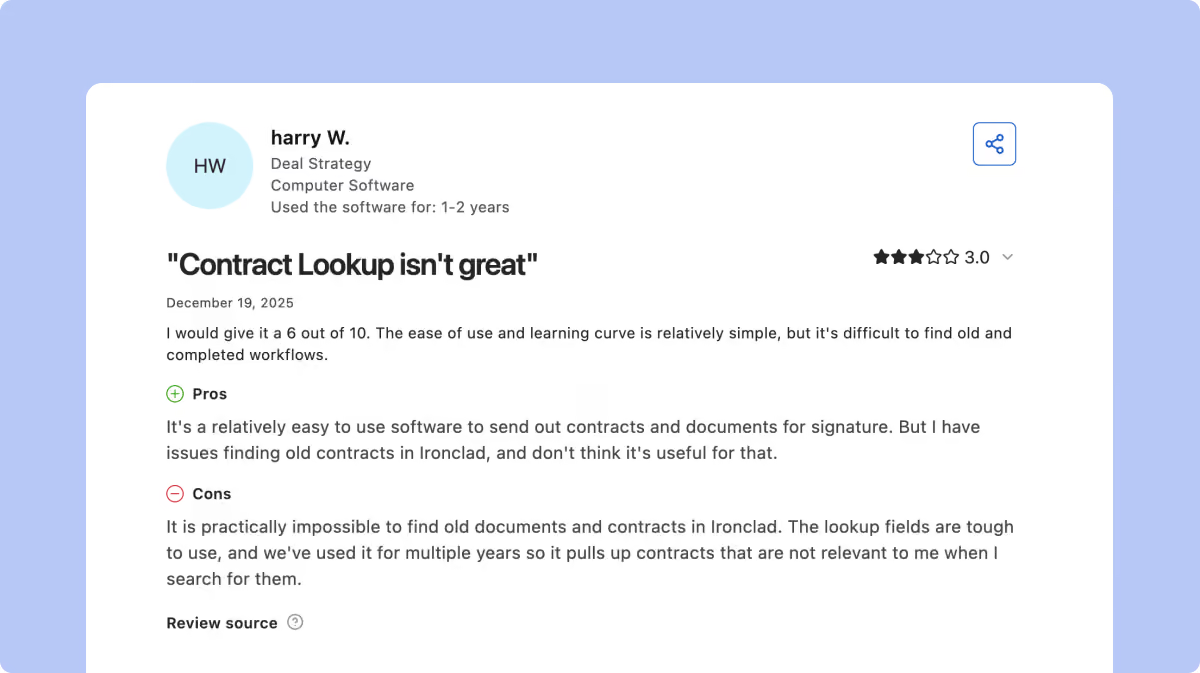
Source: https://www.capterra.com/p/162319/Ironclad/#Capterra___7066550/

Source: https://www.capterra.com/p/162319/Ironclad/#Capterra___6772402/
Ironclad’s FY2026 product descriptions state that customers select a Success Plan through the Order Form. Buyers should therefore check which customer support services are included in the quoted plan. Enhanced support can carry additional fees, while 24/7 phone support is listed as a premium add-on to the Enterprise Success Plan. Buyers should also confirm the included response times and whether a dedicated account manager or named success contact is part of their plan.
Additional licensed products, paid integrations, AI credits, and separate instances can increase the commercial scope. User roles should also be checked against the seat types listed in the Order Form.

Costs beyond the initial subscription can include implementation, paid integrations, API Access, additional products, premium support, and AI-credit usage. Which items apply depends on the products and services included in the buyer’s Order Form.
Workflow Designer lets administrators configure contract creation and workflow logic without application code. Ironclad’s current documentation also places workflow configuration, user permissions, and integration settings under administrator access. Teams expecting regular workflow changes after launch should confirm who will manage those updates and whether any additional services are included.
Several Ironclad capabilities have separate commercial terms:
Certain integrations and additional instances can also cost extra. Those additions make the Order Form important because it should identify what is licensed at launch and what would require another purchase later.
Ironclad assigns seat types according to permissions and Workflow Designer assignments.
Under FY26+ pricing, Administrator and Standard users are both classified as Power Users and are priced the same. Ironclad states that changes to permissions or Workflow Designer assignments can change a user’s seat type, so role design should be checked against the seats included in the quote.
Ironclad does not publish a standard renewal increase.
When checked in September 2026, Vendr’s marketplace write-up stated that renewal pricing typically includes annual escalators of roughly 5–8%. This is Vendr commentary, not an Ironclad-published renewal policy.
The applicable renewal terms should therefore appear in the customer agreement. The pricing for added users, products, and AI usage can then be considered when estimating the multi-year Ironclad cost.
Ironclad, SpotDraft, Juro, LinkSquares, and Agiloft’s CLM offering use quote-based pricing. A useful comparison therefore needs to look beyond the subscription and check implementation, integrations, usage limits, and services included in each quote.
These structures change how costs grow after rollout. Juro, for example, does not price according to user count and states that users, workflows, and templates are unlimited. Its quote can still change when contract volume grows or deeper integrations are required.
LinkSquares says its pricing varies with contract volume, users, selected modules, implementation/onboarding support, and custom integrations or advanced features. This means expanding the product set can increase the quote even when the user requirement stays the same.
For a deeper product comparison, see SpotDraft vs. Ironclad.
SpotDraft pricing can be based on user count or contract volume. Buyers therefore need to confirm which model their quote uses and the usage level it covers.
Implementation, workflow and integration setup, and legacy-contract migration are included in SpotDraft’s published pricing model rather than billed as separate implementation services.