What Is the Best Contract Reminder Software in 2026?
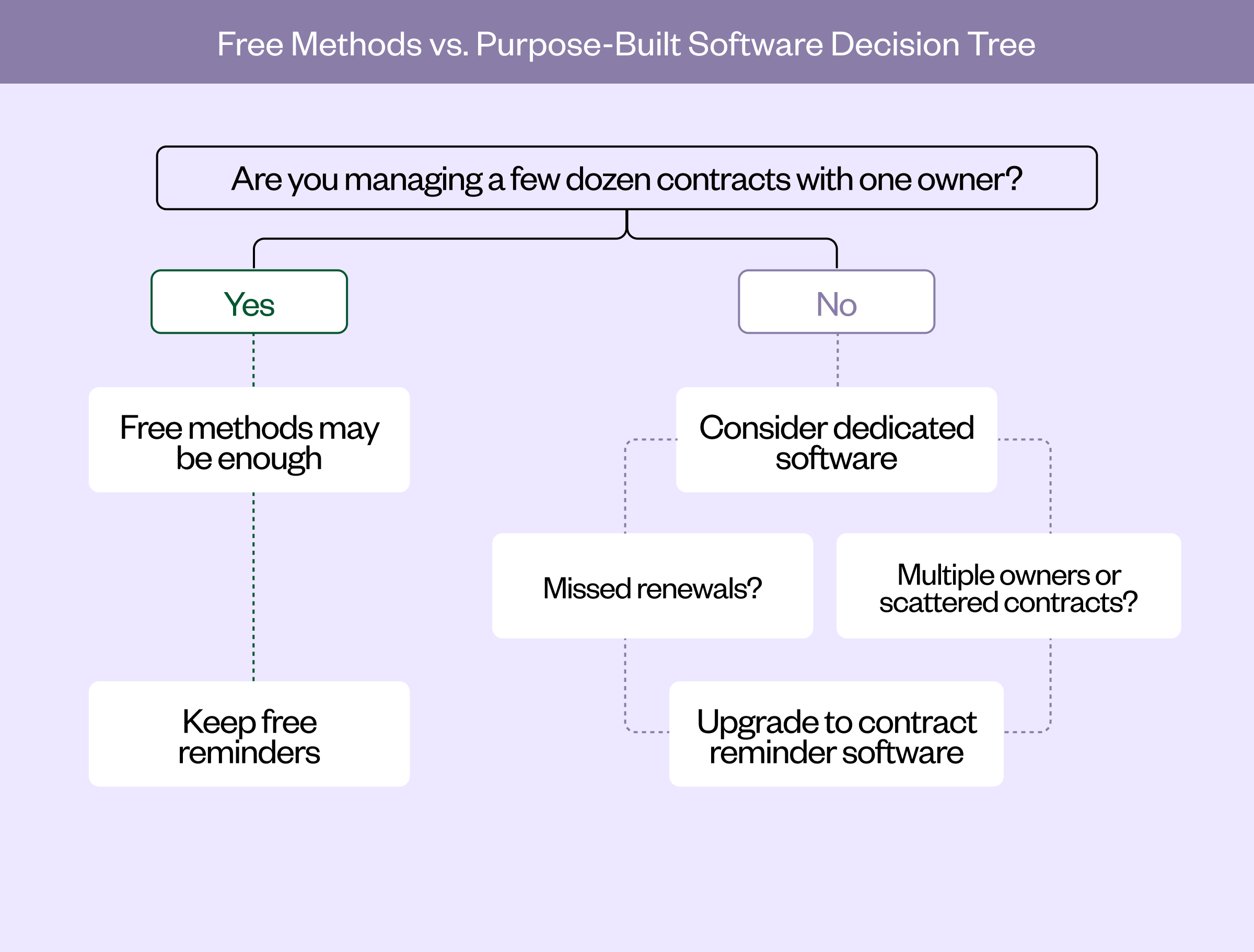
As a rule of thumb, free methods tend to hold up for a few dozen contracts with a single owner. Growing teams need AI date extraction and escalation. If renewals also involve drafting and approvals, choose a CLM with reminders built in.
Are There Free Contract Reminder Options for Small Businesses?
Yes, try a Google Sheets tracker, calendar events, or a Trello or Asana board. An email add-on like Boomerang can also help, but check its plan terms first. These work best when one person owns a small number of contracts.
Is Contract Reminder Software the Same as CLM?
No, contract reminder software tracks dates and sends alerts, while a CLM manages the whole contract lifecycle from drafting to renewal. Many CLM platforms include reminders as one built-in feature.
How Far in Advance Should You Set a Contract Renewal Reminder?
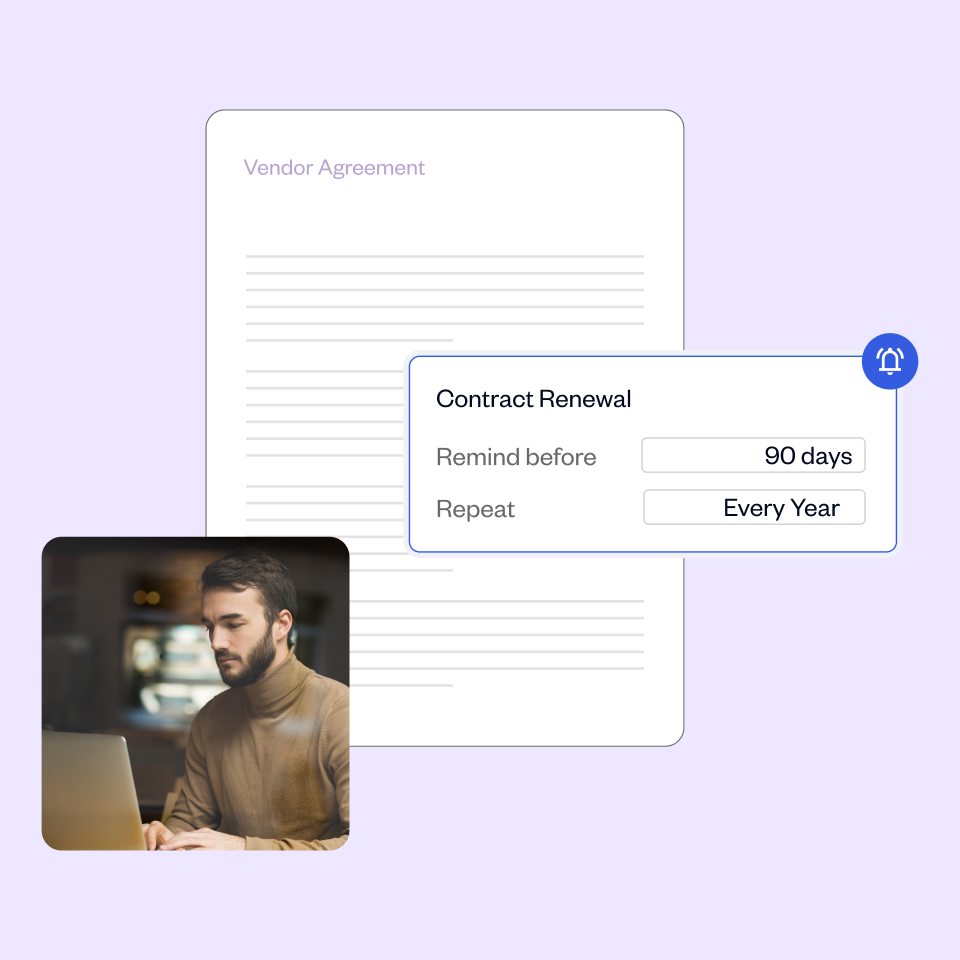
We recommend a first reminder 90–120 days before the notice deadline, then follow-ups at 60 and 30 days. SpotDraft's renewal guide suggests reminders 90–120 days before expiry. When there's a notice period, we recommend counting back from the notice deadline instead, or you may miss your chance to cancel.
Do I Need Separate Reminder Software if I Have a CRM?
A CRM can track customer renewal dates, but it usually doesn't hold vendor contracts or read notice periods from signed agreements. Connecting a contract repository to your CRM lets you cover both.
Can Contract Reminder Software Integrate With Invoicing Tools?
Many tools connect with CRM and finance systems so payment and renewal dates stay in sync. Ask each vendor which billing tools they support and how data flows between them.
Krishnapriya Agarwal is an Ex-Content Marketing leader at SpotDraft and an experienced marketing professional with a strong background in digital marketing, content strategy, and team management. She has led content teams and driven SEO-focused initiatives to support business growth.
TL;DR
Definition: Contract reminder software tracks key contract dates and alerts the right people before each one passes.
Notice dates first: Set reminders on the notice deadline, since the end date is often too late to cancel.
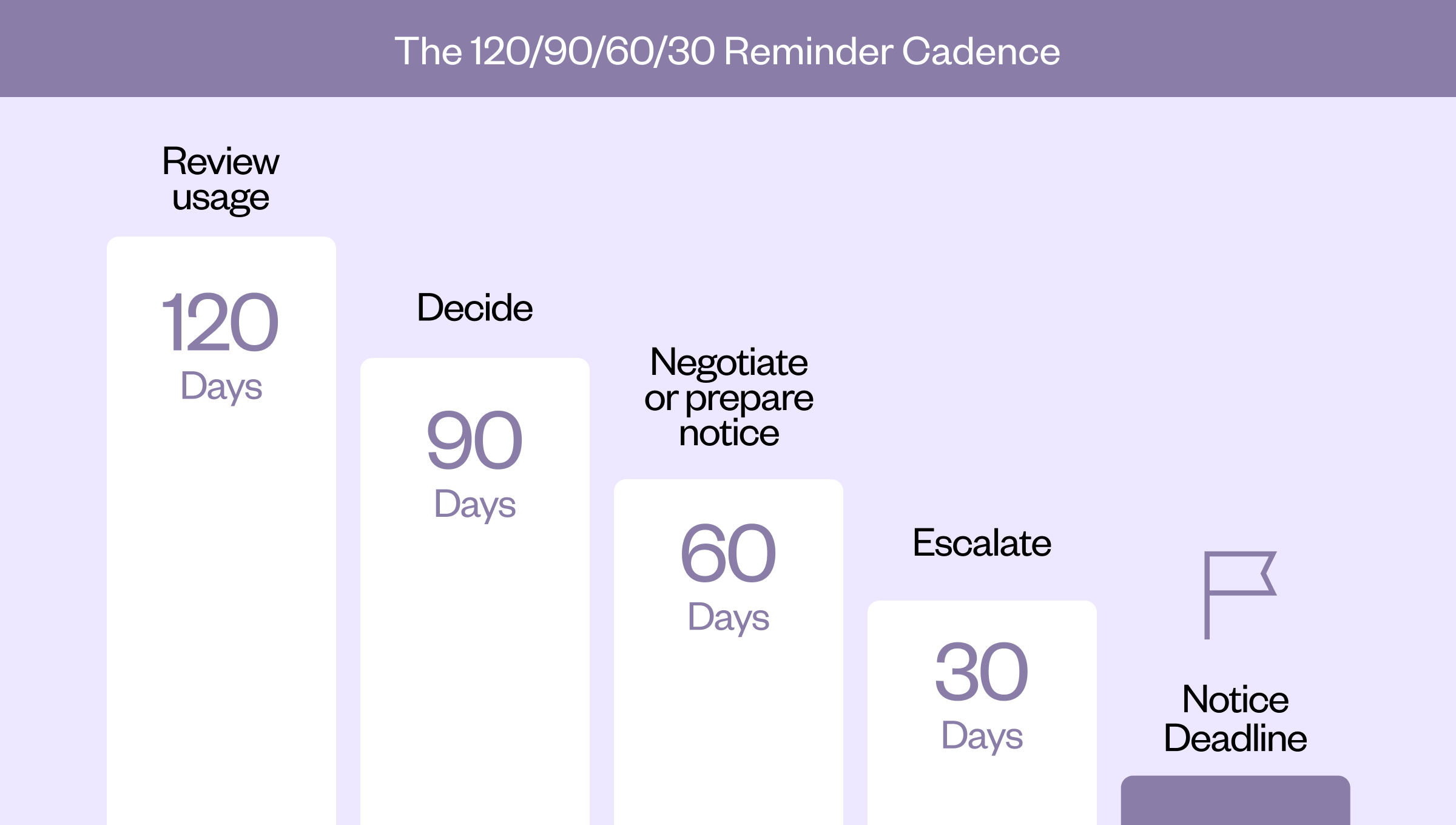
Cadence: Use a 120/90/60/30-day rhythm before each notice deadline, with a backup owner at every stage.
Free methods: Spreadsheets, calendars, task boards, and email add-ons work well for small volumes with one owner.
Upgrade signs: Growing volume, multiple owners, scattered storage, or one missed auto-renewal mean it's time for software.
Reminders need workflow: Pair every alert with an owner, a renewal template, a negotiation window, and a logged decision.
You meant to cancel that vendor contract. Then the notice window closed quietly, and you're locked in for another year. Sound familiar?
Contract reminder software exists to stop that. But you don't need to buy anything to start. This guide shows you how to set up free reminders today and when to upgrade.
It's written for heads of legal operations, in-house counsel, and ops managers who still track contract renewals in spreadsheets or calendars. The stakes are real. Per August 2025 WorldCC contract management research, "the average business loses almost 9% of value annually through poor contract management."
WorldCC adds that "the best performers lose about 3%; the worst, 15% or more." Poor contract management covers a lot, but missed deadlines are one of the easiest leaks to plug.
What Is Contract Reminder Software?
Contract reminder software is a tool that tracks key contract dates, like renewals, notice deadlines, expirations, obligations, and payment dates. It automatically alerts the right people before those dates pass. Most tools also store contracts, pull dates from documents, escalate missed alerts, and log what happened.
In practice, it's contract due date tracking reminder software with five core jobs:
Store: It keeps every signed contract in one place.
Capture: It pulls dates and terms from each contract, ideally without manual entry.
Alert: It sends reminders to the contract owner on a set schedule.
Escalate: It notifies a backup person or manager when no one acts.
Log: It records who decided what, and when.
A calendar handles only the alert step, and only if someone typed the date in correctly. Contract deadline reminder software does more, but it's usually one feature inside a bigger system. In modern platforms, reminders sit on a searchable contract repository, so each alert links to its contract.
Why Do Contract Renewals Get Missed?
Missed renewals often follow one of three patterns.
Quiet auto-renewal: The contracts keep renewing on their own due to the automatic renewal clause unless someone sends notice, so nothing forces a decision.
Scattered contracts: Agreements live in inboxes, shared drives, and desktops, so no one sees every date.
Single owner leaves: The one person who knew the dates changes roles, and the knowledge leaves too.
Manual processes make all three worse.
Deloitte and DocuSign surveyed 1,100+ leaders in 2026. The Deloitte 2026 contract management survey found "61% of organizations surveyed still rely on manual processes to surface these critical insights." Those insights include the terms, deadlines, and obligations inside stored contracts.
Software subscriptions show why reminders matter. According to Zylo 2026 SaaS waste data, a vendor-published index, "the average organization only uses 54% of its SaaS licenses." A timely reminder gives you the chance to right-size those licenses before they renew.
Here's how one legal team described life before contract renewal reminder software for businesses:
"Before we had SpotDraft, auto renewals for vendors were extremely chaotic and they were missed all the time. We lost money on several occasions, I can't even think of one because there were so many."
Lizzy Gagan
Senior Legal Counsel, Beamery
Today, two email alerts go out before every vendor renewal at Beamery. As the Beamery customer story puts it, "Renewals are no longer missed."
Which Contract Dates Should You Set Reminders For?
Start with these three date types, in this order.
#1 Notice Deadlines (The Date Most Teams Miss)
A notice period is the amount of time a contract requires you to give before you cancel or change it. The notice deadline is the last day you can send that notice. Miss it, and an auto-renewing contract usually rolls into a new term.
Here's the formula:
Notice deadline = End date − Notice period
Say your contract ends December 31 and has a 60-day notice period. Your notice deadline is November 1. Set your reminders for 90, 60, and 30 days before November 1, which lands on August 3, September 2, and October 2.
A reminder on December 1 is too late. It's an easy mistake to make, whether you use contract renewal reminder software or DIY tools. Our automatic renewal clauses guide explains how these clauses are usually written.
Regulators watch auto-renewals too. The FTC negative option rulemaking covers marketing where "the absence of affirmative consumer action constitutes consent to be charged for goods or services."
As of March 2026, the FTC's 2024 click-to-cancel rule had been vacated, and the agency reopened rulemaking for comment. That process is consumer-focused and may have changed since. This isn't legal advice, so check your B2B notice terms with counsel.
#2 Expiration and Renewal Dates
Fixed-term contracts end on a set date and don't renew on their own. If you still need the service, the expiration date is your hard stop for a new agreement.
For auto-renewing contracts, also track the date the new term starts. That's when new pricing or terms often kick in. See our guide to managing contract expiration dates for what to do as each end date nears.
#3 Obligation, Payment and Invoice Dates
Contractual obligations are the things each party promised to do by a certain date. Renewals get the attention, but these dates cause plenty of trouble too:
Deliverables: Milestones you owe a customer, or a vendor owes you.
Insurance certificates: Proof of coverage that must be renewed each year.
Price-increase triggers: Dates when fees can rise unless you object.
Invoicing milestones: Dates when you can bill, or must pay, under the contract.
Payment dates are where invoice contract reminder software integration helps most, since finance sees the same dates you do. Read more about tracking contractual obligations beyond renewals.
How to Set Up Contract Reminders for Free
As a rule of thumb, free methods tend to hold up for a few dozen contracts with a single owner. Here are four ways to set them up today.
#1 Use a Contract Tracking Spreadsheet
A spreadsheet is the easiest place to start. Download our free contract tracking spreadsheet, or build one in Google Sheets with these columns:
Column A (Counterparty): The company on the other side of the contract.
Column B (Owner email): The person who decides whether to renew.
Column C (Backup owner): The person who steps in if the owner is out.
Columns D and E (Start and end dates): The contract term.
Column F (Notice period): The notice period in days.
Column G (Notice deadline): The formula =E2-F2.
Column H (Renewal type): Auto-renew, manual renew, or fixed term.
Next, select column G and add conditional formatting with the custom formula =AND($G2>=TODAY(), $G2-TODAY()<=90) to highlight deadlines within 90 days.
Highlighting only works when someone opens the file. To get email alerts, in most accounts, open Extensions > Apps Script and paste a short script like this one:
function sendRenewalReminders() {
  const rows = SpreadsheetApp.getActive().getSheetByName('Contracts').getDataRange().getValues();
  const today = new Date();
  rows.slice(1).forEach(([counterparty, owner, backup, start, end, notice, deadline]) => {
    if (!(deadline instanceof Date)) return;
    const days = Math.ceil((deadline - today) / 86400000);
    if ([120, 90, 60, 30].includes(days)) {
      MailApp.sendEmail(owner, `Notice deadline in ${days} days: ${counterparty}`,
        `Decide to renew, renegotiate or cancel before ${deadline.toDateString()}.`);
    }
  });
}
Then open Triggers, add a time-driven trigger, and set it to run once a day. Google's guide to Apps Script time-driven triggers explains the scheduling options.
The script needs your authorization, runs from your account, and is subject to Google's daily email quotas. For more tips, see our contract tracking best practices.
#2 Set Calendar Reminders
Create a Google Calendar or Outlook event on each notice deadline. Put the contract link and the notice period in the event description. Invite your backup owner to every event.
Here’s what it looks like to set up a reminder on Google Calendar.
Note: ‘Reminder’ on Google Calendar does NOT send you an email notification. You will only receive a push notification on your mobile device. If you want email notifications to be configured, then I suggest setting up an upcoming renewal as an event instead.
You can try this with whatever calendar app you use as well.
Some other Chrome plugins you can use for the same effect are Remind Me, Pi Reminder, etc.
Google Calendar lets you add multiple notifications to one event, as Google's help page on Google Calendar notification settings explains. Set them for 90, 60, and 30 days out. If your calendar allows only one reminder per event, create separate events per checkpoint.
#3 Use a Task or Kanban Board
A Kanban board is a visual board where tasks move across columns as work progresses. In Asana, Trello, or Notion, create one card per contract and set the due date to the notice deadline.
Use columns that match your renewal stages: "Review," "Decide," "Negotiate," and "Done." Assign each card an owner, and attach the contract file so no one has to hunt for it.
If you notice here, there’s a ‘Renewal Date’ property, for which you can set custom reminders.
You can play around with Kanban boards and customize them the way you want, which is honestly the best thing about them!
#4 Try Email Add-Ons
With Boomerang follow-up reminders, you get a nudge if an email gets no reply after a set number of days. Forward the signed contract to yourself, then time the reminder to land 90 days before the notice deadline.
This works for one person with a few contracts. Nobody else sees your reminders, so it breaks when you're out of office. Check Boomerang's current plan terms before you rely on it.
Method
Setup Effort
Automatic Alerts
Team Visibility
Breaks When...
Spreadsheet
Medium
Only with Apps Script
Shared file
Someone forgets to update it
Calendar
Low
Yes
Invitees only
Dates are typed in wrong
Task board
Medium
Yes, on due dates
Whole board
Cards go stale
Email add-on
Low
Yes
Owner only
The owner is away
What's the Right Reminder Cadence?
A cadence is the schedule your reminders follow. One alert isn't enough, because a single email is easy to miss or snooze. Use four checkpoints, counted back from the notice deadline:
120 days: The contract owner reviews usage and value.
90 days: The owner and finance decide to renew, renegotiate, or cancel.
60 days: Legal negotiates new terms or sends the cancellation notice.
30 days: The backup owner or manager steps in if no one has decided.
SpotDraft recommends setting automated reminders 90–120 days before expiry, which leaves room to negotiate. Our guide on how to never miss a contract renewal walks through the full process.
Good contract deadline reminder software applies this cadence to every contract automatically. With free tools, you'll rebuild it by hand.
When Do Free Reminder Methods Stop Working?
Free methods depend on people updating them. Watch for these six signs that you've outgrown them:
Volume: You've grown past a few dozen active contracts, our rule-of-thumb limit for free methods.
Multiple owners: Renewals are split across legal, procurement, sales, and finance.
A missed auto-renewal: You've been locked into a contract you meant to cancel.
Scattered storage: Contracts live in three or more places.
Audit pressure: Leadership or auditors ask for renewal reports you can't produce quickly.
Manual data entry: Someone spends hours copying dates from PDFs into a sheet.
One G2 reviewer, a legal counsel, described life before SpotDraft in a SpotDraft G2 review:
"Before SpotDraft, our executed agreements were scattered across Google Drive, email attachments, and local folders, so we didn't have a single source of truth. Tracking signature status meant constantly pinging people on Slack, and renewal dates usually surfaced only when someone happened to remember."
If two or more signs apply, it's time to upgrade. A single missed auto-renewal is reason enough on its own.
What Should You Look For in Contract Reminder Software?
Tools handle reminders differently. Use these six features as your comparison checklist.
#1 Automatic Date Extraction
Metadata is the key data inside a contract, like parties, dates, and renewal terms. With AI contract metadata extraction, the software reads each contract and fills in those fields for you. That removes the copy-paste step where most date errors start.
The Unlimited Group customer story reports that legal saves an estimated 5–6 hours each week on routine drafting and reviews.
"The Accenture team used SpotDraft to pull out contract metadata and go through unfavorable terms and renegotiate them. That's just really helped massively during the acquisition in terms of rather than someone sitting there reading through it."
Laura Devine-Brown
Head of Legal, Unlimited Group
#2 Notice-Period Logic and Custom Lead Times
The tool should read each notice period and calculate the deadline for you. You'll also want custom lead times, since a large vendor deal may need 120 days and a small subscription only 30.
#3 Alerts to the Right Owners (With Escalation)
Reminders should go to the person who owns the decision, plus a backup. If no one acts, the alert should escalate to a manager.
Look for task assignment too, so a reminder becomes a clear next step with a name on it. Watch the tasks and reminders demo to see how this can work.
#4 Renewal Dashboards and Reporting
A dashboard shows every upcoming renewal in one view, so you can plan workload and brief leadership. Look for auto-updating reports you can filter by owner, value, or counterparty.
Your sales team lives in the CRM (customer relationship management system), and finance lives in billing tools. Renewal dates should flow into both, so no one keeps a separate list.
Ask vendors how their invoice contract reminder software integration works with your billing stack. On the sales side, the SpotDraft Salesforce integration keeps contract data next to each account.
#6 Security and Audit Trails
Contracts hold sensitive pricing and terms, so look for SOC 2 and ISO 27001 certifications. You'll also want role-based access and an audit trail of every reminder and decision.
Contract Reminder Software vs. CLM: Which Do You Need?
Contract lifecycle management (CLM) is software that handles a contract from first draft through signature, storage, and renewal. A standalone reminder tool covers only the tracking and alerts. Here's how the three options compare:
Capability
Free Methods
Standalone Reminder Tool
CLM Platform
Cost
Free
Varies
Varies
Date capture
Manual entry
Manual or basic upload
AI extraction from contracts
Notice-deadline math
Your own formulas
Usually built in
Built in
Escalation
Manual
Often included
Included, with task assignment
Contract storage
Scattered
Basic file storage
Central, searchable repository
Renewal workflow
None
Limited
Templates, approvals, negotiation
Integrations
Few
Some
CRM, e-signature, and more
Best fit
A few dozen contracts, one owner (rule of thumb)
Moderate volume, simple renewals
Growing teams with many owners
Searching for the best contract reminder software 2026 has to offer? Start with your volume and team, since a standalone tool fits if you only need alerts.
A CLM pays off when renewals tie into drafting, approvals, and negotiation. Teams weighing that step can compare contract lifecycle management software options against their own renewal checklist.
Track Renewals, Reminders, & Approvals With SpotDraft
With your teams rapidly scaling and contracts firmly growing, keeping track of contract renewals may become more challenging than ever. You may benefit from automated renewal reminders to avoid hiccups and surprises and build healthy customer relationships.
SpotDraft offers teams a separate negotiation window before the actual renewal. It gives your team extra time to ensure the deal provides a competitive advantage. Try out a demo.
Frequently Asked Questions
What Is the Best Contract Reminder Software in 2026?
Are There Free Contract Reminder Options for Small Businesses?
Is Contract Reminder Software the Same as CLM?
How Far in Advance Should You Set a Contract Renewal Reminder?
Do I Need Separate Reminder Software if I Have a CRM?
Can Contract Reminder Software Integrate With Invoicing Tools?
Related content
latest
Evisort pricing in 2026: Workday CLM costs and quote factors
Review Evisort (Workday CLM) pricing in 2026, with available benchmarks, quote factors, implementation costs, and buyer evaluation considerations.
“Before using SpotDraft, executing a contract would take up to weeks. Now, contracts are signed within minutes, with better data security and tracking. The whole process takes us less than a day!”
Arti Singh
Founder’s Office, Growth, UrbanVault
“Before using SpotDraft, executing a contract would take up to weeks. Now, contracts are signed within minutes, with better data security and tracking. The whole process takes us less than a day!”