We recommend starting about 13 weeks, or 90 days, before the notice deadline. For complex or high-value deals, start even earlier.
How Do You Renew an Agreement?
Review the terms and performance, agree on any changes, then sign a renewal agreement or order form. If the contract auto-renews, it continues unless someone gives notice.
How Do You Get Out of an Automatic Renewal Contract?
Send written notice of non-renewal before the notice deadline, using the method the contract requires. Keep proof of delivery in case the other party disputes it.
What Happens If You Miss the Notice Deadline?
An auto-renewing contract typically rolls into a new term on its current terms if no one sends notice. You can still ask the other party for an early exit, but they don't have to agree.
What's the Difference Between Auto-Renewal and Evergreen?
An auto-renewal contract renews for set terms, like one year at a time. An evergreen contract usually keeps running with no fixed end until someone terminates it.
Is a Renewed Contract a New Contract?
It depends on how it's done. A renewal signed as a new agreement is a new contract, while an auto-renewal usually continues the original contract for another term.
Ashish Upadhyay is an Ex-Senior Writer at SpotDraft, where he covers AI in contracting and helps unpack CLM best practices. He has 6+ years of experience writing for B2B SaaS, LegalTech, and Fintech, and previously worked at Gartner.
TL;DR
Renewal is a decision point: Each renewal is a chance to renew, renegotiate, extend or terminate, not a rubber stamp.
The notice date is the real deadline: Your window to act usually closes weeks before the contract's end date.
Renewal and extension differ: A renewal starts a new term, while an extension pushes back the end date on current terms.
Auto-renewal is generally legal: Most US auto-renewal laws protect consumers, though some state rules can reach B2B deals.
Start about 90 days before notice: We recommend this runway because it gives you time to review performance, compare options and negotiate.
Visibility beats memory: A central repository, date alerts and dashboards keep renewals from slipping through the cracks.
Every contract renewal quietly decides what you'll spend, what risk you'll carry and which partners you'll keep. Miss one notice window, and a vendor deal you meant to cut rolls over for another year.
In this guide, you'll learn the types, process, deadlines, legal basics and tools behind contract renewal management, the repeatable way your team tracks and decides on renewals.
What Is Contract Renewal?
Contract renewal is when the parties agree to continue an agreement for a new term after the current term ends. The terms can stay the same, or you can renegotiate them before you renew the contract.
A renewed contract usually takes one of three forms: a new renewal contract, a short renewal order form or an automatic renewal clause. In each case, put the renewal of contract terms in writing so everyone knows what applies next.
If no one renews and there's no auto-renewal clause, the agreement simply ends on its end date. Some duties, like confidentiality, can survive, so it's worth knowing what happens when a contract expires. Either way, treat each renewal as a choice you make on purpose.
What's the Difference Between Contract Renewal and Contract Extension?
People often use these words interchangeably. Yet the difference changes your paperwork and your leverage.
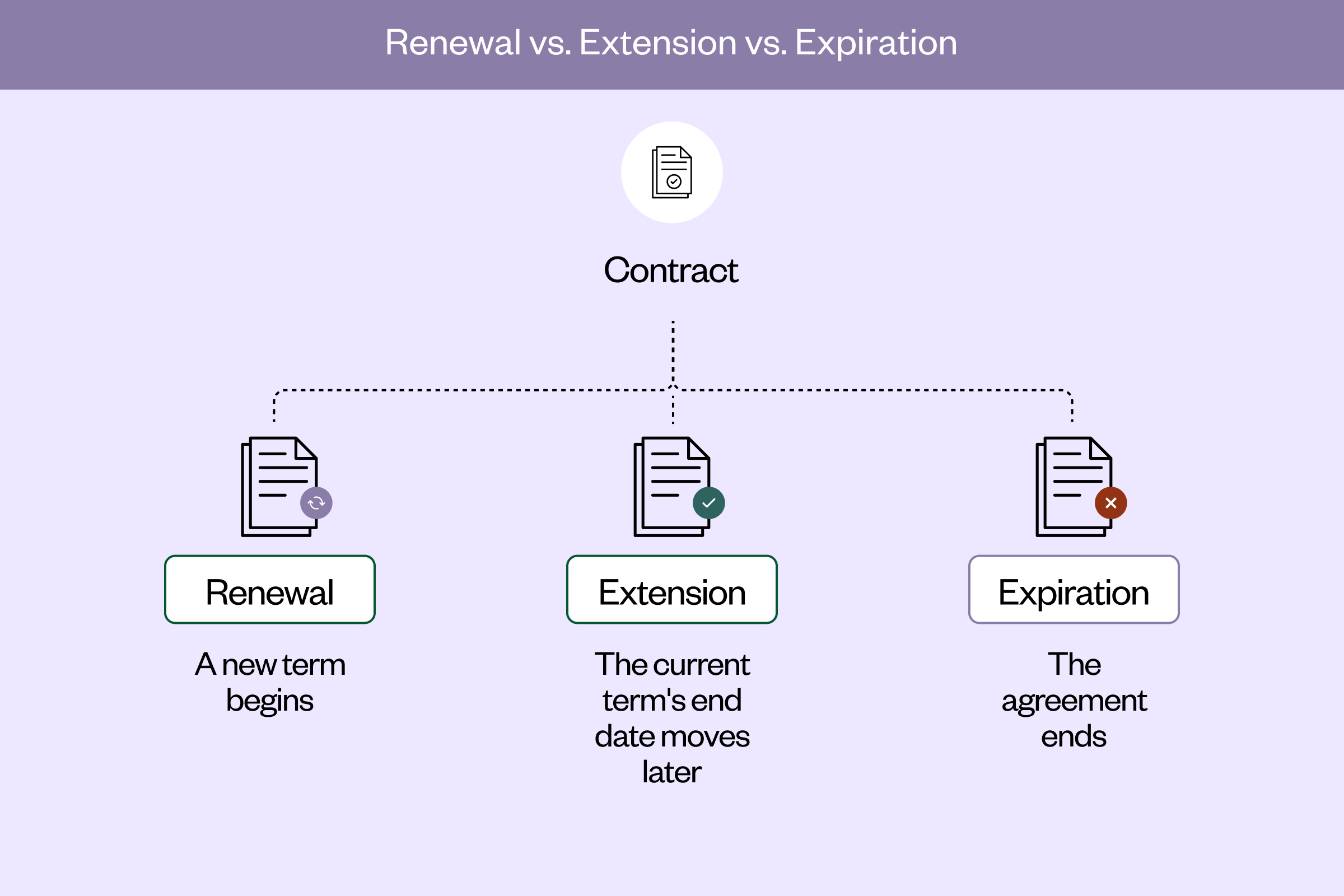
Factor
Contract Renewal
Contract Extension
What changes
A new term begins
The current term's end date moves later
Renegotiation
Common, since terms can be reopened
Rare, since terms usually stay the same
Paperwork
New agreement, order form or auto-renewal
A short amendment to the existing contract
Best when
You want new pricing, scope or protections
You need a few more weeks or months to decide
Choose renewal when the relationship is working, but the deal needs updating.
Choose an extension when a negotiation is running late or a replacement vendor isn't ready yet.
Contract renewals touch both sides of your business. On the buy side, they shape vendor spend, and on the sell side, they protect customer revenue.
Cost control: Each service contract renewal is your chance to cut unused seats, cap price increases or drop a tool.
Vendor performance: Renewal is when you can hold vendors to past SLAs, or service level agreements, before you commit again.
Revenue continuity: For customer contracts, an on-time renewal protects recurring revenue and opens room to expand the deal.
Risk management: Older contracts may carry outdated data, security or liability terms that no longer fit your business.
In his WorldCC value leakage research post, WorldCC co-founder Tim Cummins notes the organization first evaluated value leakage at an average 9.2% of revenue back in 2013. That figure covers contracting broadly, not renewals alone. Still, each renewal is a scheduled chance to stop some of that leak.
Here's what it looks like when renewals go unmanaged:
"Before we had SpotDraft, auto renewals for vendors were extremely chaotic and they were missed all the time. We lost money on several occasions, I can't even think of one because there were so many."
Lizzy Gagan
Senior Legal Counsel, Beamery
What Are the Types of Contract Renewals?
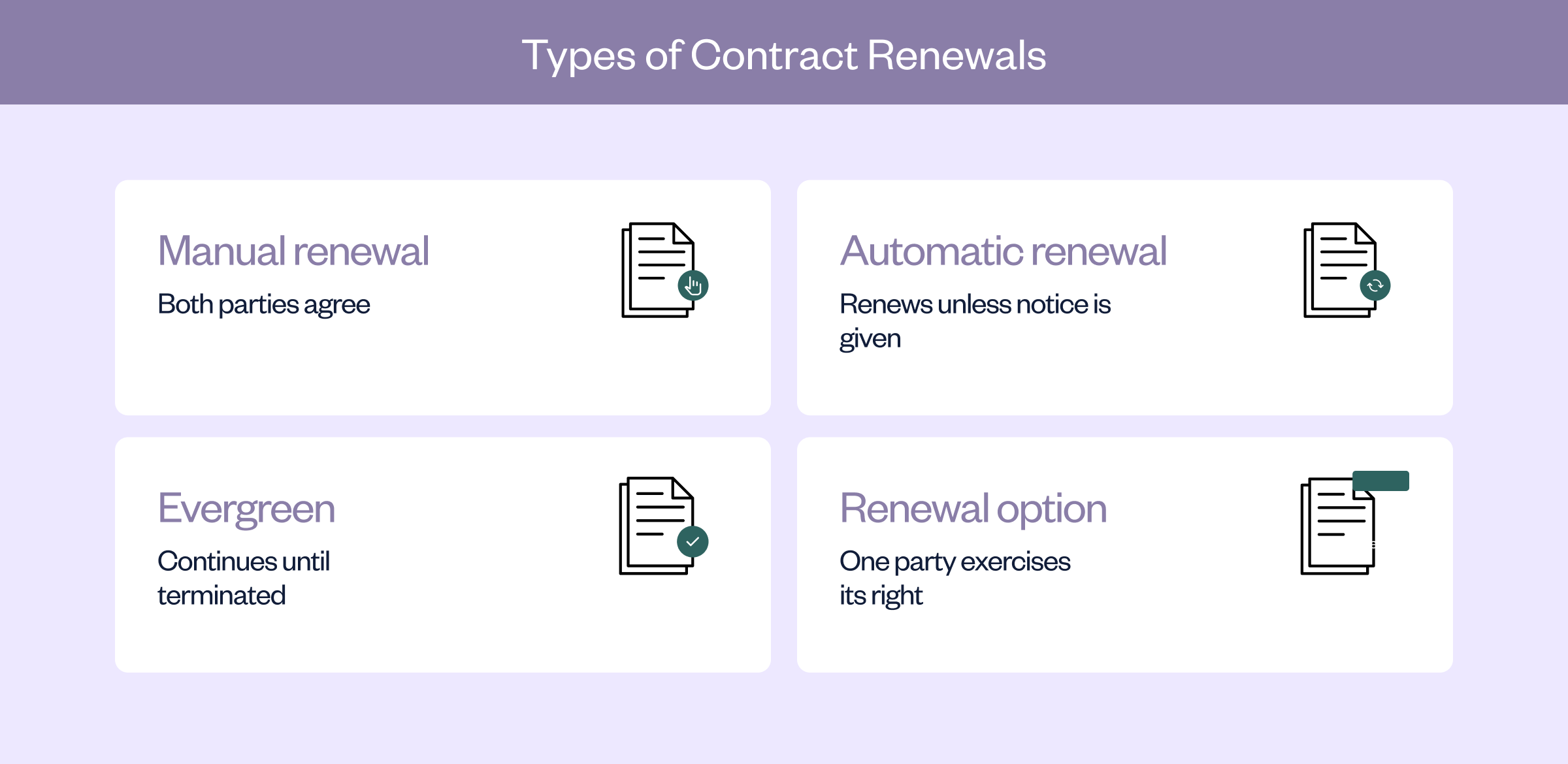
Most contracts renew in one of four ways. The type is set in the contract, so check it long before the term ends.
Type
How It Works
Pros
Cons
Manual renewal
Both parties must actively agree to a new term
Forces a fresh review
Easy to let lapse by accident
Automatic renewal
The contract renews for a set term unless someone gives notice
No gap in service
Can lock you into bad terms
Evergreen
The contract keeps rolling until someone ends it
Low admin effort
Terms can go stale for years
Renewal by option
One party has the right to renew on agreed terms
Gives the holder control
The other side may lose leverage
How Does the Contract Renewal Process Work?
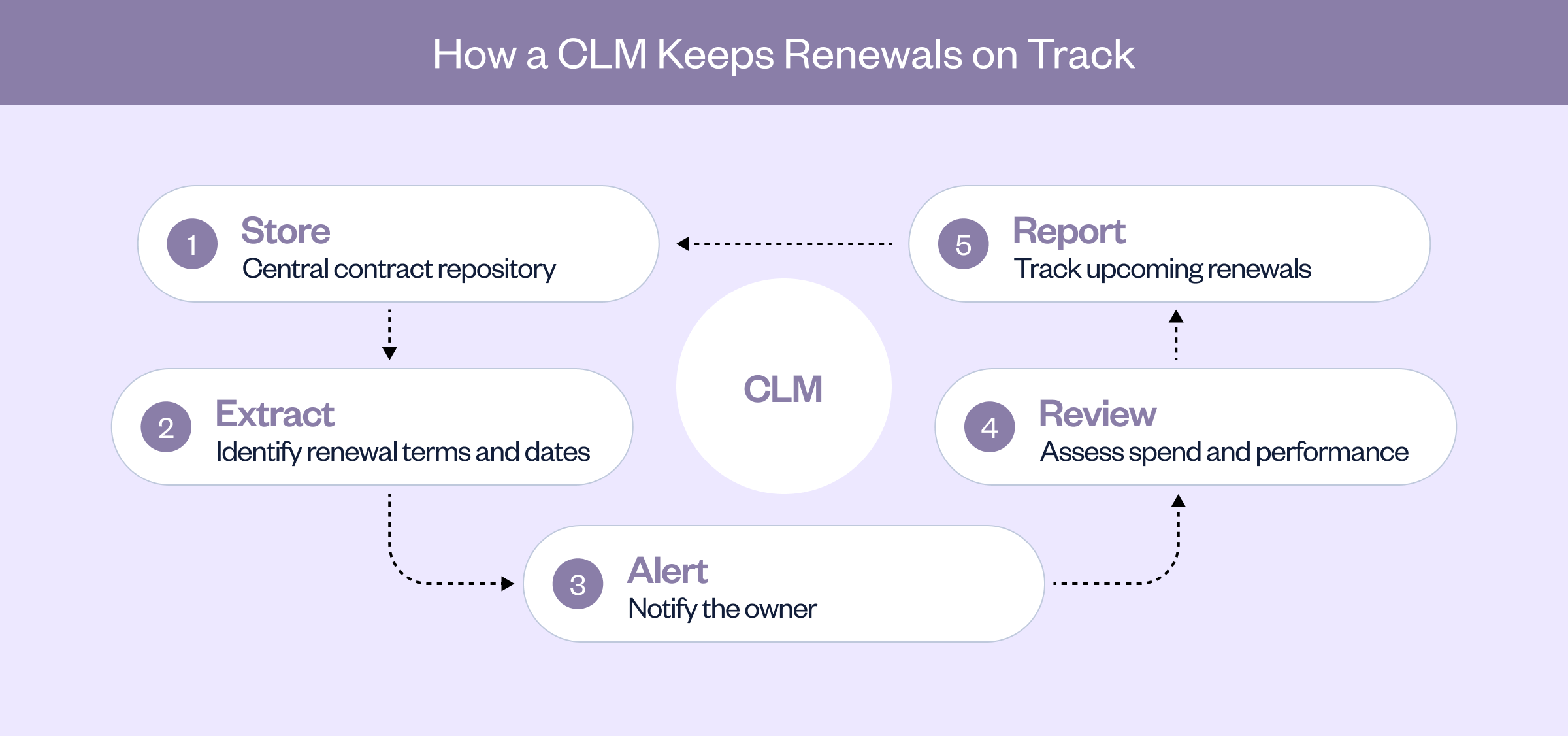
A good contract renewal process has five stages, and Legal shouldn't run it alone. Business owners know how the vendor or customer is performing, while Legal knows the terms and the risks.
Start by pulling three facts from each contract: the renewal date, the notice period and whether it auto-renews. The notice period is how much warning one party must give the other before the term ends.
Then name one accountable owner for each renewal, even when several teams weigh in.
#2 Review Terms and Performance
Look at the renewal term, which is the length of the next period, plus pricing, scope and any price escalators. Check SLAs, liability caps and data protection terms against your current policies.
Next, compare what you pay for with what you use, and ask the business owner whether the vendor delivered.
#3 Decide: Renew, Renegotiate, Extend or Terminate
Now make the call. The renewal of a contract should be a deliberate choice among four paths:
Renew: Keep the deal on current terms when performance and pricing still work.
Renegotiate: Reopen terms when the partner fits, but the deal doesn't.
Extend: Buy short-term time when you need it before a final call.
If you plan to renew the contract on new terms, bring your data to the table. Usage reports, missed SLAs and market pricing give you leverage that opinions can't.
Share redlines, which are your proposed edits to the text, and route them through your normal approvals. For tactics and talking points, see our contract renewal strategy guide.
#5 Execute, Store and Set the Next Reminder
Sign the renewed contract and store it where your team can find it. Update its metadata, the key data fields like dates, parties and values, so reports stay accurate.
Finally, set reminders for the next cycle the day this one closes.
When Should You Start the Contract Renewal Process?
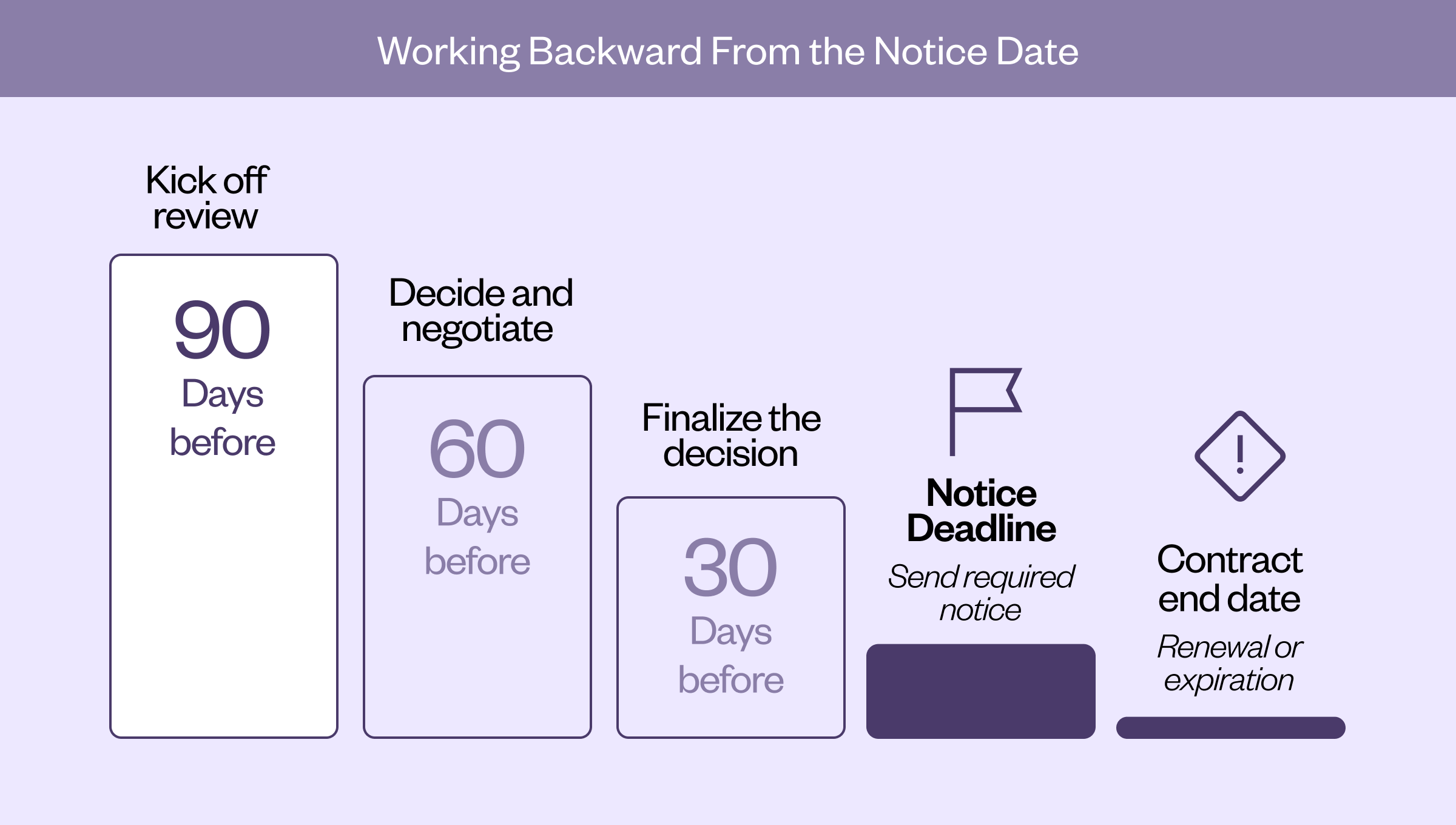
We recommend starting at least 90 days before the notice deadline, not the end date. That's about 13 weeks, which leaves room to review, decide and negotiate without rushing.
Here's why the notice date matters most. Say your contract ends December 31 and requires 60 days' notice. Your real deadline is November 1, so a 90-day runway means kicking off around August 3.
Miss November 1 on an auto-renewing deal, and you may be locked in for another full term. To get the math right every time, learn how to calculate a contract's end date and its notice date.
Also check the notice clause for the required method, such as certified mail or email, and the address it must go to.
What Are the Most Common Contract Renewal Challenges?
Most renewal problems come from process gaps. These are the ones legal teams hit most often:
Missed deadlines: Notice windows pass quietly when no one is tracking them.
Unwanted auto-renewals: Contracts roll over on terms you'd never sign again.
Poor visibility: Signed contracts sit in inboxes, drives and folders, so no one sees the full picture.
Last-minute negotiations: Late starts leave you with little leverage and few options.
Unclear ownership: Legal assumes the business is watching, and the business assumes Legal is.
Poor visibility often drives the rest. When contracts live in scattered places, renewal dates surface only when someone happens to remember.
The good news? A few habits prevent most renewal problems.
Track auto-renewal as its own field: Flag every auto-renewing contract so you can filter for them in seconds.
Fix renewal terms at signing: Negotiate shorter notice periods and price-increase caps before the first term starts.
Review a monthly renewal pipeline: Use contract analytics dashboards to see which contracts renew in the next two quarters.
Bring finance and procurement in early: They hold spend and usage data you'll need in negotiations.
Record every decision: Note why you renewed, renegotiated or ended a deal, so the next owner has context.
Use this checklist each time you renew a contract:
Checkpoint
What to Confirm
Typical Owner
Dates
End date, renewal term and notice deadline
Legal or legal ops
Auto-renewal
Whether it renews automatically and how to opt out
Legal
Notice method
Required format, address and delivery method
Legal
Commercials
Pricing, escalators, usage and unused seats
Finance or procurement
Performance
SLA results and business owner feedback
Business owner
Risk terms
Liability, data protection and security terms
Legal
Close-out
Signed copy stored and next reminder set
Legal ops
What Tools Help With Contract Renewal Management?
Spreadsheets work for a few dozen contracts and one careful owner. As volume grows, they break down, because someone must enter every date by hand and remember to look.
A dedicated tool keeps the data and the reminders in one loop. Here's how the pieces fit together.
Centralized Contract Repository
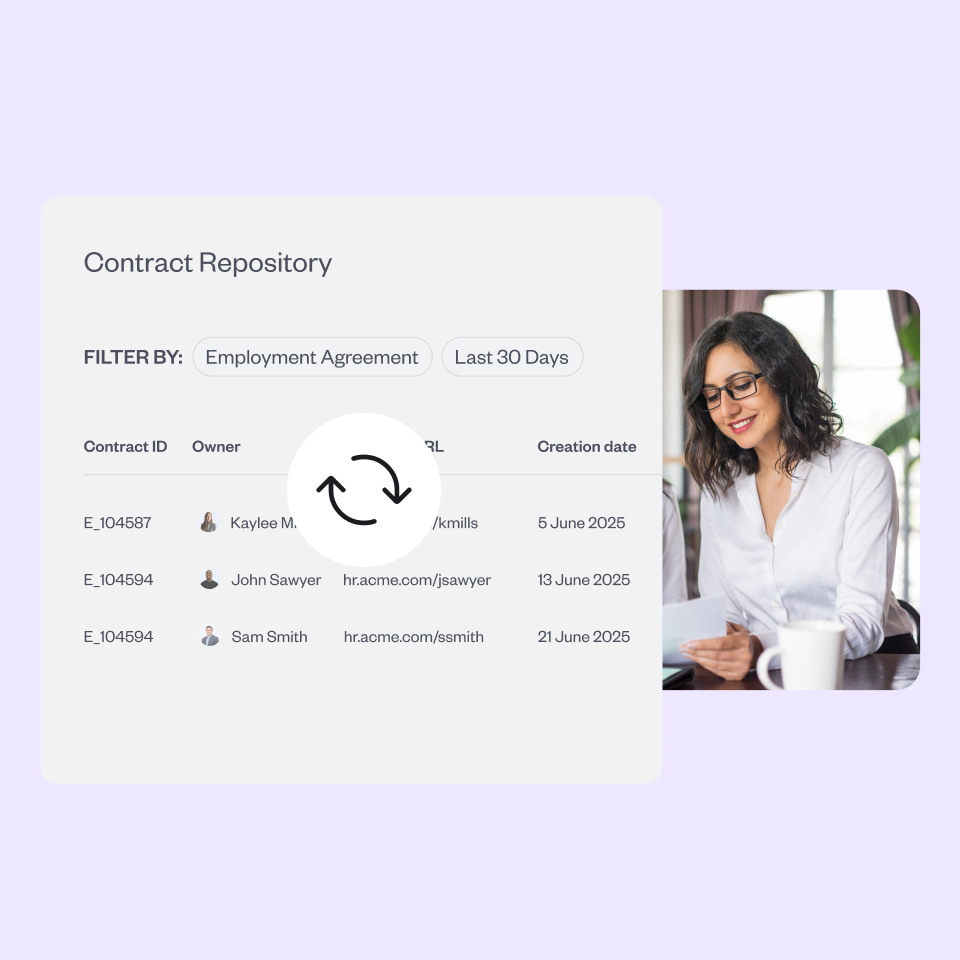
A repository gives you one source of truth for every signed agreement. With a searchable contract repository, you can filter by renewal date, party or contract type instead of digging through drives. According to its product page, SpotDraft's repository can extract over 1,000 types of metadata properties from contracts, so those filters stay complete.
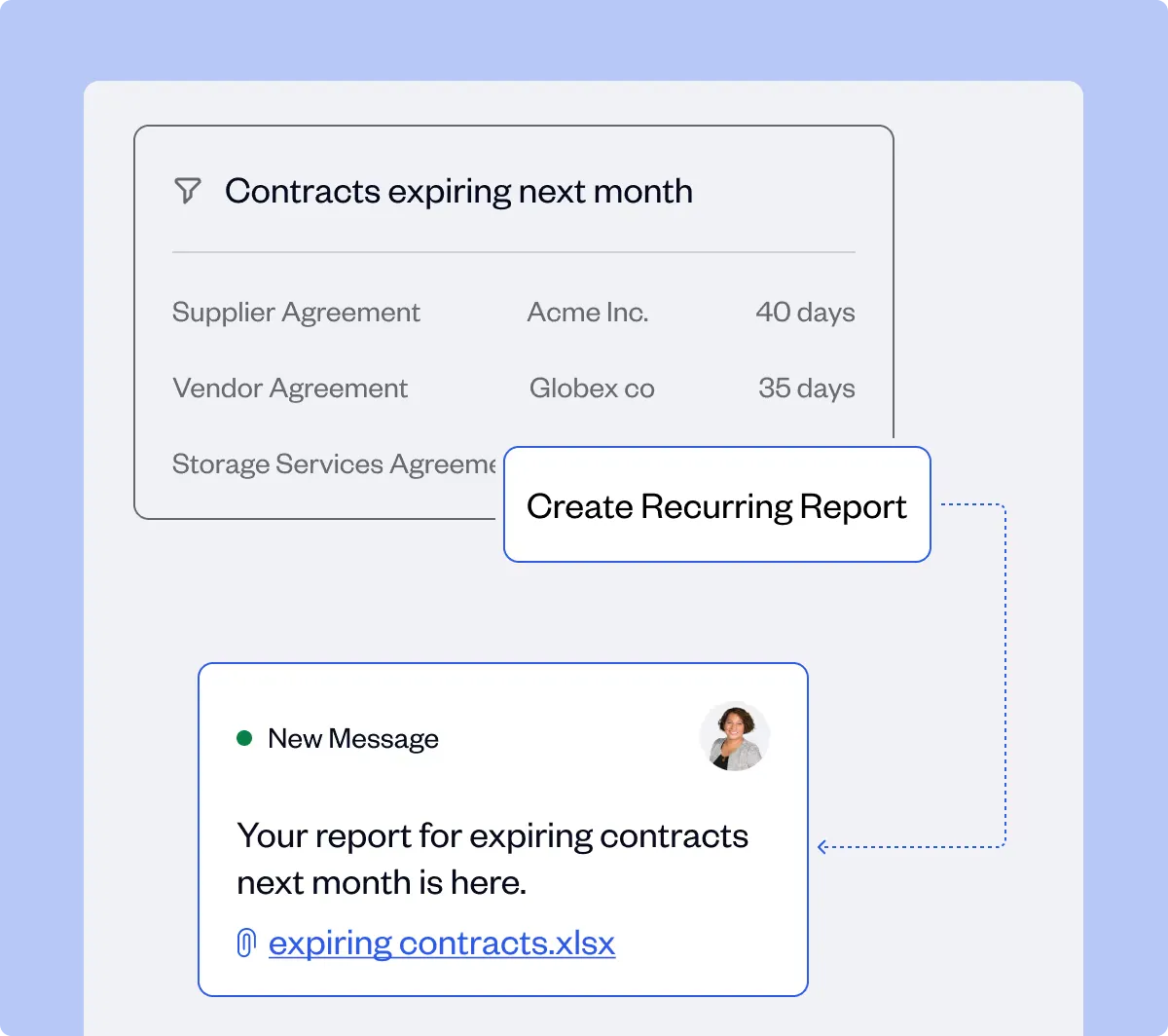
At UrbanVault, the team also gets weekly reports of key deadlines and reminders.
“Thanks to SpotDraft, all the information we need is in one place. Once a deal is closed, even the finance team is notified so they can raise invoices accordingly. We also have visibility on which leases are expiring and need renewal. It is so convenient.”
Simran Chanda
Marketing Manager, UrbanVault
Automated Reminders and Alerts
Alerts work best when they count down to the notice deadline. A good rule of thumb: send them to the named owner and a backup at 90, 60 and 30 days out.
Older contracts often have renewal terms buried in the text. AI-powered key date extraction pulls key dates and renewal clauses from contracts.
Full contract lifecycle management (CLM) software connects drafting, negotiation, signature and storage. That way, renewal data stays linked to the deal that created it.
After Two Failed CLMs, Astronomer Finally Found One That Stuck:
"SpotDraft is the anchor in our contracting process. It unified everything — drafting, negotiation, signature, repository — all in one place. And it works where our teams already work."
Nicole Ducharme
Director of Legal Operations & Contracts, Astronomer
Conclusion: Make Every Contract Renewal a Deliberate Decision
Every contract renewal is a recurring chance to cut costs, fix terms and keep the right partners.
Anchor on the notice date and give yourself about 90 days of runway. Run the five stages with a named owner, and back them with a repository, alerts and dashboards.
Want to see how legal teams keep every renewal on track? Request a demo.
Frequently Asked Questions
How Many Weeks Before Renewal Should You Start?
How Do You Renew an Agreement?
How Do You Get Out of an Automatic Renewal Contract?
What Happens If You Miss the Notice Deadline?
What's the Difference Between Auto-Renewal and Evergreen?
Is a Renewed Contract a New Contract?
Related content
latest
Mastering Business Contracts: A Complete Guide
Learn what a business contract is, the key types and elements that make one binding, and how to use them to protect your business. Start with the basics.
“Before using SpotDraft, executing a contract would take up to weeks. Now, contracts are signed within minutes, with better data security and tracking. The whole process takes us less than a day!”
Arti Singh
Founder’s Office, Growth, UrbanVault
“Before using SpotDraft, executing a contract would take up to weeks. Now, contracts are signed within minutes, with better data security and tracking. The whole process takes us less than a day!”


.webp)





.webp)