Contract drafting is the process of writing a legally enforceable document that defines the rights, obligations, and terms governing a business relationship between two or more parties.
How do you draft a contract step by step?
Identify the parties, define the scope of the agreement, outline payment terms, address warranties, include dispute resolution and governing law, protect confidentiality, and define termination conditions, add standard boilerplate clauses, and route the draft through a review process before signature.
What is the correct format for a contract?
A standard contract format includes a title and preamble identifying the parties, recitals explaining background and purpose, a definitions section, the operative clauses covering scope and obligations, boilerplate provisions, and a signature block.
How long does it take to draft a contract?
It depends heavily on complexity, but marketplace data from ContractsCounsel puts the average turnaround for drafting a business contract from scratch at around 7 working days. Automated drafting using pre-approved templates typically cuts that down significantly.
Do you need a lawyer to draft a contract?
Not always for simple, low-stakes agreements, but contracts involving significant money, IP, or long-term obligations benefit from legal review to make sure enforceability and risk allocation are handled correctly.
Krishnapriya Agarwal is an Ex-Content Marketing leader at SpotDraft and an experienced marketing professional with a strong background in digital marketing, content strategy, and team management. She has led content teams and driven SEO-focused initiatives to support business growth.
TL;DR
Contract drafting is the process of writing a legally enforceable agreement that defines each party's rights, obligations, and the terms governing their relationship.
A standard contract drafting format includes parties, recitals, definitions, scope, payment terms, warranties, dispute resolution, governing law, and signature blocks, in that order.
Missing a single provision, like a termination clause or governing law, can leave part of a contract unenforceable or push a disagreement straight into litigation.
Automated drafting using pre-approved templates cuts contract turnaround dramatically compared to drafting each clause manually from scratch.
A 10-item drafting checklist, covered in full below, catches the gaps that manual drafting under deadline pressure tends to miss.
What Is Contract Drafting?
Contract drafting is the process of creating a legally enforceable document that outlines the rights and obligations of parties involved in a business relationship. It involves defining key elements such as scope of work, payment terms, warranties, and dispute resolution mechanisms to make sure every promise is clearly stated and protected against potential risk or disagreement.
According to Tonya Reynolds' article on the five pillars of contract drafting, clear and precise contract language helps ensure that all parties understand their rights, obligations and remedies while reducing ambiguity and the risk of multiple interpretations.
What Is a Contract Drafting Checklist?
A contract drafting checklist is a structured tool used by legal professionals, contract managers, and business owners to make sure nothing important gets missed when creating or reviewing a contract. It highlights key considerations and common pitfalls at every stage of drafting, the same function a contract review checklist serves on the reviewing side of the process.
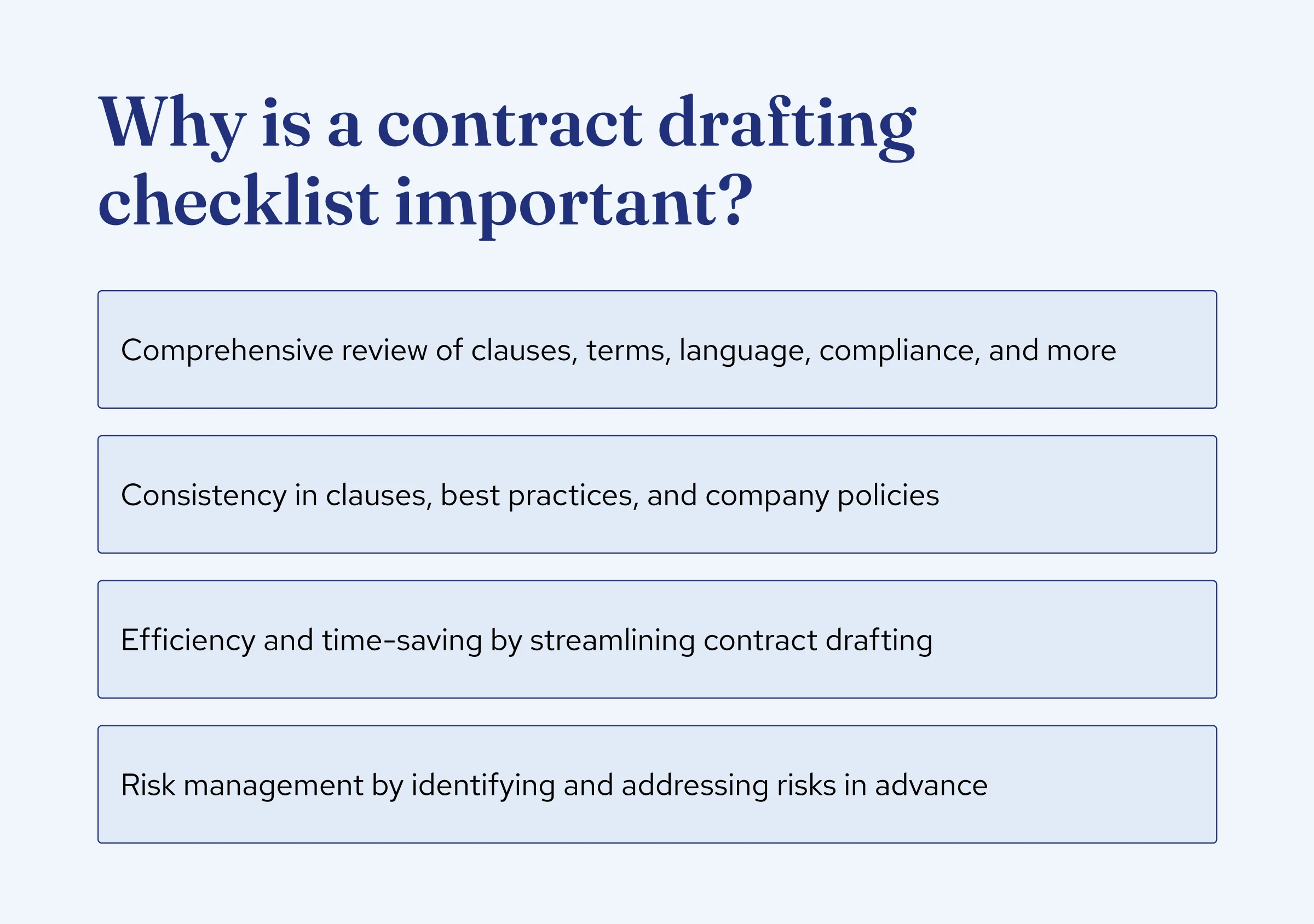
Why Is a Contract Drafting Checklist Important?
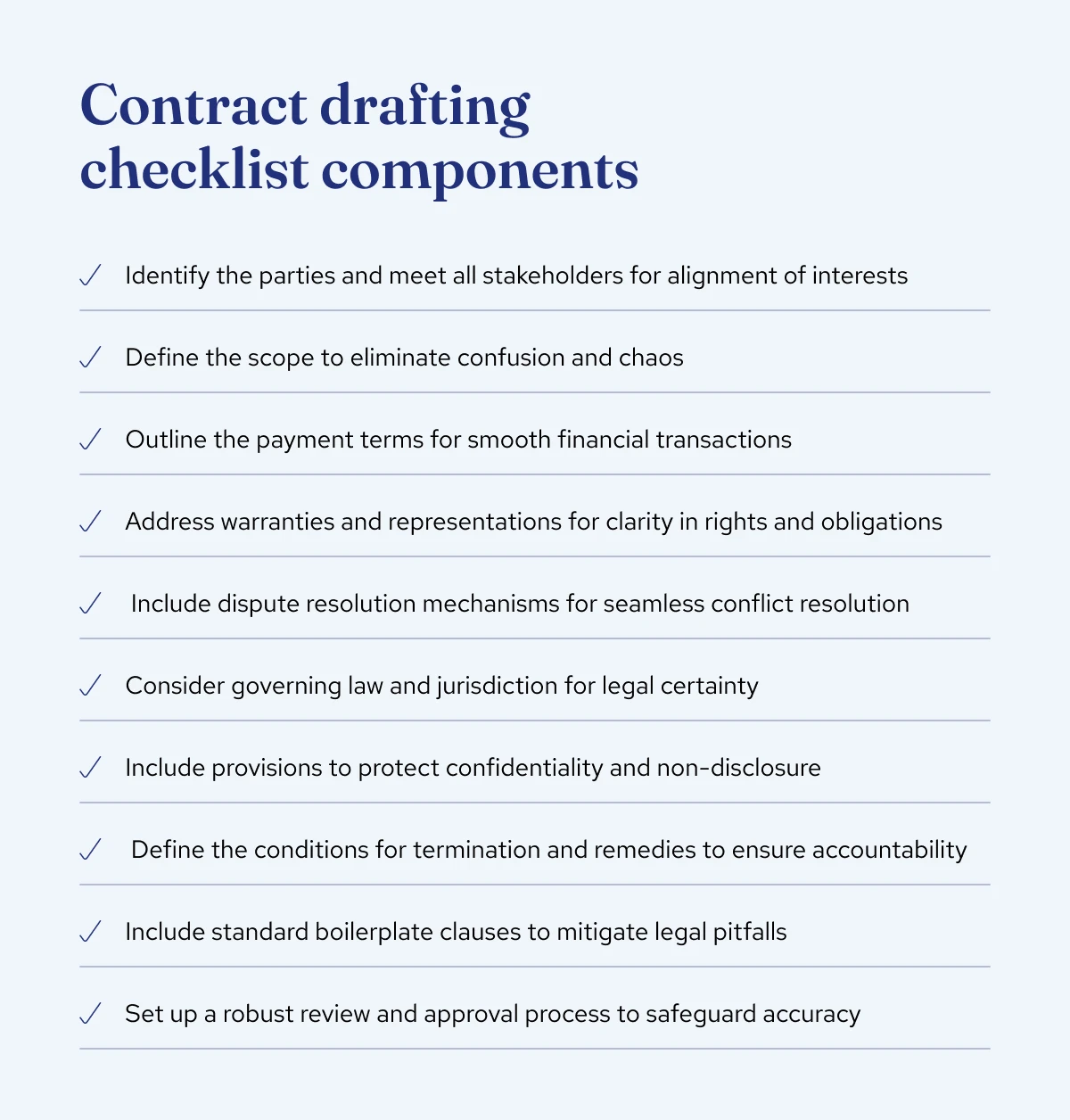
The 10-Item Contract Drafting Checklist
Identify the parties. Full legal names, contact details, and authorized signatories for every party involved.
Define the scope. Purpose, objectives, deliverables, and timelines, stated clearly enough to prevent scope creep.
Outline payment terms. Exact amounts, deadlines, invoicing details, and any late payment penalties.
Address warranties and representations. Quality standards, disclaimers, limitations of liability, and remedies for breach.
Include dispute resolution mechanisms. Whether that's negotiation, mediation, arbitration, or litigation, covered further in our guide on resolving contract disputes.
Specify governing law and jurisdiction. Which legal framework applies, especially important for cross-border agreements.
Protect confidentiality. Clear obligations and restrictions around sensitive information, detailed further in our NDA guide.
Define termination conditions. Notice periods, breach consequences, and what happens to obligations after the contract ends.
Include standard boilerplate clauses. Force majeure, assignment, entire agreement, and amendment clauses that protect against edge cases.
Set up a review and approval process. A structured process, not an ad hoc email chain, before anyone signs.
Why Does Each Checklist Item Actually Matter?
Missing party identification can leave the enforceability of a contract in question. An undefined scope invites scope creep and disputes over deliverables. Vague payment terms create cash flow uncertainty and strained relationships.
Skipping warranties leaves both sides exposed to undefined liability. No dispute resolution clause means disagreements default to expensive litigation, and litigation isn't cheap: research from ContractsCounsel's marketplace data shows the average turnaround time to draft a business contract from scratch runs about 7 working days, and that's before factoring in the delays that come from a gap discovered mid-negotiation.
Missing governing law creates uncertainty about which rules even apply. Weak confidentiality provisions risk your competitive edge. Undefined termination conditions turn an exit into a legal mess. Skipped boilerplate clauses leave fundamental scenarios, like force majeure events, open to interpretation. And no review process means errors reach signature stage instead of getting caught beforehand, which is exactly the gap Aditi Kapoor, Director of Legal at Gameskraft, described before her team adopted a structured drafting and review workflow:
"Before we onboarded a CLM tool, we relied on emails. Contracts were scattered everywhere, making it hard to locate a specific contract when needed." After standardizing the process, her team reported saving over 10 hours a week, with contract lifecycle efficiency up 70-75%.
Manual vs. Automated Contract Drafting
Manual contract drafting involves building agreements clause by clause, relying on individual legal diligence and traditional processes. Automated contract drafting uses pre-approved templates and software workflows to increase speed, ensure consistency, and reduce risk.
Factor
Manual Drafting
Automated Drafting
Time
Slow, clause by clause
Fast, using pre-approved templates
Consistency
Prone to error and variation
Standardized across every contract
Legal knowledge required
High
Lower, since frameworks are pre-set
Risk mitigation
Depends on the drafter's diligence
Built into standardized clauses
Cost
Higher legal resource cost
Lower over time
Arti Singh from UrbanVault's founder's office described what that shift looked like in practice:
"Before using SpotDraft, executing a contract would take up to weeks. Now, contracts are signed within minutes, with better data security and tracking. The whole process takes us less than a day!"
Read the full UrbanVault story for more on how a small legal team scaled contract volume without adding headcount.
What Are the Best Practices for Contract Drafting?
Use templates. They give you a solid starting point and reduce the odds of missing important provisions.
Keep the checklist handy. Even experienced contract managers miss details under deadline pressure. One G2 reviewer of SpotDraft's platform put it plainly:
"SpotDraft makes contract management exceptionally smooth and efficient. Its clean interface, AI-powered drafting, and automated workflows save significant time while ensuring consistency across documents." (full review on G2)
Draft with a business-first mindset. Balance legal caution with what actually helps the deal move forward.
Define key terms upfront. A clear definitions section prevents misinterpretation later in the document.
Think ahead of scenarios. Anticipate missed deadlines, breaches, or changes in law, and build provisions that address them before they happen. This is also where AI in contract drafting is changing the baseline, since AI tools can flag missing standard provisions against a playbook automatically, catching gaps a rushed manual draft might not.
Draft Contracts Automatically With SpotDraft
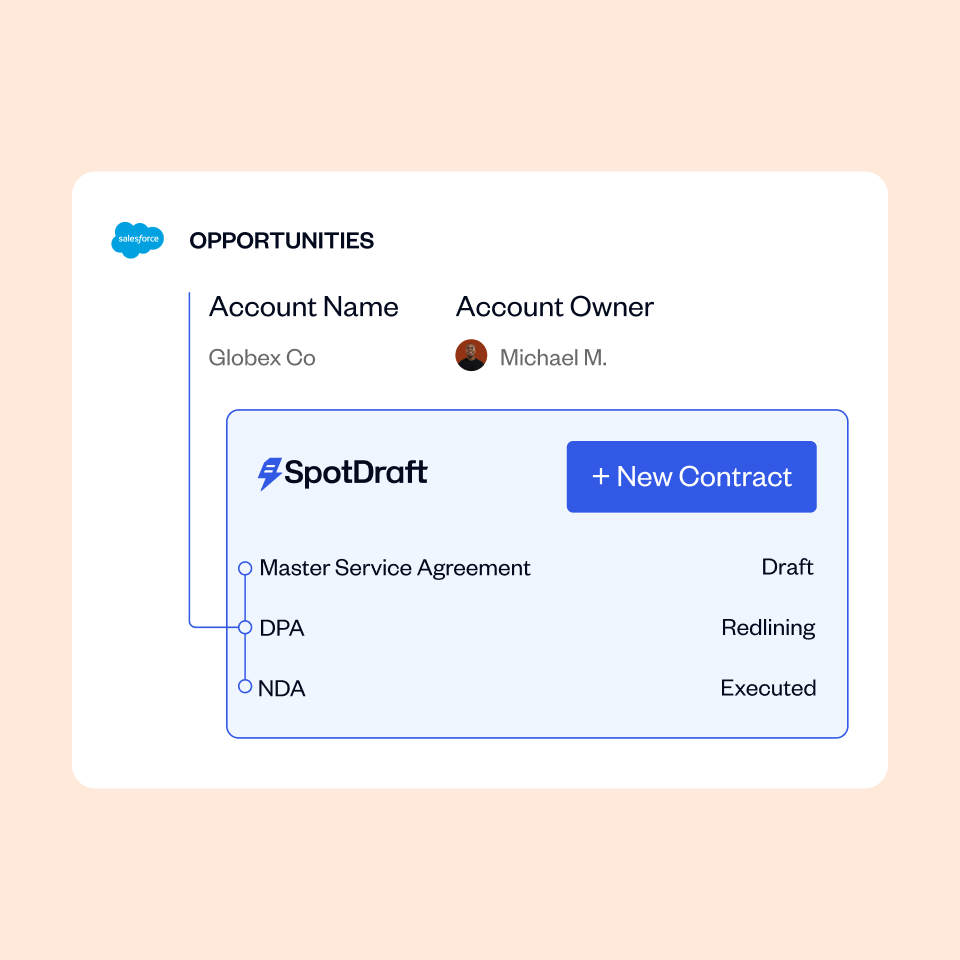
SpotDraft lets you select a pre-approved template, fill in party and counterparty details, and answer a short questionnaire to generate a fully drafted contract with the right legal guardrails built in. From there, VerifAI reviews the draft automatically, and a structured approval workflow keeps it moving without stalling in someone's inbox.
Once you've drafted a few contracts this way, pairing your checklist with a contract playbook turns your standards into something your whole team can use consistently, not just legally. Request a demo to see it in action.
Frequently Asked Questions
What is contract drafting?
How do you draft a contract step by step?
What is the correct format for a contract?
How long does it take to draft a contract?
Do you need a lawyer to draft a contract?
Related content
latest
Contract management ROI: a framework for building the business case for CLM
A systematic approach to turning contract data into a budget decision, not a slide deck.


.avif)