You could face penalties, service credits, lost rights or a breach claim, depending on the contract. Log the miss right away, notify the other party if the contract requires it and agree on a fix.
What Is Contract Obligation Management Software?
It’s software that identifies the duties in signed contracts, assigns each one an owner and a due date, and tracks completion. Most tools also send reminders and store proof that the work was done.
Can Obligations Change Over Time?
Yes, amendments, renewals and new laws can all add, remove or change obligations. Update your obligation records the same day any change is signed.
Who Is Responsible for Contract Obligation Management?
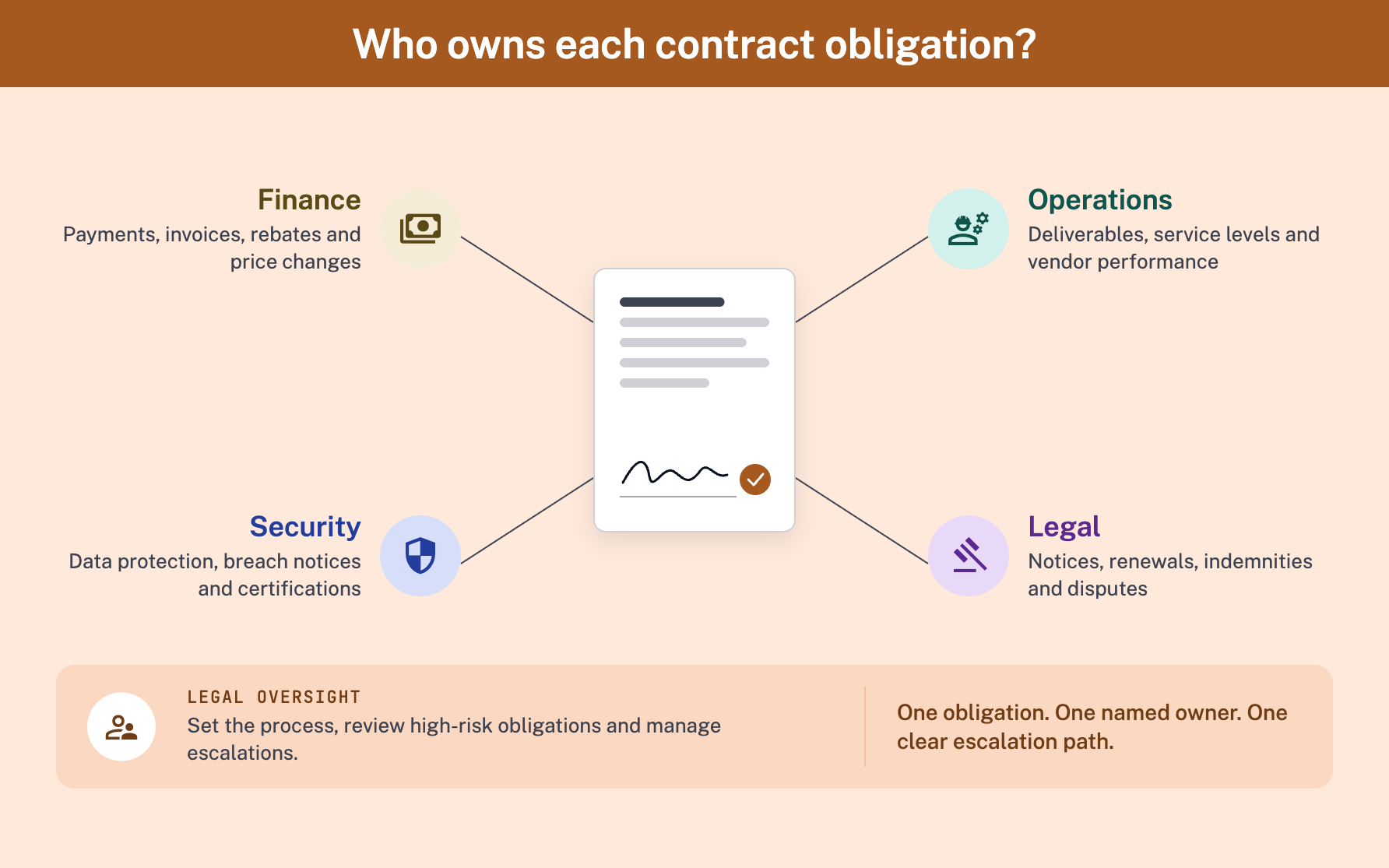
Legal or legal ops usually owns the process, while business owners in Finance, Ops or Security do the actual work. Each obligation should have one named owner and a clear escalation path.
How Often Should You Review Obligations?
Review high-risk obligations at least quarterly and lower-risk ones at least once a year. Recheck any contract right after an amendment or renewal.
Does Obligation Management Help With Renewals?
Yes, it surfaces notice windows early, so you can renegotiate, renew or cancel on your terms. It also shows whether the other party delivered, which gives you leverage in the next deal.
Huzaifa Sultana is a Marketing Associate at SpotDraft, specializing in organic growth, SEO, and AEO. Her work focuses on content optimization, keyword research, and developing strategies to improve search rankings and organic visibility.
TL;DR
It's post-signature work: Contract obligation management gives every promise in a signed contract an owner, a deadline and proof.
Skipping it costs real money: Missed renewals, SLA credits and penalties drain value long after the deal closes.
Tracking is only the first layer: Tracking shows what's coming up, while management makes sure someone delivers it.
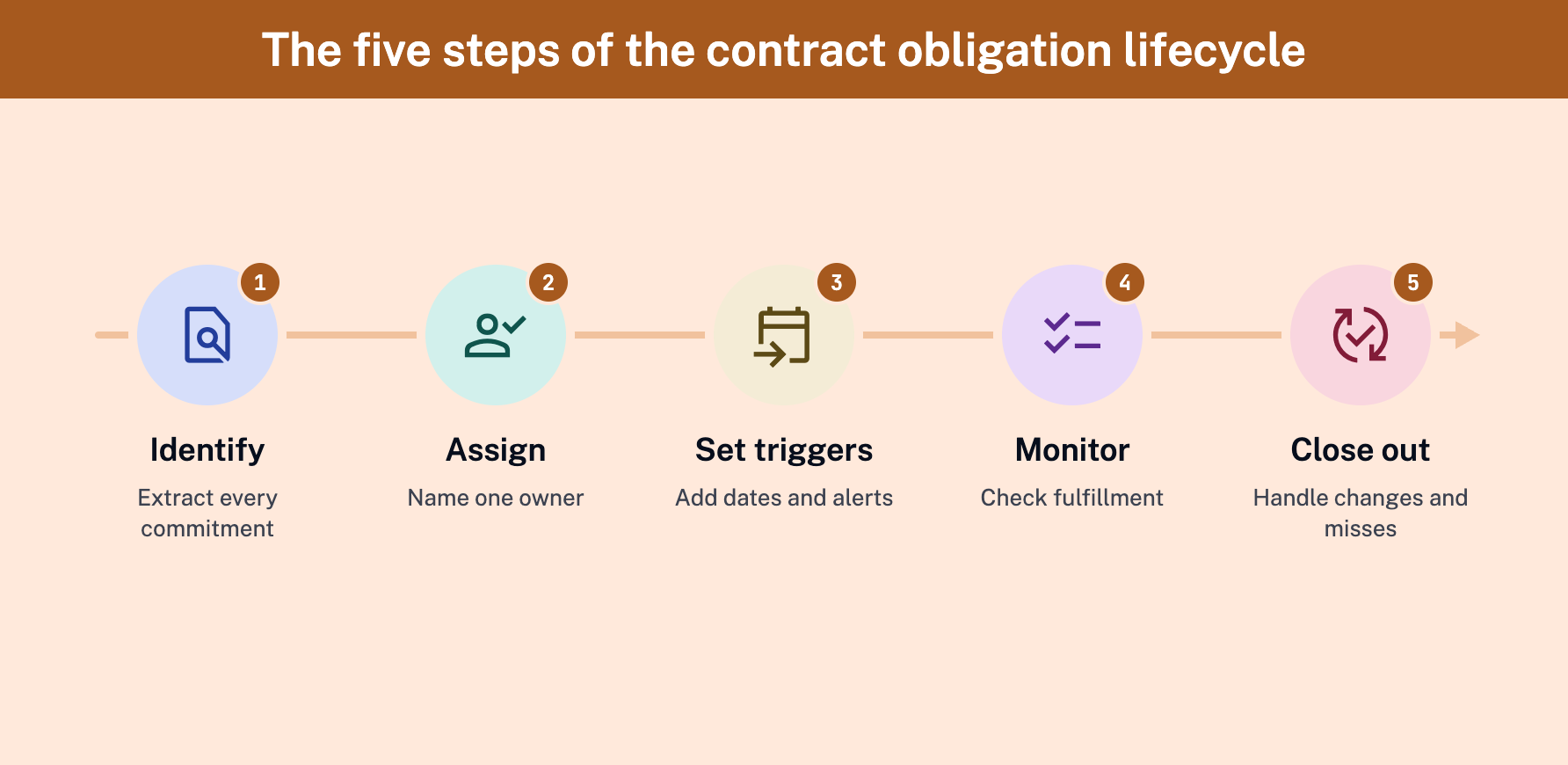
The lifecycle has five steps: Identify, assign, set triggers, monitor, then handle changes through close-out.
Owners mostly sit outside Legal: Finance, Ops and Security do most of the work, while Legal sets the rules and checks the proof.
Spreadsheets don't scale: One searchable repository with alerts beats data spread across shared drives.
AI speeds up extraction: Let AI pull the terms, then have Legal spot-check the output.
You signed the contract. Now someone has to do what it says. That's the job of contract obligation management, and it's where a lot of legal teams quietly lose money.
Every agreement is a stack of promises. You promised to pay on time, send reports, protect data and give notice before you cancel. The other side promised uptime, delivery dates and credits when they fall short.
Once the deal closes, those promises scatter across inboxes, spreadsheets and people's memories.
In this article, you'll get a five-step lifecycle and a clear split between tracking, management and compliance. You'll also get practices that keep Legal in control while business owners do the work.
What Is Contract Obligation Management?
Contract obligation management is the process of identifying, assigning, monitoring and proving fulfillment of every commitment in your signed contracts. It covers what your company owes and what the other party owes you. Done well, it gives each obligation a clear owner, a due date and proof that the work happened.
Obligation management picks up where most of the contract lifecycle leaves off: the moment the ink dries. Drafting, negotiation and signature get most of the attention. But a deal only pays off when both sides deliver.
It also covers both parties. Your side owes payments, reports and notices. The counterparty owes services, deliverables and credits, and you need to check that they deliver too.
That's why contract obligation management works as a process. Each obligation needs a named owner, a trigger to act and evidence that the work is done.
Why Does Contract Obligation Management Matter?
Contract obligations rarely fail loudly. Missed obligations are one of the quietest costs of poor contract management, because nobody notices until a penalty or a dispute shows up.
The numbers back this up. WorldCC research found that the average business loses almost 9% of value annually through poor contract management.
WorldCC and Ironclad research on procurement contracts points to 11% value leakage. Organizations lose an average of 11% of contract value, mostly after signature, and most don't formally track it (procurement contracts only).
Here's where that value usually slips away:
Missed renewals: A contract rolls over at old pricing because no one sent notice in time.
Penalties and SLA credits: You pay credits you owe, or forget to claim the ones you're owed.
Disputes: When nobody can prove what was delivered, small gaps turn into legal fights.
Damaged relationships: Late reports and missed deliverables wear down trust with customers and vendors.
Unused savings: Discounts, rebates and price caps go unclaimed because no one remembers they exist.
Auto-renewal clauses are the classic example: miss the notice window by a day and you're locked into another year. Beamery's legal team knows that pain well.
How Is Obligation Management Different From Tracking and Compliance?
These three terms often get used as if they mean the same thing. They overlap, but each one answers a different question.
Contract tracking answers, "Where is this contract and what's coming up?" while obligation management answers, "Who's doing what we promised, and can we prove it?" Some teams lump both together as contract obligation and tracking management, which works as long as you know which job you're doing.
Contract compliance is the wider goal of both parties sticking to the agreed terms, and obligation management is the day-to-day work that gets you there.
Here's how the three compare.
Contract tracking
Obligation management
Contract compliance
Goal
Know where every contract stands
Get every promise delivered on time
Keep both parties within the agreed terms
Question it answers
What's coming up?
Who's doing what, and can we prove it?
Are both sides following the contract?
Typical owner
Legal ops or contract admins
Named business owners, with Legal oversight
Legal, compliance and risk teams
Output
Dates, statuses and alerts
Assigned tasks, status updates and evidence
Audit reports and corrective actions
In short, tracking feeds management and management produces the proof compliance needs. Skip the middle layer and you'll have dates on a calendar with nobody accountable for them.
What Does the Contract Obligation Lifecycle Look Like?
The contract obligation lifecycle runs from the day you sign to the day the contract closes out. It breaks into five steps, and each one hands off cleanly to the next.
#1 Identify and Extract Every Obligation
You can't manage what you haven't found. Start by reading each signed contract and pulling out every duty for both sides.
Ask four questions for each obligation:
What: The specific action, like delivering a quarterly usage report.
Who: The party that owes it, whether that's you or the counterparty.
When: The due date or the event that triggers it.
Conditions: Any caps, exceptions or dependencies that change the duty.
Log the answers in an obligation register, with one row per obligation. Good metadata extraction turns each obligation into structured fields, like party, due date and trigger, that you can filter and report on.
#2 Assign a Named Owner
The party in the contract isn't the person doing the work. Your company owes the security report, but someone on your security team has to send it.
That gap is common. A 2025 CCM Institute benchmark found that 70-80% of businesses lack a single point of clarity for contracting performance.
Route each obligation by type:
Finance: Payments, invoices, rebates and price changes.
Operations: Deliverables, service levels and vendor performance.
Security: Data protection, breach notices and certifications.
Legal: Notices, renewals, indemnities and disputes.
Then set an escalation path. If the owner doesn't act by a set date, the task goes to their manager and then to Legal.
#3 Set Deadlines, Triggers and Reminders
Obligations follow two kinds of triggers. Date-based ones fall on a fixed day, like a renewal notice due before the term ends. Event-based ones start when something happens, like a data breach or a missed service level.
Date-based obligations line up with contract milestones, so map them on the same timeline your team already watches. Recurring duties, like monthly reports, need a schedule that repeats instead of a single date.
Tie each obligation to tasks and reminders that fire well before the due date, not on it. SpotDraft's Obligations feature, currently in beta, lets you set an assignee, a due date and up to five reminders per obligation.
Expiry dates matter just as much. A public US university learned this the hard way.
"It was difficult to track contract expirations. Coaches would end up working with us beyond contract expiration and settlements would become tricky"
For this university's legal team, a missed expiry date meant coaches kept working past their contracts and settlements got messy.
#4 Monitor Fulfillment
Once owners have their tasks, tracking contract obligations means watching the status of each one. Keep the status values simple:
Open: The owner hasn't started yet.
In progress: The owner is working on it.
Met: The work is done, with evidence attached.
Missed: The deadline passed without completion.
Waived: The other party formally released the duty.
Check the counterparty's performance as well as your own. Monitoring fulfillment is where obligation work overlaps with contract performance management, since both ask whether the deal is delivering what it promised.
#5 Handle Changes, Breaches and Close-Out
Contracts change after signature, and obligations change with them. A contract amendment can quietly change a deadline or add a new duty, so update the obligation record the same day it's signed.
When an obligation is missed, log it, tell the right people and agree on a fix. That might be a cure period, a service credit or a revised plan.
At expiry, close out every open item, like final reports, data return or deletion. Then carry what you learned into the renewal, so the next version of the deal is easier to deliver.
How Does Contract Obligation Compliance Management Work?
Managing obligations gets the work done. Compliance is about proving it to auditors, regulators, the board or the other party.
Proof starts with evidence. Attach the report, invoice or confirmation email to the obligation itself, and keep an audit trail of who did what and when.
Build your compliance routine on four habits:
Evidence: Store proof of completion next to each obligation.
Risk scoring: Rank obligations by impact so the costliest misses get the most attention.
Regulatory focus: Flag duties tied to data protection and other laws for extra review.
Periodic reviews: Check high-risk obligations on a set schedule, like every quarter.
Score obligations by contract risk, putting regulatory and high-dollar duties at the top of the review queue. A simple contract audit checklist helps you test whether each high-risk obligation has an owner, a date and proof of completion.
In a 2022 WorldCC and Deloitte study, the Deloitte post-award survey found that only 34% of surveyed organizations were working on more robust obligation management.
How Does AI Help With Contract Obligation Management?
Manual extraction is slow, and it's where most errors creep in. AI changes the first step of contract obligation management the most.
The same models used in AI contract review can read signed agreements and pull out who owes what, and by when. They can also compare an amendment to the original and flag what changed.
Contract data extraction works best when Legal spot-checks the output instead of copying terms by hand. Keep a human in the loop for anything high-risk or unusual.
Here's where AI helps most:
Extraction: Pull dates, parties, renewal terms and duties from every signed contract.
Spot-checks: Give Legal a quick review step to correct edge cases.
Change detection: Flag new or changed obligations when an amendment is signed.
Portfolio questions: Ask which contracts auto-renew next quarter and get answers across every agreement.
Zeplin's legal team used to pull key terms like effective date, term length and auto-renewal by hand. Now AI handles the abstraction, and Legal spot-checks the output.
"Since we have been using SpotDraft as a repository, I know it has access to our data and documentation. So the analysis I get from Sidebar is specific and unique to us."
Zeplin's experience shows why AI answers get sharper when they draw on your own repository.
What Should You Look for in Contract Obligation Management Software?
Contract obligation management software finds the commitments inside signed contracts, gives each one an owner and a due date, and keeps proof that the work happened. So the best test of any tool is whether it supports the five lifecycle steps above, not how long its feature list is.
Most comparisons stop at features. It usually helps to ask what happens after signature instead. These checks can sort the options quickly:
What to check
Why it matters
Obligation extraction
Shows whether the tool can pull duties, dates and parties from signed contracts, and whether Legal can review and correct each field
Named owners
Lets you assign obligations to Finance, Ops or Security, not just Legal
Dates, triggers and reminders
Supports fixed dates, recurring duties and event-based triggers, with alerts before the due date
Escalation
Sends overdue tasks to a manager and then to Legal
Evidence and audit trail
Keeps proof of completion attached to each obligation
Amendment handling
Updates obligations when a contract changes
Reporting
Shows overdue items and fulfillment rates across the portfolio
Extraction deserves the closest look. AI can speed up step one, but accuracy typically varies with contract type and clause wording. So check whether your team can spot-check results before they go live.
Ownership is the next gap. Obligations rarely sit with Legal alone. A tool that only works for the legal team may leave the real owners tracking tasks somewhere else.
The data underneath matters too. Obligation records are only as good as the contracts behind them, so software tied to a central contract repository tends to stay more accurate than a standalone tracker. If you already track dates and compliance separately, contract compliance tracking shows how the two fit together.
What Are the Best Practices for Contract Obligation Management?
You don't need to fix every contract at once. These practices help you build momentum and show results.
Start with high-risk contracts: Begin with your top vendors, biggest customers and regulated deals.
Standardize templates and metadata: Use the same fields across contracts so reports stay clean.
Give each obligation one owner: Shared ownership usually means no one acts.
Track a few KPIs: Watch fulfillment rate, overdue count and time to close each obligation.
Review every quarter: Check open obligations, upcoming renewals and recent amendments.
Add obligation fulfillment rate to the contract management KPIs you already report to leadership. Contract analytics dashboards make it easy to spot which teams have overdue obligations before the quarter closes.
The good news is that small wins compound. Once one team sees fewer surprises, others tend to follow, and contract obligation management becomes part of how the business runs.
How Does SpotDraft Help Automate Contract Obligation Management?
SpotDraft handles obligation work inside the same platform that stores the signed contract. So each obligation stays attached to the agreement instead of living in a separate spreadsheet.
The feature is called Obligations, and it’s built for contracts that are already in Executed status. The workflow follows the lifecycle steps covered earlier.
Extract obligations with AI. Open an executed contract in the repository and find the Obligations section in the right sidebar. The Extract option uses AI to scan the document and find obligations automatically, and Create obligation lets you add one by hand. Examples include a notice of breach or an insurance cancellation.
Review before you save. Extracted obligations appear in a review window, where you can open each one and check its details. So Legal stays the final check, which matches the spot-check habit we covered in the AI section.
Assign an owner through a task. You can turn on a task for any obligation and pick the team member responsible. Each obligation also supports a due date and up to five reminders, so the owner hears about it before the deadline.
Track it in one place. The task shows up on the contract itself and in the main Task Center, where obligation tasks carry an “Obligation:” prefix. So owners see this work next to their other tasks, and Legal can check status without chasing updates.
For teams that already use SpotDraft as their contract management platform, this keeps extraction, ownership and tracking in one workflow. Ask about the current beta scope in a demo before you plan around it.
Next Steps for Your Obligation Program
Pick your highest-risk contracts, name an owner for each obligation and set reminders before deadlines arrive. Ready to move off spreadsheets? Request a demo of SpotDraft to see how one repository, AI extraction and reminders keep your team in control.
Frequently Asked Questions
What Happens if a Contract Obligation Is Missed?
What Is Contract Obligation Management Software?
Can Obligations Change Over Time?
Who Is Responsible for Contract Obligation Management?
How Often Should You Review Obligations?
Does Obligation Management Help With Renewals?
Related content
latest
Tracking Contract Obligations: A Step-by-Step Guide for Legal Teams
Use this 6-step process for tracking contract obligations: extract every duty, assign owners, set notice-date reminders and keep proof ready for audits.
“Before using SpotDraft, executing a contract would take up to weeks. Now, contracts are signed within minutes, with better data security and tracking. The whole process takes us less than a day!”
Arti Singh
Founder’s Office, Growth, UrbanVault
“Before using SpotDraft, executing a contract would take up to weeks. Now, contracts are signed within minutes, with better data security and tracking. The whole process takes us less than a day!”