It depends on your gap: SpotDraft fits fast-growing mid-market legal teams, while Icertis, Sirion and Agiloft suit large or highly configured enterprises. Test your top two or three on your own contracts before you decide.
How Do You Measure Contract Compliance?
Track the share of obligations completed on time, renewals handled before the notice deadline and contracts signed on approved templates. Review those numbers monthly so problems show up before an audit does.
Can AI Reliably Extract Obligations From Contracts?
AI often handles standard fields like dates, parties and renewal terms well, but accuracy drops on poor scans and unusual clauses. Test it on your own contracts and keep a human review step for high-risk obligations.
What Records Should You Keep to Prove Contract Compliance?
Keep the signed contract, every version, approval records, an audit log of access and edits, and proof that each obligation was met. Store it all in one searchable repository so you can produce it fast.
Do You Need Separate Tools for Pre-Signature and Post-Signature Compliance?
Usually not, because most CLMs on this list cover both stages in one system. Separate tools only make sense if one stage is already well handled and the other is your clear gap.
What Is the Difference Between Obligation Compliance and Spend Compliance?
Obligation compliance checks whether each party did what the contract requires, like sending reports or meeting service levels. Spend compliance checks whether purchases follow negotiated contracts and pricing, which is usually a procurement metric.
Huzaifa Sultana is a Marketing Associate at SpotDraft, specializing in organic growth, SEO, and AEO. Her work focuses on content optimization, keyword research, and developing strategies to improve search rankings and organic visibility.
TL;DR
Contract compliance software checks contracts against your policies before signature, then tracks obligations, renewals and deadlines after signature.
You need both halves: pre-signature controls like templates and approvals, and post-signature tracking like owners, alerts and audit trails.
SpotDraft suits fast-growing mid-market legal teams, while Icertis, Sirion and Agiloft lean toward large or highly configured enterprises.
Every platform here uses quote-based pricing, so compare three-year total cost instead of license fees alone.
Test each shortlisted tool on 20 of your own contracts before you sign anything.
Skip the purchase for now if your volume is tiny, your policies aren't agreed or your real problem is intake.
You signed the contract. Now someone has to make sure both sides do what it says, on time, every time. If that someone is a spreadsheet and a calendar reminder, you already know how that ends.
Contract compliance software can help enforce policies, but understanding contract compliance is the first step to knowing what your business needs to monitor."
This page is for general counsel, in-house counsel and legal ops leaders who are comparing platforms and want a clear way to decide.
You'll get a feature checklist split by contract stage, a side-by-side table of 10 platforms and the cost drivers to plan for. You'll also get an honest look at when buying software is the wrong move.
What Is Contract Compliance Software?
Contract compliance software is a tool, usually part of a contract lifecycle management (CLM) platform, that makes sure contracts follow internal policy and the law. It checks terms before signature, then tracks obligations, renewals and deadlines after signature so nothing slips.
In August 2025, World Commerce & Contracting research reported: "Our research shows the average business loses almost 9% of value annually through poor contract management. The best performers lose about 3%; the worst, 15% or more."
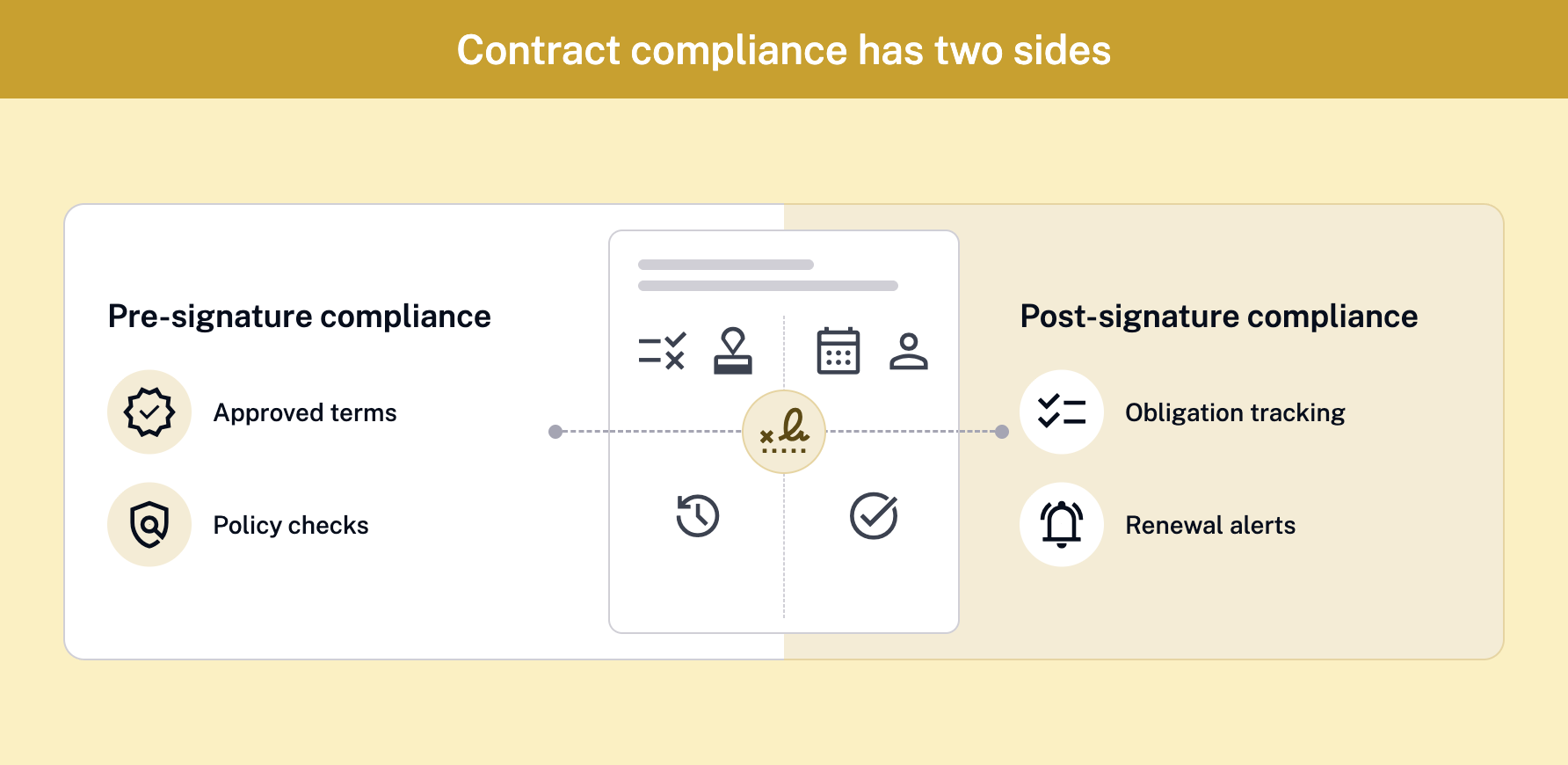
It helps to think of compliance in two halves. Pre-signature compliance keeps risky terms out of the deal. Post-signature compliance makes sure everyone delivers what they agreed to.
Most buyers searching for contract compliance tracking software want one thing: a reliable way to see which obligations are met, which are due and which have slipped, which is what compliance tracking and reporting looks like once it leaves the spreadsheet. That tracking layer is the post-signature half, and it's where most teams feel the pain first.
What Should Contract Compliance Software Do?
Good contract compliance software covers both halves of the contract lifecycle. Use this checklist to separate what you can't live without from what's nice to have.
#1 Pre-Signature Controls
Pre-signature controls stop risky terms before they become binding. They start with templates, which are pre-approved contract formats your business teams fill in instead of drafting from scratch. That shrinks your review queue and keeps every draft starting from approved language.
An approved clause library keeps non-standard liability caps and indemnities out of first drafts. A clause library is a set of pre-vetted clause wording, plus the fallback positions your team has agreed to accept.
Conditional approval workflows route a deal to finance or security only when a threshold is crossed, so nobody signs off on terms they never saw. For example, a large discount might go to the CFO, while a new data-transfer clause goes to security.
Without version control, it's easy to sign a draft that still carries a clause legal already rejected. Look for a full redline history that shows who changed what, and when.
#2 Post-Signature Obligation and Renewal Tracking
Post-signature, the core job of contract compliance management is assigning each commitment an owner, a due date and a status. An obligation is anything a party promised to do, like sending a report, keeping insurance or meeting a service level.
A common cadence for avoiding missed contract renewal dates is alerts at 90, 60 and 30 days. The 90-day alert gives you time to renegotiate, and the 30-day alert is your last call.
Auto-renewal clauses with short notice windows are a common source of surprise spend. These clauses extend the contract unless someone cancels by a set date. Your tool must track the notice deadline as well as the end date.
Also ask how each tool handles obligations that repeat, like quarterly reports or annual audits. A good tracker creates the next instance once the current one is marked done.
#3 AI Extraction and Search
Most teams have years of signed PDFs that nobody ever tagged. AI contract compliance tools can read those files and pull out key data points, called metadata, such as parties, dates, renewal terms and payment terms.
Good metadata extraction turns a PDF into fields you can filter, report on and set alerts against. Without it, your obligation tracker only covers the contracts someone typed in by hand.
AI use in legal is climbing fast. The Thomson Reuters Institute's 2026 AI in Professional Services Report found that "41% of law firms and 47% of corporate legal departments say their legal teams are using GenAI, up from 28% and 23%, respectively in 2025." Keep in mind that figure covers general GenAI use, not contract work specifically.
So don't take extraction accuracy on faith. Upload 20 of your own contracts, including messy scans and third-party paper, and check every extracted field against the source.
Score each tool on three things: field accuracy, missed clauses and how it handles amendments that change an earlier term. An amendment that moves a renewal date is exactly the kind of detail a weak model skips.
#4 Audit Trail, Access Controls and Reporting
An audit trail is a time-stamped record of who viewed, edited, approved or signed a contract. Pair it with role-based access, which limits who can see or change each contract type, and you can answer an auditor with evidence.
A searchable contract repository matters most on audit day, when someone asks for every agreement with a specific data-transfer clause. If finding them takes a week of inbox searches, you've found your gap.
Run your current process against a contract audit checklist before demos, so you know which gaps the software must close. Then ask each vendor to build an audit-ready report live, using your sample data.
Three reports are worth requesting in every demo:
Obligations due in the next 90 days, grouped by owner
Signed contracts that used non-standard clauses
Contracts expiring this quarter, sorted by value
Contract Compliance Software Compared at a Glance
Use this table to build your shortlist. Each compliance strength reflects how the vendor describes its own product, and none of these vendors publishes list prices.
Platform
Best for
SpotDraft
Fast-growing mid-market and in-house legal teams
Icertis
Large global enterprises
Sirion
Regulated, procurement-heavy enterprises
Ironclad
Mid-market to enterprise legal teams
Agiloft
Enterprises that want deep configuration
DocuSign CLM
Existing DocuSign eSignature users
LinkSquares
Legal teams focused on signed-contract analytics
Conga
Revenue and Salesforce-centric organizations
Juro
Scale-ups and growing in-house teams
Gatekeeper
Finance and procurement teams
Treat the "best for" labels as a starting point. Your own contracts and process should make the final call.
If your biggest gap is after signature, weight the compliance strengths column toward tracking and audit trails. If it's before signature, look harder at approvals and templates, because most contract compliance software covers both stages unevenly.
The 10 Best Contract Compliance Software Platforms
We built this list from each vendor's published capabilities, as stated on its own website in November 2026. It isn't based on analyst rankings.
SpotDraft is our platform, so we've listed it first and been upfront about it. Every other entry sticks to the vendor's own wording, plus a question worth asking in the demo.
#1 SpotDraft
SpotDraft is an AI-native CLM for fast-growing mid-market and in-house legal teams that need enterprise controls without an enterprise-length rollout. It covers both halves of compliance in one system, from conditional templates to a secure repository.
SpotDraft's AI-powered data capture pulls over 1,000 types of metadata, including renewal dates, payment terms and indemnities, into the repository automatically. That repository includes end-to-end encryption, role-based access controls and audit logs, backed by ISO 27001, SOC 2 and GDPR compliance.
Automated contract workflows loop in budget, legal, IT and security approvers and record each decision. Built-in e-signature keeps execution in the same place, and a structured onboarding plan gets you live by Week 6. You also get a dedicated customer success manager and 24/7 support across email, Slack, Teams and in-app chat.
Apollo.io's legal ops team knew this problem well. Before SpotDraft, deal approvals happened with little visibility:
"There was no visibility into what conversations were happening. No clear process. Just reviewing and moving along. Everything happens in one place now. It’s really exciting to have that kind of visibility and control. We’re a fast-paced company. SpotDraft helps us keep up without missing a beat."
Brenda Perez
Ex-Senior Legal Operations Manager at Apollo.io
Now Apollo.io's legal team has approvers "automatically looped in, tracked, and documented." That gives the team a ready-made audit trail for every approval.
#2 Icertis
Icertis promotes "Audit-ready obligation discovery and tracking" and AI built to "track every obligation." Its home page cites customers "with more than $30 billion in annual revenue."
It's best for large global enterprises with complex, multi-region contract portfolios. In the demo, ask what a typical rollout timeline looks like for a team your size.
#3 Sirion
Sirion says its AI agents "monitor obligations and SLAs, surface gaps, trigger owners." An SLA, or service level agreement, sets measurable performance targets like uptime or response times.
It's best for regulated, procurement-heavy enterprises, and its named customers include Citi, GE and Vodafone. In the demo, ask how SLA data flows in from your supplier systems.
#4 Ironclad
Ironclad's Renewal Agent focuses on "surfacing key terms… ahead of vendor negotiations." The platform also offers "Policy-Based Access Control for enterprise-grade governance" and serves mid-market to enterprise legal teams.
If AI-assisted redlining is your top requirement, AI contract review tools are a narrower category worth comparing separately. Gartner predicts that "By 2029, approximately 50% of contract reviews will be delegated to self-service systems that escalate only one in 10 for human review." That's a forecast rather than a current adoption rate.
#5 Agiloft
Agiloft lists "obligation tracking and renewal management" among its capabilities. Its AI extraction surfaces "terms, risks, and obligations," and it describes itself as an "Enterprise CLM that adapts to your business."
It's best for enterprises that want a highly configurable CLM. In the demo, ask how much setup your own team can handle and how much needs vendor services.
#6 DocuSign CLM
DocuSign CLM lets you "Manage obligations, renewals and more with agreement reports." It also uses AI to "flag non-compliant clauses" during review.
It's a natural fit for enterprises already using DocuSign eSignature. In the demo, ask which compliance features come with your plan and which are add-ons.
#7 LinkSquares
LinkSquares aims to help you "Find key terms, obligations, and risk across every agreement." Its renewal tracking covers "obligations, and notice windows," and its strength is post-signature analytics.
Teams whose main gap is reporting on signed contracts often shortlist contract analytics platforms alongside full CLMs. If you also need pre-signature controls, test how LinkSquares handles drafting and approvals.
#8 Conga
Conga says its CLM can "Identify and track obligations." Its AI analysis "tracks compliance, cycle time…with configurable dashboards and alerts," and it pitches coverage from "Redline to Renewal."
It fits revenue teams and Salesforce-centric organizations that run quote-to-cash in one stack. In the demo, ask how obligation data syncs with your CRM records.
#9 Juro
Juro offers "key date reminders post-signature, so you never miss an expensive automatic renewal." It pairs those with signing reminders and an intelligent repository.
It's best for scale-ups and in-house legal teams at growing companies. In the demo, ask how reminders work for third-party paper you upload after signing.
#10 Gatekeeper
Gatekeeper's pitch is to "Never miss a renewal or obligation," backed by a "complete audit trail." It keeps vendor risk and compliance on the same record as the contract.
It's best for finance and procurement teams that manage vendor and contract governance together. In the demo, ask how legal review fits into its approval workflows.
How Do You Choose the Right Contract Compliance Software?
Interest in automation is high, but commitment lags. SpotDraft's 2025 Contracting Efficiency Benchmarking Report found that "76% of organizations report a high willingness (between level 3-5) to invest in automation." Yet "only 10% describe their organizations as 'fully committed.'"
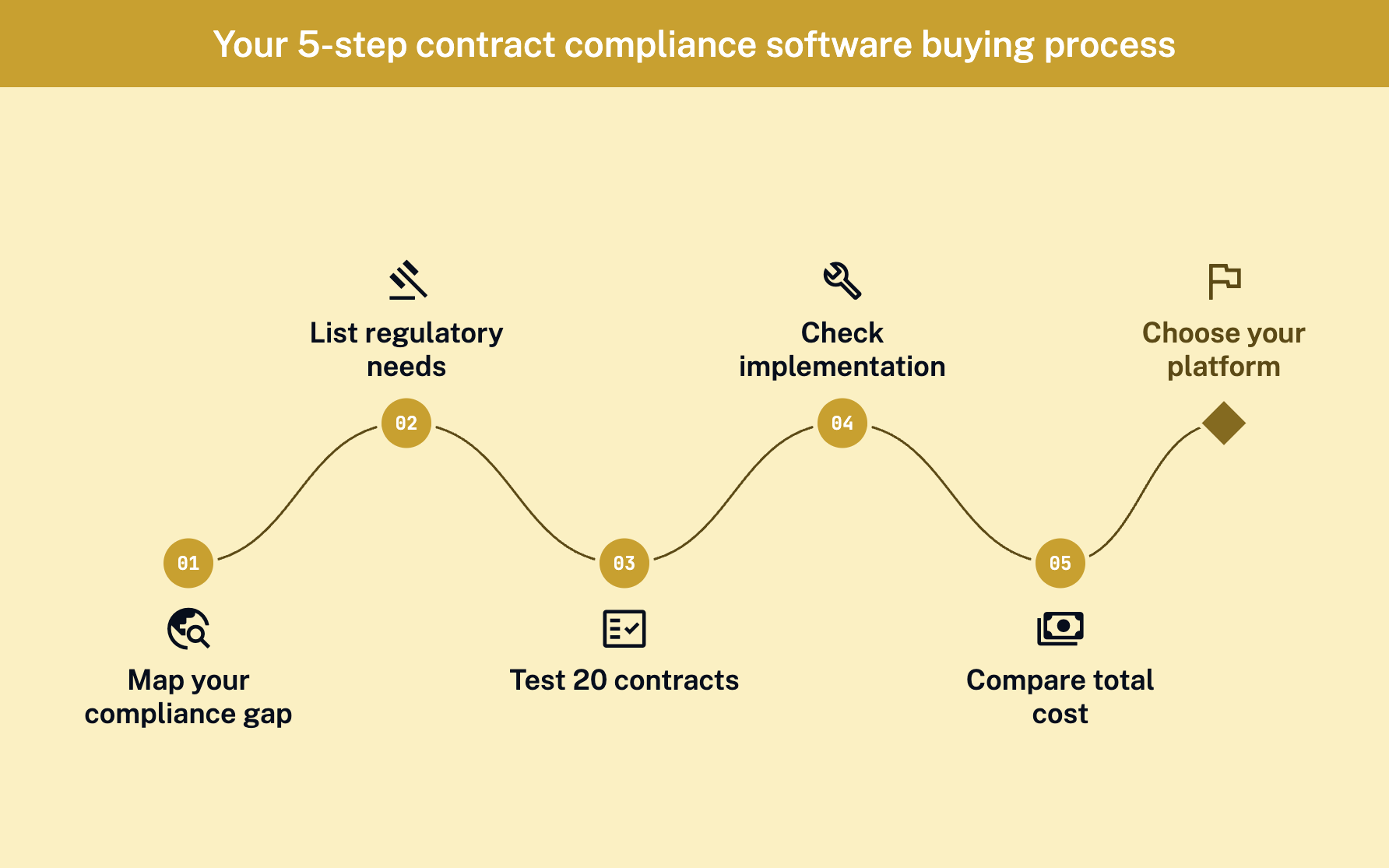
Lean teams choosing CLM software should weight adoption and setup speed above feature count. A tool your business teams avoid won't enforce anything, so use these five steps to pick one they'll actually use.
#1 Map Whether Your Gap Is Pre- or Post-Signature
Pull your last five compliance misses. If bad terms got signed, prioritize templates and approvals. If deadlines or obligations slipped, prioritize tracking, alerts and extraction.
Chaberton Energy, a renewable energy company, built its buying criteria around risk and a single source of truth. Here's how its legal lead put it:
"We needed a CLM that could automate, manage risk, and serve as our single source of truth. SpotDraft understood our use case immediately."
Reason Abajuo
VP of Legal and Corporate Affairs, Chaberton Energy
Chaberton Energy now keeps its contracts and metadata in one place. Its legal team uses analytics to show the business how legal drives value.
#2 List Your Regulatory Requirements
Write down every rule your contracts must meet, by contract type and region. Contracts with processors carry GDPR obligations that your software should flag and track, such as breach-notification timelines and sub-processor approvals.
The exposure is real. DLA Piper's January 2026 survey found that "The aggregate total fines reported since the application of GDPR on 25 May 2018 to 10 January 2026 across all the jurisdictions surveyed now stands at EUR7.1 billion." Those fines span European data protection broadly, not contract management failures alone.
#3 Test on 20 of Your Own Contracts
Give every vendor the same 20 contracts: your templates, third-party paper, old scans and a few amendments. Score each tool on extraction accuracy, search speed and how easily you can set an obligation alert.
A CLM RFP template keeps every vendor answering the same questions, which makes the shortlist comparable. Pair the written answers with your test results, because an RFP answer and a live demo don't always match.
#4 Check Implementation Time
Ask for a week-by-week rollout plan with named owners on both sides. Every month spent in setup is another month of manual tracking.
A public US university went live on SpotDraft in "4 weeks" after struggling to track coaching contract expirations. Its team now saves "6+ hours" per week, per person.
Speed pays off after go-live, too. SpotDraft's 2025 Contracting Efficiency Benchmarking Report found that "Manual contracting takes 19 days—automation brings it down to 3 days."
#5 Compare Total Cost
Ask every vendor for a three-year quote that includes implementation, integrations, training and e-signature. Then add your own team's time for setup and ongoing admin.
This step keeps a low first-year quote from hiding higher costs later. It also gives your CFO a number to approve, which makes the business case easier to defend.
What Does Contract Compliance Software Cost?
None of the 10 vendors above publishes list prices for its CLM. Most CLM software pricing is quote-based and tied to users, contract volume and modules.
Expect your contract compliance software quote to move with these cost drivers:
Number of users, including the mix of full and requester seats
Contract volume and the size of your legacy backlog
Modules such as AI extraction, analytics or advanced reporting
Integrations with your CRM, ERP or procurement tools
Implementation, data migration and training services
E-signature licenses, if signing isn't built in
To compare fairly, build a three-year total cost for each vendor. Add license fees, one-time setup, integration work and separate e-signature licenses, then weigh that total against the hours your team spends on manual tracking today.
Before you sign, ask each vendor a few pointed questions. Is there a cap on price increases at renewal? What does adding users mid-term cost, and are AI features included or sold separately?
When Is Contract Compliance Software the Wrong Purchase?
Sometimes the honest answer is "not yet." Contract compliance software is probably the wrong purchase right now if one of these sounds like you:
You sign only a handful of contracts a year, so a shared tracker with calendar alerts still works.
Nobody has agreed on policies, fallback positions or who owns each obligation.
Your real bottleneck is intake, meaning requests arrive by email and chat with no standard form.
Your need is purely regulatory, which governance, risk and compliance (GRC) tools handle better.
Software can't fix contract risk management that has no agreed owners or fallback positions. Agree on those first, and any platform on this list will have rules worth enforcing.
GRC tools map your controls to laws and frameworks across the whole company. If contracts are only one input to that program, a CLM can come later as an add-on.
If intake is the problem, start with a request form and a simple triage process. Then check whether your shortlisted CLM can handle intake, too.
Conclusion: Choose the Platform That Closes Your Gap
The right contract compliance software matches the gap you actually have. Start by deciding whether you lose control before signature, after it or both.
Next, shortlist two or three platforms from the table, test them on 20 of your own contracts and compare three-year cost. If you need enterprise controls without an enterprise-length rollout, SpotDraft covers both halves in one system. Request a demo to see how SpotDraft handles compliance on your own contracts.
Frequently Asked Questions
What Is the Best Contract Compliance Software?
How Do You Measure Contract Compliance?
Can AI Reliably Extract Obligations From Contracts?
What Records Should You Keep to Prove Contract Compliance?
Do You Need Separate Tools for Pre-Signature and Post-Signature Compliance?
What Is the Difference Between Obligation Compliance and Spend Compliance?
Related content
latest
Contract Tracking Software: Features, Costs and How to Choose
Compare contract tracking software features, costs and buying steps. See what to look for so you never miss a renewal, notice deadline or obligation again.
“Before using SpotDraft, executing a contract would take up to weeks. Now, contracts are signed within minutes, with better data security and tracking. The whole process takes us less than a day!”
Arti Singh
Founder’s Office, Growth, UrbanVault
“Before using SpotDraft, executing a contract would take up to weeks. Now, contracts are signed within minutes, with better data security and tracking. The whole process takes us less than a day!”