Not exactly. Generative AI is one technique used inside contract AI, specifically for drafting and summarizing text. Contract AI as a category also includes older classification and extraction techniques that don't generate new text at all.
Can contract AI draft an entire contract on its own?
It can produce a first draft from a template and clause library, especially for standard agreement types. It's not a reliable substitute for legal review on the final terms, particularly for anything non-standard or high-value.
Is AI-generated contract language legally binding?
Yes, once it's reviewed, negotiated and signed the same way any other contract is. The AI-assisted origin of a clause doesn't change its enforceability. What matters is whether the final signed terms meet the standard elements of a valid contract.
What's the biggest risk of using contract AI?
Over-reliance without human verification, especially on anything outside routine, standardized paperwork. AI tools are strongest as a first-pass filter, not a final decision-maker on genuinely high-stakes agreements.
Do small legal teams actually benefit from contract AI or is it mainly for enterprise?
Smaller teams often see a bigger relative benefit, since a two- or three-person legal function handling growing contract volume has less slack to absorb repetitive review work manually than a large team does.
Krishnapriya Agarwal is an Ex-Content Marketing leader at SpotDraft and an experienced marketing professional with a strong background in digital marketing, content strategy, and team management. She has led content teams and driven SEO-focused initiatives to support business growth.
TL;DR
Contract AI applies NLP, machine learning, and generative AI to contract creation, review, negotiation, and management.
It's used across the full contract lifecycle: drafting, review, negotiation, data extraction, search, and post-signature compliance.
The main benefits are faster review and drafting, earlier risk detection, less manual admin, better data visibility, and more consistent contracting.
Contract AI has real limitations, including hallucinated or inaccurate outputs, so it still requires human review, particularly for high-value or unusual agreements.
Choosing a solution comes down to its AI capabilities, lifecycle coverage, security posture, usability, and how well it integrates with your existing systems.
Contracts contain large amounts of unstructured information and legal and business teams spend a significant share of their time drafting, reviewing, extracting, and tracking it manually. Contract AI is the use of artificial intelligence to help organizations create, review, analyze, negotiate, and manage contracts. It uses technologies such as natural language processing, machine learning, and generative AI to understand contract language, identify important information, flag potential risks, and automate repetitive contract tasks.
If all the chatter around the arrival of AI has left you curious, you’ve come to the right place.
Here, we’re looking at the definition of contract AI, its use, and its benefits. Let’s get started.
What is contract AI?
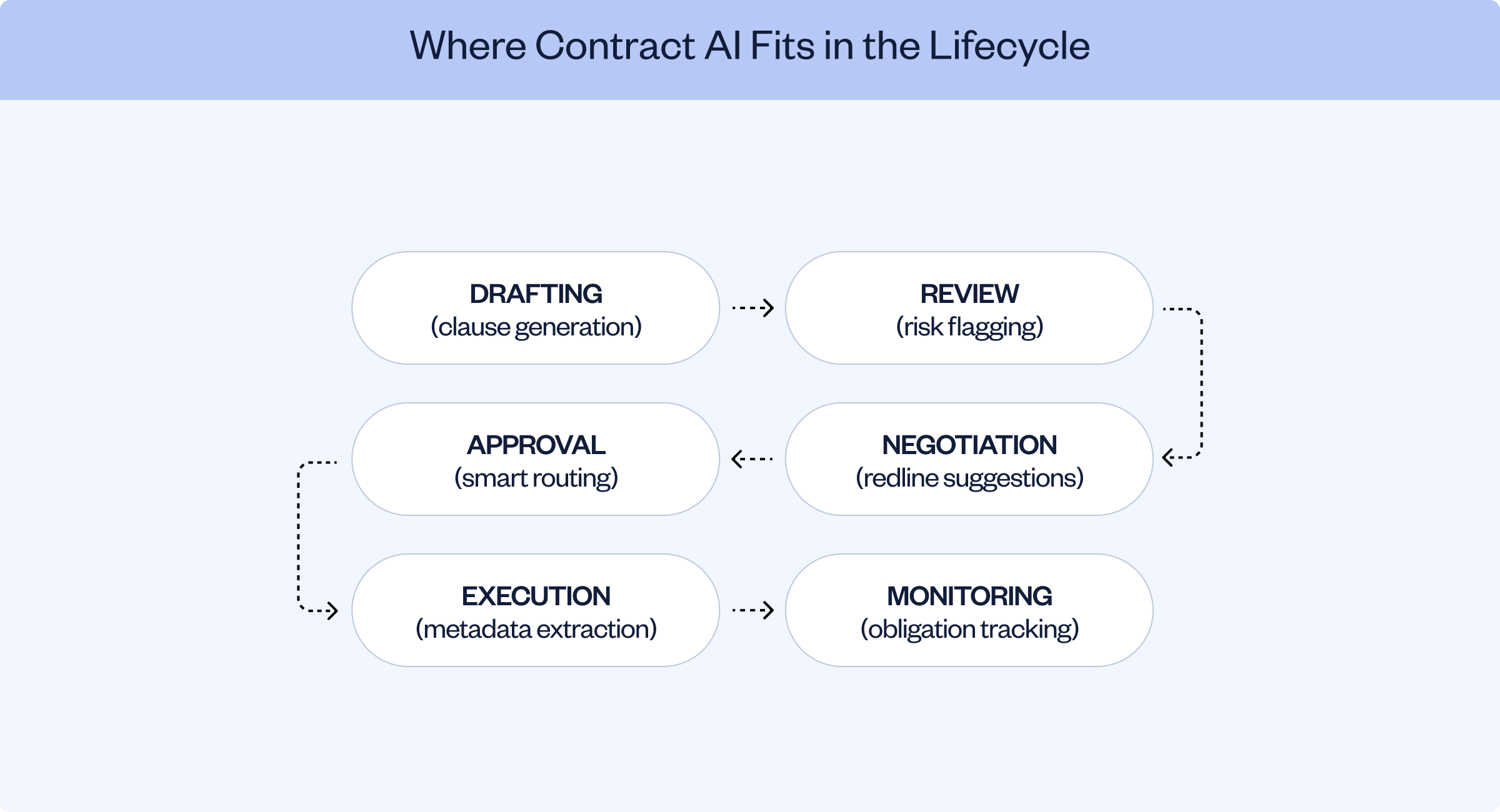
Contract AI refers to the use of artificial intelligence, specifically machine learning and natural language processing (NLP), to automate and support tasks across the contract lifecycle. That includes drafting, reviewing, negotiating, approving, executing and, in many platforms, monitoring obligations after signature.
It's a broad label covering a lot of different capabilities, not a single tool that does one thing. A contract AI feature might mean an assistant that drafts a first pass of an NDA, a risk engine that flags a missing indemnification clause or a metadata extractor that pulls renewal dates out of a thousand PDFs without anyone opening each one manually.
According to World Commerce & Contracting's 2025 AI in Contracting Report, based on input from 374 organizations, 42% were already implementing AI somewhere in their contracting process as of that survey, with participants describing adoption as "not optional" but "essential" to staying competitive. That's a meaningful jump from where contract AI sat even a couple of years earlier, when most of what got called "AI" in contracting was closer to basic pattern-matching.
“Try to glean as much info about what causes friction as possible. Your biggest wins will come from addressing these knowledge gaps or hesitancies that are blocking/slowing deals.”
Contract review, or anywhere else in the contract lifecycle, is not where you want to miss discrepancies that could stall the process later. AI revolutionizes this entire approach.
Instead of reaching for another cup of coffee to help them stay focused, legal teams can run a fresh contract through a contract lifecycle management (CLM) tool using AI to instantly spot discrepancies. No time is wasted. The CLM tool will automatically flag any potential problem spots, saving an unprecedented amount of time.
Most contract AI tools combine a few underlying techniques, though the exact mix varies by vendor and use case:
Natural language processing (NLP) lets the system read and interpret contract text, identifying clauses, defined terms and structure, rather than treating the document as unstructured text.
Machine learning models, trained on large sets of contracts, learn to recognize patterns: what a standard indemnification clause looks like, what counts as an unusually broad limitation of liability and what language typically signals a missing term.
Generative AI, built on large language models, goes a step further, producing new text rather than just classifying existing text. This is what powers clause drafting, contract summarization and chat-style "ask this contract a question" features are.
In practice, these layer on top of each other. A modern contract AI feature might use NLP to parse the document, a trained risk model to flag deviations from your playbook and a generative layer to suggest replacement language, all in the same review pass.
How is AI used in contracts?
Contract AI shows up across every stage of the contract lifecycle, not as a single feature.
Contract drafting. AI can generate first drafts, suggest individual clauses, populate templates with the right variables, rewrite or simplify existing language and adapt clause selection based on the specific deal's requirements.
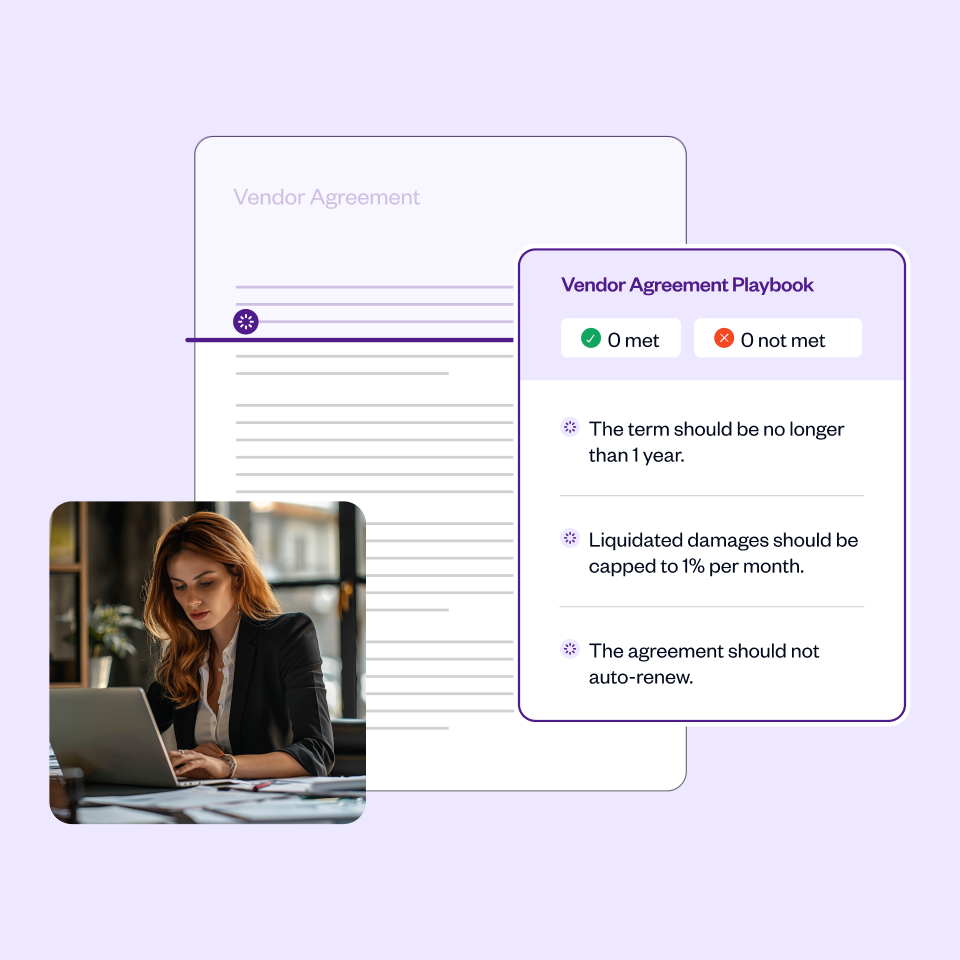
Contract review. AI can identify unusual language, compare incoming clauses against your clause library or playbook, flag missing provisions, highlight deviations from standard positions, and summarize the key risks in a document rather than requiring a full manual read-through first.
Contract negotiation. This includes redline analysis, suggesting fallback language based on prior negotiations, identifying which counterparty changes actually shift risk in a meaningful way and comparing incoming language against your organization's approved positions.
Contract data extraction. Pulling structured information, dates, parties, renewal terms, payment terms, liability caps, governing law and obligations out of unstructured contract text so it's usable in reporting rather than locked inside a PDF.
Contract analysis and search. Modern platforms increasingly let users ask questions across an entire contract repository directly, "which vendor contracts include an auto-renewal clause," rather than manually opening documents one at a time to find out.
Contract compliance and obligation management. Post-signature, AI can track renewal reminders, ongoing obligations, deadlines and compliance requirements, flagging what needs attention before it's missed rather than after.
Gartner has identified contract data extraction and automated contract review among the higher-value generative AI use cases legal departments are prioritizing, which tracks with where most teams report seeing the clearest, fastest return: the repetitive review and extraction work, not the creative or judgment-heavy parts of contracting.
4 benefits of using contract AI software
Implementing contract AI is a significant change for most companies. While a daunting investment, it can give you the tools and accuracy you need for rapid business growth through digital transformation.
Here’s a snapshot of some of the benefits you can expect when you use AI for contract management.
1. Run a faster contract management process
The amount of time it takes AI to review and handle a contract is negligible compared to the time it takes a human. Most AI tools can look over a contract and recommend changes in minutes. It might take a human an hour or more to thoroughly examine the entire agreement. AI saves teams valuable time that they can spend focusing on work that can propel the business forward.
For example, consider the contract negotiation stage. Both parties review contracts, redlining any areas that warrant further discussion. A contract management software that utilizes AI can generate accurate agreements based on contract templates. As a result, reviewers spot fewer places within the contract that need adjustments, allowing the approvals process to continue without setbacks.
AI helps you scale contract creation, too. As a business grows, the number of contracts it creates grows. However, if every contract requires by-hand review and processing, how many contracts you can process at once will plateau. In saving you time, AI contracting tools free up your schedule so you can process more contracts than ever before.
2. Spot mistakes sooner for better risk mitigation
Another way AI improves contract management is by helping find risk factors early in the contract process. As mentioned before, AI uses NLP to pick up on key terms and clauses within a contract to establish an average. The more contracts within a database it has to review, the more accurate this average becomes. As a result, it’s better able to flag discrepancies within new contracts.
“First, build out a workflow considering all the risks involved. Conduct training sessions with stakeholders and ensure they are comfortable using the CLM tool. The next step is to create a speck document with clause variations in different scenarios. Train the growth teams to refer to the speck document and make necessary changes to the contract, as needed."
Instead of relying solely on legal teams to parse through headers and large blocks of jargon-heavy text, AI can get an accurate read on possible problem spots fast. By using named entity recognition (NER), it can pinpoint contract metadata like names, dates, monetary figures, and any other specific details you’ve trained the AI to look for. All this data combined creates the aforementioned average.
You can also train the AI to capture specific clauses within each contract, anything from data related-text to termination, confidentiality, and dispute resolution. Take this a step further to capture more objective data like syntax, context, and grammar. Between identifying unclear terms and flagging inaccurate clauses, AI helps improve risk mitigation.
SpotDraft developed the Advanced Search feature to help you spot mistakes and conduct seamless risk mitigation. It streamlines the process of identifying key contract information and flagging areas that might require modification, depending on the customer. You can gather all these contract analytics together to find unique insights you likely wouldn’t have caught by hand.
3. Improved consistency across contracts
It’s important that all your contracts follow the same style and template. However, if your legal team is responsible for ensuring this consistency by hand, you’re potentially wasting valuable time and increasing the chances of human error.
AI technologies help make sure all your contracts look the same. You can rest assured that AI-generated contracts abide by specific templates, regulatory guidelines, and laws.
AI can also help quicken your pace when drafting fresh contracts. Based on existing similar contracts, a CLM tool that uses AI can generate a new contract. It will pull in necessary legal language automatically, saving you from having to dig it up by hand. Within moments, a new and accurate contract is at your fingertips.
“The absence of contract templates leads to non-standardisation and makes contracts prone to errors. The legal team, therefore, is required to delve deep into contracts and proofread all clauses with a fine-tooth comb to identify and rectify the simplest of human errors.”
Consistent contracts are as important for streamlining processes as they are for optics. In the eyes of your customers, consistent contracts establish trust. This makes you look professional and reliable.
4. Boost contract accuracy, decrease human error
When you automate the contract lifecycle process, you remove the risk of human error. Any prior assumptions or experiences that could influence a human’s review of an agreement are no longer a risk factor. AI leans on logic and standards set forth by you, ridding the process of the potential for human error or inconsistent judgments.
If you take this reasoning a step further, you can use AI to process a huge number of contracts. There are limits to how many contracts a human can accurately review by hand. With AI, the limit doesn’t exist. It boosts the likelihood that your contracts will have consistent formatting, standardized terms and clauses, and superb readability, along with ensuring compliance and regulatory requirements.
“With rapidly evolving technologies, the legal framework tends to lag behind. Whenever there is any amendment in a related regulation, you should be able to suggest necessary changes to the product team to ensure compliance.”
For example, implementing contract AI for contract analysis gives you the data you need to make clever business decisions. You can spot consistent sticking points during the contract’s lifecycle and address discrepancies in a timely manner.
What's the difference between contract AI and traditional contract automation?
Traditional contract automation
Contract AI
Follows predefined rules
Understands contract language
Automates predictable workflows
Can interpret unstructured information
Template-driven
Can generate or recommend language
Rule-based alerts
Can identify patterns and risks
Requires structured inputs
Can extract information from unstructured contracts
These aren't competing approaches. Most effective contract platforms combine both: automation handles the predictable, rules-based parts of a workflow reliably, while AI handles the parts that require actually understanding language and judgment calls are fixed rules that can't be made on their own.
AI-generated contracts: what can AI actually create?
AI can generate a range of contract-related content: complete first drafts, individual clauses, plain-language summaries of existing agreements, alternative phrasing for a specific term, explanations of what a clause actually means, and suggested language for a negotiation response.
An important distinction: AI-generated does not mean automatically approved or legally correct. Generated language still needs review before it goes anywhere near a counterparty, particularly for high-value, unusual, or legally complex agreements where a generic pattern-matched clause may not actually fit the specific deal. Treat AI output as a strong first draft, not a finished, reviewed document.
What are the risks and limitations of contract AI?
This part gets skipped in a lot of vendor content, but it matters for setting realistic expectations.
Hallucinations or inaccurate outputs. Generative models can produce confident, plausible-sounding text that's factually wrong, a real risk when the output concerns specific legal terms. NIST's Generative AI Profile specifically names "confabulation," confidently stated but false or misleading content, as one of the risk categories unique to or significantly worsened by generative AI systems.
Missing context and incorrect clause interpretation. A model trained broadly on contract language may miss context specific to your industry, jurisdiction, or negotiating history that changes how a clause should actually be read.
Data privacy and confidentiality. Feeding sensitive contract data into an AI tool raises real questions about where that data goes, who can access it, and whether it's used to train models beyond your own use.
Inconsistent outputs and over-reliance. The same input can occasionally produce different outputs, and a team that stops doing spot-checks because "the AI already reviewed it" is taking on a risk it may not have signed up for.
Poor results from low-quality contract data. A tool trained or configured against a weak or generic playbook will flag the wrong things or miss the right ones, regardless of how capable the underlying model is.
The American Bar Association's Formal Opinion 512, issued in July 2024, addresses exactly this territory for lawyers specifically: it holds that existing duties of competence and confidentiality under the Model Rules of Professional Conduct apply fully to generative AI use, meaning lawyers need to understand a tool's capabilities and limitations and independently verify its output rather than treating it as inherently reliable. None of this means contract AI isn't useful. It means it reduces manual work without removing the need for legal judgment.
What are the types of contract AI software?
Contract drafting software
Contract drafting tools step in during the contract creation process. The tool reviews each drafted contract to ensure it hits on specific terms and uses language to boost accuracy. It saves legal teams time by scanning the contract and recommending changes.
Contract drafting software builds a foundation for a cohesive contract management process. SpotDraft helps teams create high-quality contracts using templates. You can create a new agreement in moments, and rest assured that SpotDraft’s built-in legal guardrails will cover your regulatory compliance bases.
SpotDraft helps you create precise and accurate contracts in moments by using pre-built templates. On average, SpotDraft customers who use templates to help streamline their contract creation process close deals twice as fast as those who draft contracts by hand.
Contract review is one of the most efficient ways to use contract AI software. It relies on NLP to find and review contracts to flag potential problems. This is helpful for teams interested in scaling their contract operations. With the help of AI, the days of having to sift through piles of legal documents filled with jargon are gone.
During the contract review process, AI scans your agreement for essential terms and clauses imperative to the agreement. It highlights these problem areas for you.
Contract analysis happens throughout the contract’s entire lifecycle. It monitors potential bottlenecks and setbacks due to unclear terms or misleading clauses. It helps you identify these areas for continuous iterative improvement.
“These insights can help the legal team identify gaps in the system and work toward improving workflows and building solutions that would increase efficiency.”
Without AI in contract analysis, legal teams would be on the hook for reviewing contracts throughout the entire process. It’s unlikely they would spot trends in discrepancies. AI does the hard work for you. It captures and stores contract information and then transforms it into actionable data points. You can use these data pieces to make smarter business decisions while improving your processes.
Contract lifecycle management
Depending on how many contracts you process, using AI to push contracts through the lifecycle could be a game changer. It reduces the amount of work required by your entire team. You can process and track more contracts in less time. AI will flag potential risks and ping signers when they need to take action and ensure a contract stays on track.
How can legal teams use contract AI effectively?
Start with repetitive, high-volume contract tasks. Standard NDAs and routine vendor paper are a better initial fit than complex, one-off agreements.
Define your playbooks and approval rules clearly. AI output quality depends heavily on what it's being measured against.
Keep humans involved in high-risk decisions. Reserve full human review for high-value, unusual, or legally complex agreements.
Review AI outputs before they reach counterparties. Treat generated drafts and flagged risks as a starting point, not a final answer.
Monitor accuracy and improve workflows over time. Track where the AI is getting things right and wrong, and adjust the playbook or configuration accordingly.
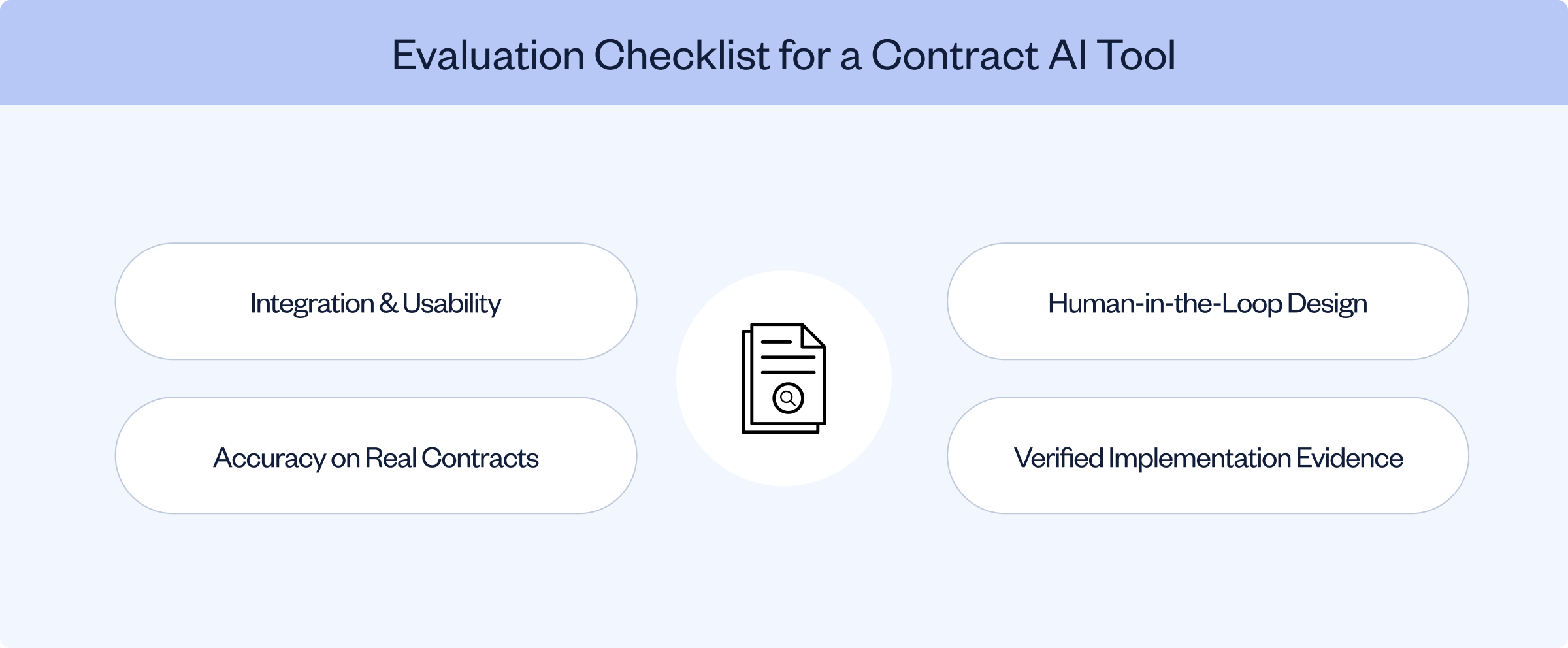
A few categories are worth checking systematically rather than going by a features list alone:
AI capabilities. Drafting, review, extraction, search, analysis, negotiation support—does it actually cover what you need or just one piece of it?
Contract lifecycle coverage. Workflow, approvals, e-signatures, repository renewals, obligation tracking, and an AI feature bolted onto nothing operational are different products than AI built into a full lifecycle platform.
Security. Data privacy practices, access controls, encryption and auditability are all worth confirming directly rather than assuming.
Usability. Integration with the tools your team already uses (like Word), ease of adoption, and whether business users outside legal can actually use it without extensive training.
Governance. Playbook configuration, permission controls, human review checkpoints, and explainability—can you actually see why the AI flagged what it flagged?
Integration. Connections to your CRM, ERP, communication tools, and any existing CLM system, since a tool that lives in isolation from the rest of your stack adds friction rather than removing it.
Contract AI vs. AI-powered contract management software
Area
Contract AI
AI-powered contract management software
What it is
AI capabilities for understanding, drafting and analyzing contracts
A complete platform that uses AI to manage contracts end to end
Main purpose
Automates specific contract tasks
Manages the full contract lifecycle
Drafting
Generates clauses and contract language
Combines AI drafting with templates and workflows
Review
Identifies risks, clauses and deviations
Adds playbooks, approvals and collaboration to AI review
Negotiation
Suggests edits and summarizes changes
Manages redlining, versions and reviewer workflows
Approvals
Limited or task-specific
Automates approval routing and workflows
Storage
Analyzes contract data
Stores and organizes contracts in a central repository
Post-signature
Extracts obligations and key dates
Tracks obligations, renewals and important milestones
Overall role
The AI engine
The system that puts the AI to work across the lifecycle
Contract AI with SpotDraft
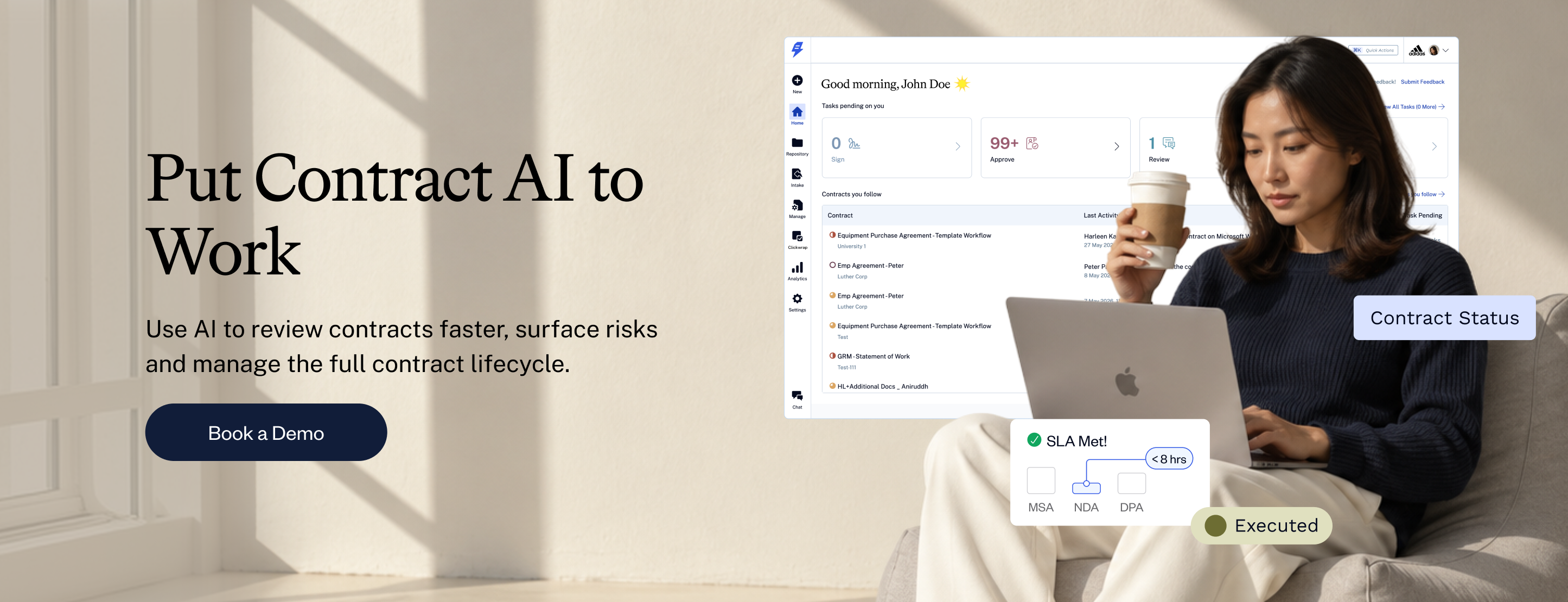
SpotDraft brings AI into the contract lifecycle across most of the stages discussed above, rather than as a single bolted-on feature. That includes drafting from templates and pre-approved language, reviewing contracts for risk and deviation through SpotDraft AI, extracting and searching contract data through Smart Data Capture, automating approval workflows, supporting negotiation, collecting e-signatures and storing and tracking every contract after execution in a searchable repository.
The point isn't any single capability in isolation. It's that these pieces operate inside one connected workflow, so contract AI here means the whole lifecycle gets faster and more consistent, not just the review step or the drafting step on its own.
The future of AIin contract management
The general trajectory has moved from basic automation to AI assistance on individual tasks to generative AI capable of drafting and summarizing and increasingly toward agentic workflows that orchestrate multiple steps toward a goal rather than executing one task at a time.
Current contract AI is still largely centered on discrete tasks, extraction, review, drafting, with a human confirming the output at each stage. The direction several platforms are moving in is broader workflow orchestration, where AI coordinates more of the sequence with less manual handoff between steps. That shift is underway rather than complete, and how far it goes in practice will depend heavily on how much organizations trust AI-driven decisions without a human checkpoint at every stage, particularly for anything beyond routine, low-risk paperwork.
Want to see contract AI applied across the full lifecycle rather than as a single feature? Book a demo.
Frequently Asked Questions
Is contract AI the same as generative AI?
Can contract AI draft an entire contract on its own?
Is AI-generated contract language legally binding?
What's the biggest risk of using contract AI?
Do small legal teams actually benefit from contract AI or is it mainly for enterprise?
Related content
latest
Top 12 Conga Competitors & Alternatives for Contract Management
Compare 12 Conga competitors & alternatives for contract management in 2026 by use case, workflows, migration, and fit for your Conga setup.
“Before using SpotDraft, executing a contract would take up to weeks. Now, contracts are signed within minutes, with better data security and tracking. The whole process takes us less than a day!”
Arti Singh
Founder’s Office, Growth, UrbanVault
“Before using SpotDraft, executing a contract would take up to weeks. Now, contracts are signed within minutes, with better data security and tracking. The whole process takes us less than a day!”