Evisort pricing in 2026: Workday CLM costs and quote factors

Huzaifa Sultana is a Marketing Associate at SpotDraft focusing on Organic Growth through SEO and AEO.
Workday acquired Evisort in October 2024 and now offers Workday Contract Lifecycle Management (CLM), powered by Evisort AI. Workday does not publish standard Workday CLM pricing, fixed subscription rates, or public Workday CLM pricing plans. Organizations evaluating enterprise CLM therefore need a personalized quote to establish the real cost of their deployment.
Workday offers Contract Intelligence for extraction, search, and analytics, and Contract Lifecycle Management for drafting, negotiation, approvals, and execution. Buyers seeking a full CLM platform should confirm that their proposal includes the latter; the contract management platform selected determines which contracting processes are covered.
Independent sources provide limited historical pricing context. Vendr data show a $41,850 purchasing benchmark, but the reported Evisort prices reflect earlier transactions rather than a published Workday CLM rate. Contract volume, implementation, workflows, integrations, and support still need to be included in the total cost calculation.
This guide examines available pricing information, explains what to request in initial quotes, and identifies the product and service terms to verify throughout the full procurement cycle.

For buyers researching Evisort pricing in 2026, Workday CLM has no publicly available monthly or annual subscription price. Start with a direct sales conversation to request product-specific pricing and ask whether a free trial or guided proof of concept is available. The first sales meeting should establish the pricing metric, product entitlements, and services included in the proposed subscription.
The available pricing information comes primarily from third-party procurement data associated with Evisort. Vendr's Evisort marketplace displays a $41,850 contract value benchmark. Its headline labels the figure as an average contract value, while the detailed pricing section describes the same amount as a median annual buyer payment.
Because Vendr labels the figure differently across its page, treat it as a reported purchasing benchmark. It cannot establish a higher entry cost for Workday CLM or determine what a new subscription costs.
The current pricing position is summarized below.

The Vendr figure reflects historical Evisort purchasing. Buyers with initial Evisort proposals from before the Workday acquisition should compare them with current product entitlements rather than carry forward old assumptions. The benchmark does not reveal an individual customer's effective annual spend after separately billed implementation or integrations.
Vendr also reports a wider range of historical purchase amounts. Descriptions of an Evisort CLM pricing model in third-party procurement data do not establish today's Workday formula or a standard enterprise CLM pricing range. Compare contract scope, subscription periods, and transaction terms before using those numbers in a budget.
Compare itemized proposals covering the same requirements before approving a final quote. Separate recurring software charges from migration, implementation, integrations, and professional services so procurement can establish the full value and cost of what is being purchased.
Comparing the subscription and implementation costs of different CLM platforms?
An Evisort pricing evaluation should start with a Workday CLM proposal defining contract volume, user access, workflows, integration requirements, and subscription term. Workday does not publish a price formula for these inputs, although Vendr identifies several as historical Evisort purchasing factors. Enterprise buyers should also request any proposed Workday bundling terms in writing rather than assume that existing Workday subscriptions include CLM.
A common limitation of public pricing comparisons is that documented product functionality is treated as an included commercial entitlement. Verify each module and service against the proposed Order Form.
Contract volume is one of the factors Vendr identifies in historical Evisort pricing. Workday does not publish standard contract-volume bands or the charges associated with them.
To define capacity, distinguish contracts in the existing repository from new agreements expected during the subscription. Confirm whether amendments, attachments, archived documents, and multiple versions count separately toward the purchased allowance.
If the contract repository will be the system of record for executed agreements, inventory contract types, formats, metadata, and projected growth. Use that inventory to establish included volume, migration responsibilities, and expansion terms.
The proposal should state how contracts are counted, what volume is included, and how additional usage is handled.
Evisort pricing cannot be calculated from a published per-user rate because Workday does not specify whether current CLM subscriptions are priced primarily by licensed seats, contract volume, or another metric.
Large organizations require different access levels by function. Legal administrators manage workflows and permissions; Sales and Procurement teams initiate and review agreements; Finance may need reports. HR teams handling talent management vendor contracts may require requester or read-only access.
The proposal should specify which user roles are licensed, how many users are included, and whether additional requesters, reviewers, administrators, or read-only users require further licensing.
Because Workday does not publish a standard CLM licensing metric, the proposal should identify how user access, contract volume, and additional usage are priced.
Workday offers Contract Intelligence and Contract Lifecycle Management as separate products, both powered by Evisort AI.
According to Workday's contract management overview, Contract Intelligence provides an AI-powered contract repository, extraction capabilities, search, custom AI models, and reporting dashboards.
Workday Contract Lifecycle Management includes those contract intelligence capabilities and adds processes for contract requests, drafting, negotiation, approvals, and execution.
This product distinction affects Evisort pricing comparisons because buyers need to identify whether their requirements involve post-signature contract intelligence alone or the entire contracting process.
Workday does not publish separate subscription rates for these products. The commercial proposal should specify which product is licensed and identify any additional capabilities included.
Workflow requirements should be defined using the actual contracting processes the organization intends to automate.
Workday CLM documents contract requests, templates, automated redlining, collaboration, approvals, and signature coordination. For detailed clause negotiation, ask Legal to test third-party redlines and review history. A deal desk manager should also test how contract changes move through Sales approvals. The quote should identify the processes included in configuration.
For example, a legal department handling nondisclosure agreements (NDAs), vendor contracts, and master service agreements (MSAs) may require separate approval conditions, templates, and participant roles for each contract type.
Before implementation, document:
These requirements also form the basis of a contract approval process. Specifying them in advance allows buyers to compare the workflow configuration included in each implementation proposal.
Workday documents native integrations with Adobe Sign, Docusign, Salesforce, SharePoint, Box, and Google Drive, plus REST API connectivity for other systems. Workday customers already using Workday HCM or Workday Adaptive Planning should verify any CLM data flows separately; using products from one vendor does not establish a native integration or shared license.
The presence of an integration does not, by itself, establish the licensing or implementation services included in a particular subscription. Procurement and IT teams should list the systems involved and identify the data that needs to move between them.
For CRM integrations such as Salesforce, test how customer details, approval status, and executed documents synchronize. If Finance needs contract values or renewal dates in a financial management platform, establish whether that requires a supported connection or a separately scoped API project.
The quote should list the supported connections, configuration responsibilities, API access, connector costs, and any ongoing maintenance or technical services priced separately.
The initial subscription period and renewal terms should be documented separately from the implementation scope.
Vendr identifies contract duration and multi-year commitments among the commercial considerations associated with Evisort purchases. However, Workday does not publish a standard discount schedule for longer CLM subscriptions.
The written agreement should specify the initial subscription term, payment schedule, renewal provisions, annual price-adjustment terms, and charges associated with expanding usage.
These terms help Finance calculate the total commitment rather than comparing only the first year's subscription amount.

Implementation services, contract migration, integration work, training, and additional usage are the main cost areas to assess beyond the subscription. Workday does not publish standard charges for these items, so their treatment must be established through the commercial proposal.
Vendr identifies implementation and professional services as possible additions to historical Evisort purchasing costs. Buyers should establish which services are included in the current Workday CLM proposal and which require separate charges.
Implementation costs depend on the agreed configuration scope and change management work required to prepare legal and business teams for new contracting processes.
Workday CLM supports intake, drafting, redlining, approvals, repository management, and reporting. For enterprise deployment, the implementation plan should define workflows, templates, roles, permissions, environments, and documented best practices for testing configuration changes before go-live.
Implementation requirements should be established before the statement of work is finalized. The number of workflows, templates, integrations, and historical contracts included in the original scope should be documented alongside the implementation schedule.
If additional workflows are identified during configuration, the implementation agreement should define how changes to scope, fees, and delivery milestones are handled.
For a current Workday CLM implementation, the statement of work should identify the agreed workflow count, configuration responsibilities, milestones, acceptance criteria, and charges for changes to the original scope.
Workday also reports an average 21-day implementation period for Contract Intelligence. This figure applies specifically to Contract Intelligence and should not be treated as the implementation timeline for the full CLM offering.
A CLM implementation plan should document the technical work and internal responsibilities required for the selected deployment.
Contract migration requires the transfer of historical agreements and their associated data into the new repository.
The work involved depends on the existing sources, file condition, required metadata, and number of agreements. Organizations migrating contracts from shared drives or another CLM platform should define the following before obtaining a final implementation quote:
These requirements should be reflected in the legacy contract migration plan rather than assumed to be included in the subscription.
Workday documents AI-powered extraction and repository capabilities. The buyer's implementation proposal should identify which migration activities Workday will perform, which remain with the customer's team, and whether data preparation or specialized services carry additional charges.
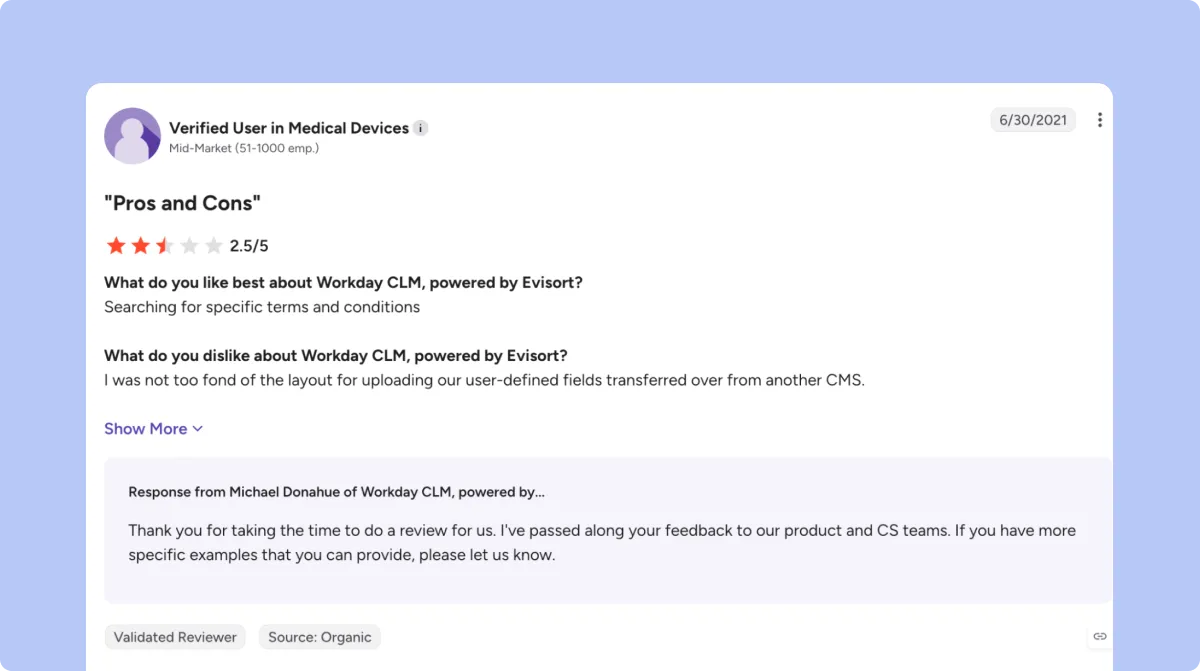
An earlier Evisort customer described a problem with transferring contract information from an existing contract management system. The customer valued being able to search contractual terms and generate information for audits but found the interface for uploading custom fields from the previous system inconvenient. This experience predates Workday's acquisition and does not establish how current Workday CLM implementations operate. It does, however, provide a practical reason to test custom metadata fields during migration and document how import issues will be resolved.
Integration costs should be evaluated against the specific business systems, data flows, and technical services included in the deployment.
Workday documents native integrations and REST API connectivity, but its public materials do not specify which connections are included in each CLM subscription. The proposal should distinguish licensed connectors, configuration work, and any separately scoped technical services.
To define the integration scope, identify each system, data-flow direction, information exchanged, and testing responsibilities. If Docusign CLM or another CLM provider is also on the shortlist, apply the same integration and connector cost criteria to its proposal; do not compare features without matching scope.
For custom connections, the proposal should also identify whether API access, professional services, or ongoing maintenance are priced separately.
Training and administration requirements depend on the number of teams using the platform and the responsibilities assigned to each role.
Legal administrators need training on template management, workflow configuration, permissions, and reporting. Business users need guidance on contract requests, approvals, and repository access. Identify whether a dedicated contract lifecycle manager will maintain these configurations and whether the budget includes a dedicated hire, rather than assuming the vendor handles ongoing administration.
Buyers should specify which teams receive initial training, whether administrator training is included, the availability of post-launch resources, and who will maintain workflows after implementation.
Contract volumes, users, workflows, and integrations can change as global operations expand. The commercial agreement should state how additional regions, requirements, and usage are priced.
For example, an organization that initially deploys Workday CLM for Legal and Sales may later extend contract requests to Procurement or Finance. That expansion can involve additional users, templates, approval processes, or integrations.
Workday does not publish a standard expansion rate for these requirements. The contract should therefore define how additional usage is measured, when a price adjustment applies, and whether new implementation services require a separate statement of work.
Organizations should also document how additional workflows and contract data migration requirements are handled after the initial deployment.
Comparing implementation and ongoing support requirements? Review SpotDraft's implementation, migration, integration, and support services alongside the requirements of your Workday CLM proposal.
A Workday CLM quote should identify the licensed product, subscription period, usage allowances, implementation deliverables, support commitments, and prices for additional requirements.
Because Workday CLM pricing is customized, the order form and implementation statement of work are the primary documents for establishing these terms.
The checklist below separates subscription commitments from the services and operating requirements that need to be defined before purchase.
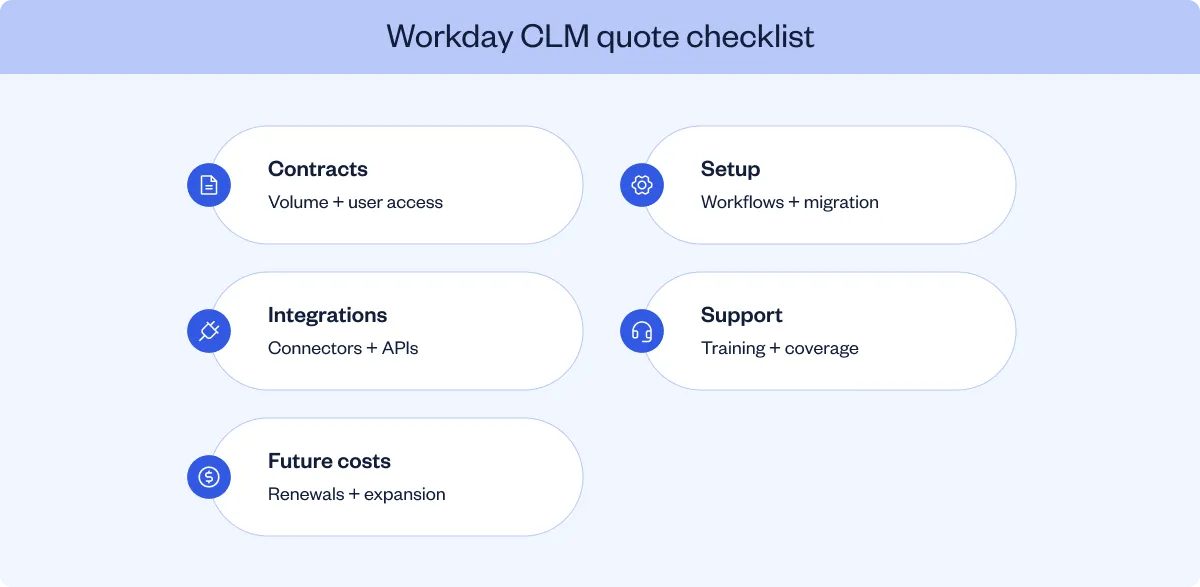
The checklist should be completed using the organization's actual contract requirements. For example, a deployment involving ten contract workflows and two enterprise integrations should not be compared with a proposal covering five workflows and one integration without identifying the difference in scope.
Implementation timelines also need to account for internal dependencies. If the customer is responsible for data preparation, security approvals, or user testing, those responsibilities should appear in the project plan.
Finally, calculate the total commitment over the proposed subscription period. This includes the recurring subscription, any additional services, expected usage charges, and contractual renewal terms. A documented contract renewal process also helps teams track notice periods and future purchasing decisions.
Need a SpotDraft quote covering the same requirements? Review the product scope, migration responsibilities, integrations, and support terms in a personalized demonstration.
SpotDraft provides contract creation, AI-assisted review, approval workflows, electronic signatures, repository management, and contract analytics. SpotDraft offers custom pricing based on users or contract volume, with in-house implementation, workflow and integration setup, and legacy contract migration included.
To compare SpotDraft with Workday CLM, use the same agreement types, approval requirements, migration volume, reporting needs, and integrations. The following sections explain how SpotDraft supports these requirements across the contract lifecycle.
The following capabilities form part of that evaluation.
SpotDraft Templates allow legal teams to create reusable contract templates and make them available to business users.
Each template can include a questionnaire that captures the information required to generate an agreement. Conditional logic changes the contract content based on the responses, while approved templates establish the language employees use for recurring agreements.
For example, Legal can prepare an NDA template that adjusts the relevant fields and clauses based on the counterparty and agreement requirements. Business users complete the questionnaire to generate the contract rather than drafting each agreement independently.
When comparing SpotDraft with Workday CLM, use the same contract template and questionnaire. Document the supported conditional clauses, required fields, user permissions, and approval conditions in both systems.
Evaluate SpotDraft's contract review and editing capabilities using your organization's contract types and review guidelines.
SpotDraft Workflows allow legal teams to configure processes for contract creation, review, and approval.
Workflow rules route agreements to designated reviewers based on conditions established by Legal. Business users submit contract information through questionnaires and intake forms, while the workflow determines the required approval path.
For example, a vendor agreement above a defined contract-value threshold can require Finance approval in addition to Legal review. The workflow records the required steps and allows administrators to update the routing conditions as the organization's processes change.
The comparison with Workday CLM should cover supported conditions, approval assignments, administrator permissions, notification behavior, and the work required to configure and maintain each workflow.
SpotDraft's Contract Repository centralizes contract storage, search, and metadata management.
The repository supports full-text search, metadata filters, saved views, and relationships between agreements. SpotDraft's AI-powered data extraction identifies contract information for reporting and post-signature management.
The contract management functionality also supports organization and visibility across the contract portfolio.
For execution, SpotDraft Sign provides native electronic signature functionality. Buyers should confirm the signing entitlements and applicable commercial terms in their proposal.
Once contracts are executed, SpotDraft Contract Analytics provides dashboards covering lifecycle activity, approvals, reviews, and turnaround times. These metrics help legal teams report on contracting activity alongside the terms and obligations contained in agreements.
Workday CLM also documents contract intelligence, repository search, AI-powered extraction, dashboards, and signing workflows. Evaluate both platforms using the same legacy contract sample, reporting requirements, and electronic signature process.
SpotDraft includes in-house implementation, workflow configuration, integration setup, and migration of legacy contracts in standard pricing.
SpotDraft's in-house implementation team helps customers configure contract workflows and migrate existing agreements. SpotDraft also offers integrations with business systems used throughout the contracting process.
SpotDraft advertises dedicated customer success and 24/7 support; buyers should confirm support channels, response commitments, and any additional charges in the commercial proposal.
For an equivalent comparison with Workday CLM, procurement teams should account for:
Both products should be evaluated against the same deployment requirements before comparing the quoted subscription and total contract value.