Icertis does not publish standard public pricing. Buyers need to request a quote based on their contract-management requirements, implementation scope, and deployment needs.
Who are the competitors of Icertis?
Icertis competitors include SpotDraft, Ironclad, Sirion, Agiloft, DocuSign CLM, Conga CLM, LinkSquares, Juro, Leah, Workday CLM, Gatekeeper, Malbek, and HyperStart. Each contract management solution takes a different approach to contract workflows, AI, integrations, administration, and post-signature management.
What should you check before switching to an Icertis alternative?
Before switching to an Icertis alternative, you should check contract migration, workflow recreation, integrations, permissions, historical data, reporting, user onboarding, implementation ownership, and the expected transition timeline. SpotDraft provides in-house implementation and assisted migration through its Contract Buyout Program.
How long does Icertis take to implement?
Icertis takes around six months to implement on average. Implementation scope can include contract-data migration, workflow and template configuration, permissions, integrations, and user onboarding, depending on the deployment.
Is Icertis easy to use?
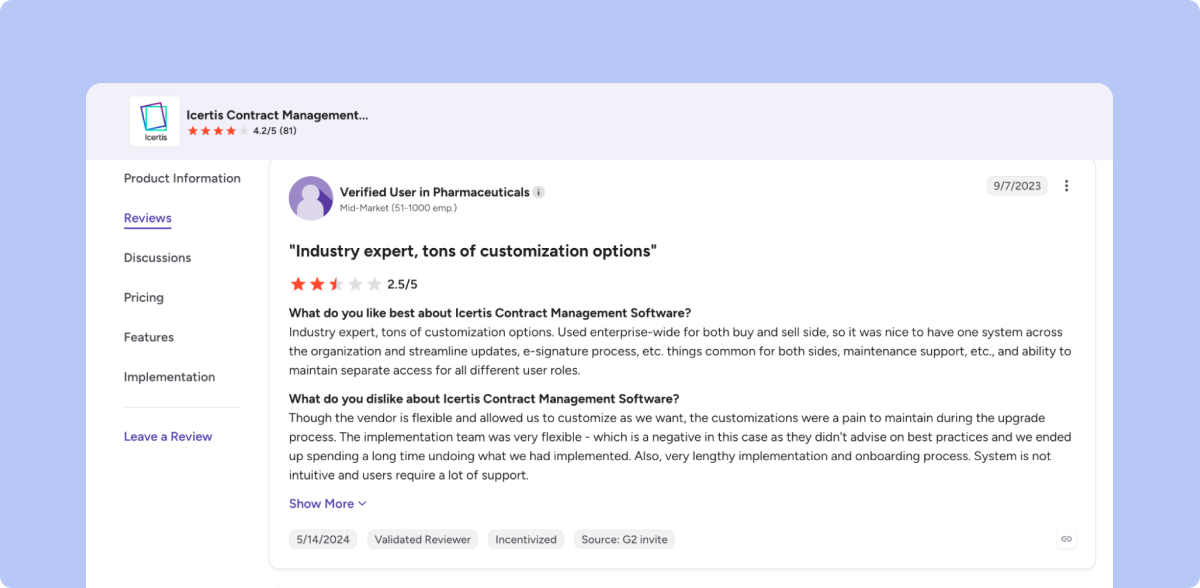
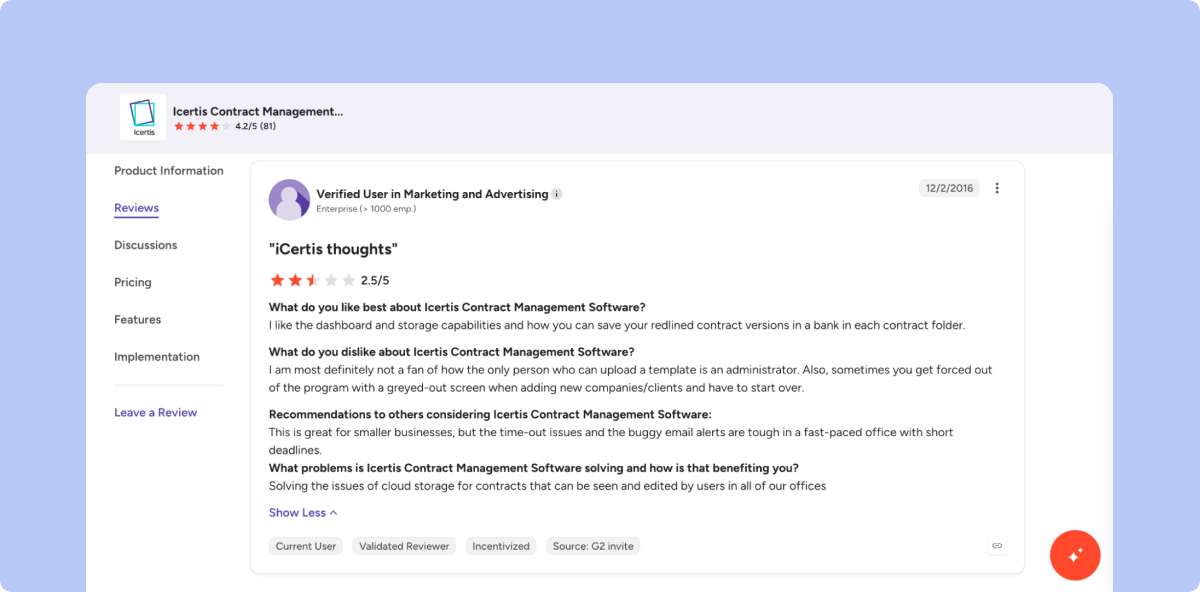
Icertis supports role-based experiences and self-service contracting. User feedback on ease of use is mixed: some reviewers describe the platform as intuitive, while others report a learning curve, less-intuitive navigation, or a need for additional user support.
Huzaifa Sultana is a Marketing Associate at SpotDraft focusing on Organic Growth through SEO and AEO.
TL;DR
Implementation timelines, administration, integrations, and user adoption are key factors when comparing Icertis alternatives.
Sirion, Agiloft, Conga, and Workday CLM support enterprise teams with complex workflows and integrations.
LinkSquares focuses on contract intelligence and contract analytics.
Gatekeeper combines contract and vendor management for procurement teams.
Juro and HyperStart use AI capabilities across contract review and contract workflows.
SpotDraft provides a contract lifecycle management solution for the entire contract lifecycle, with business self-service and in-house implementation support.
Are you comparing Icertis with other CLM platforms before committing to a long-term rollout? Or checking whether its enterprise CLM setup fits the way your organization manages contracts and contract volumes?
Icertis supports contract management across multiple teams, systems, and workflows, including approvals, permissions, integrations, workflow automation, and post-signature processes.
For teams with simpler requirements, the implementation and administration effort may be more than they need. Comparing other CLM platforms can help identify a contract management solution that better matches the way contracts are handled day to day.
This guide looks at 13 Icertis competitors in 2026, covering what each platform does well, where it may fall short, and the type of team it is best suited for.
Why Buyers Look for Icertis Alternatives
Icertis may not fit every contract team in the same way. The need to compare alternatives often comes up when legal departments assess what it takes to implement and operate the contract management software in practice.
G2 currently reports an average implementation time of six months for Icertis and an average of 22 months to ROI based on user data. Some reviewers report lengthy implementation and onboarding, along with a learning curve during initial use.
Day-to-day administration can create friction as well. Another user reported that only administrators could upload templates and also described a greyed-out screen that required restarting the process.
These concerns can make Icertis harder to manage over time. For buyers, the real question is whether the platform’s depth is worth the extra effort their contract management process requires.
13 Best Icertis Competitors for Contract Management in 2026
The 13 platforms below show how different Icertis competitors approach contract management and where each one fits best.
Platform
Notable Use Case
Capability
SpotDraft
Legal teams managing end-to-end contracting
Legal control with business self-service
Ironclad
Legal and business teams sharing contract workflows
Enterprises with highly customized contract processes
No-code configuration
DocuSign CLM
Organizations using the DocuSign agreement ecosystem
Contract workflows with e-signature integration
Conga CLM
Enterprises connecting contracts with commercial systems
Contract AI and commercial integrations
LinkSquares
Legal teams managing large contract repositories
Repository intelligence and analysis
Juro
Legal teams using AI across contract review and management
AI review and contract intelligence
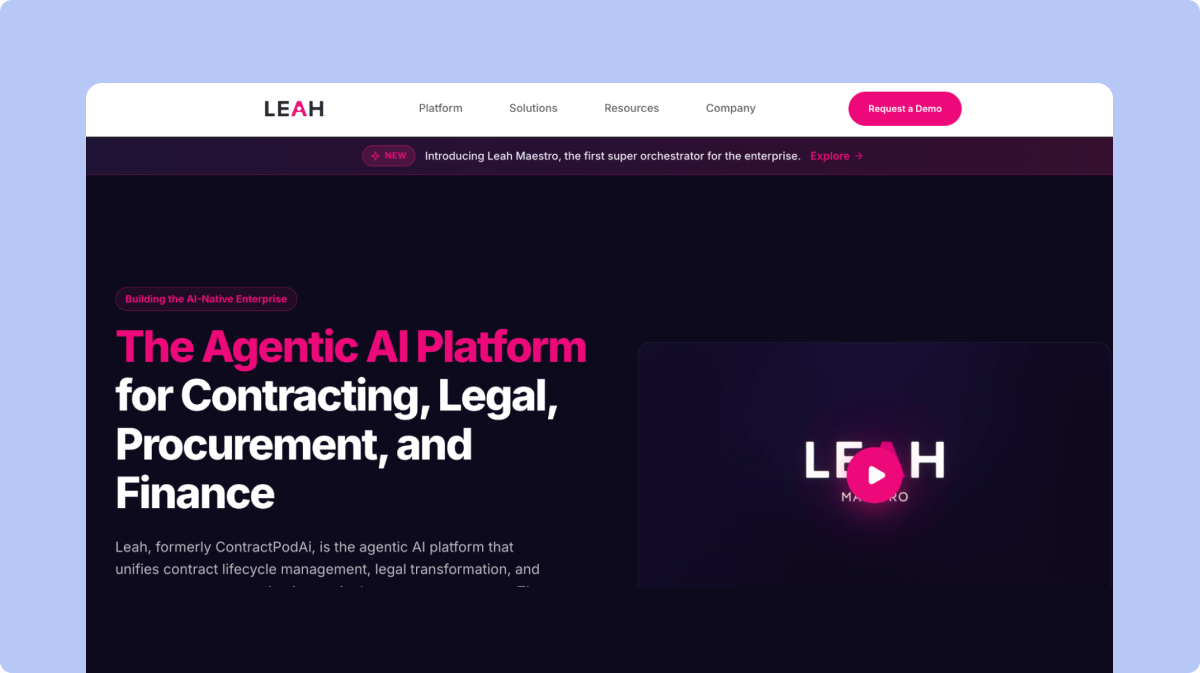
Leah
Enterprises extending AI across Legal and other functions
Agentic AI with CLM
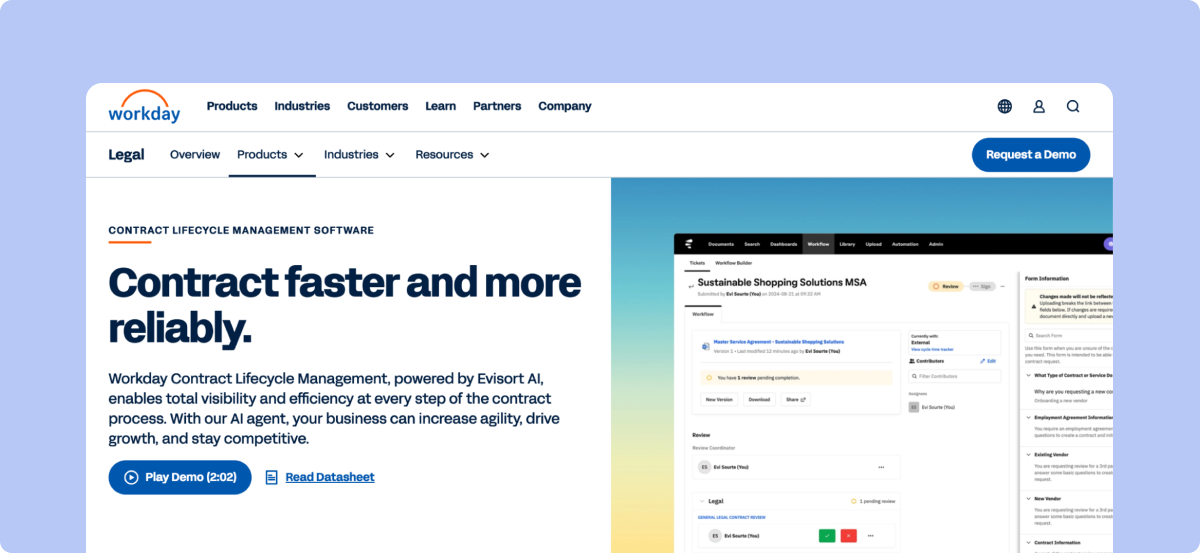
Workday CLM
Enterprises applying AI across contract workflows and data
Contract intelligence with lifecycle workflows
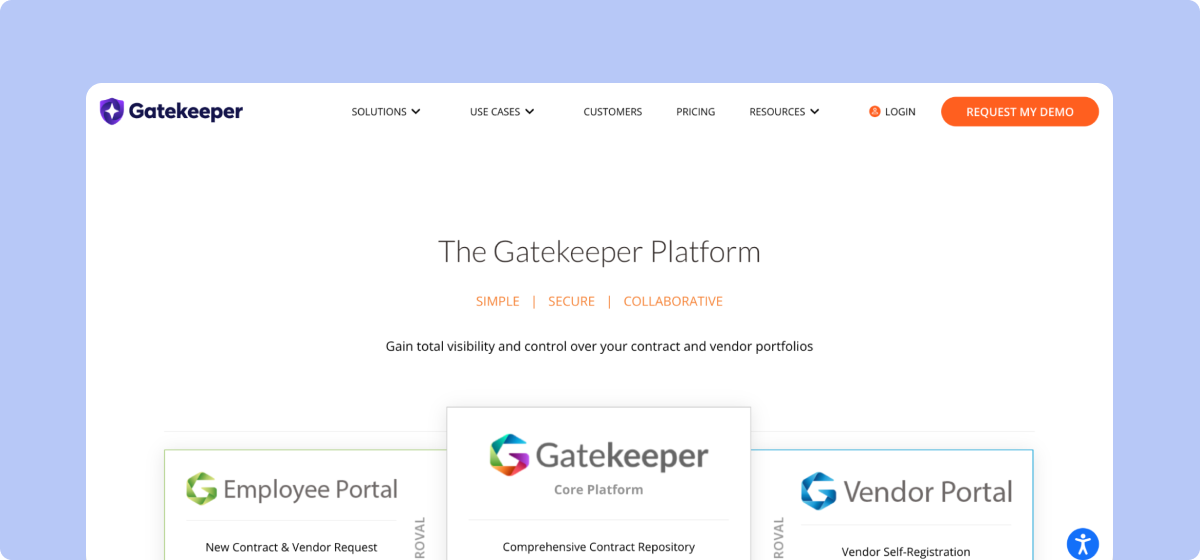
Gatekeeper
Procurement and Finance teams managing vendors and contracts
Vendor and contract management
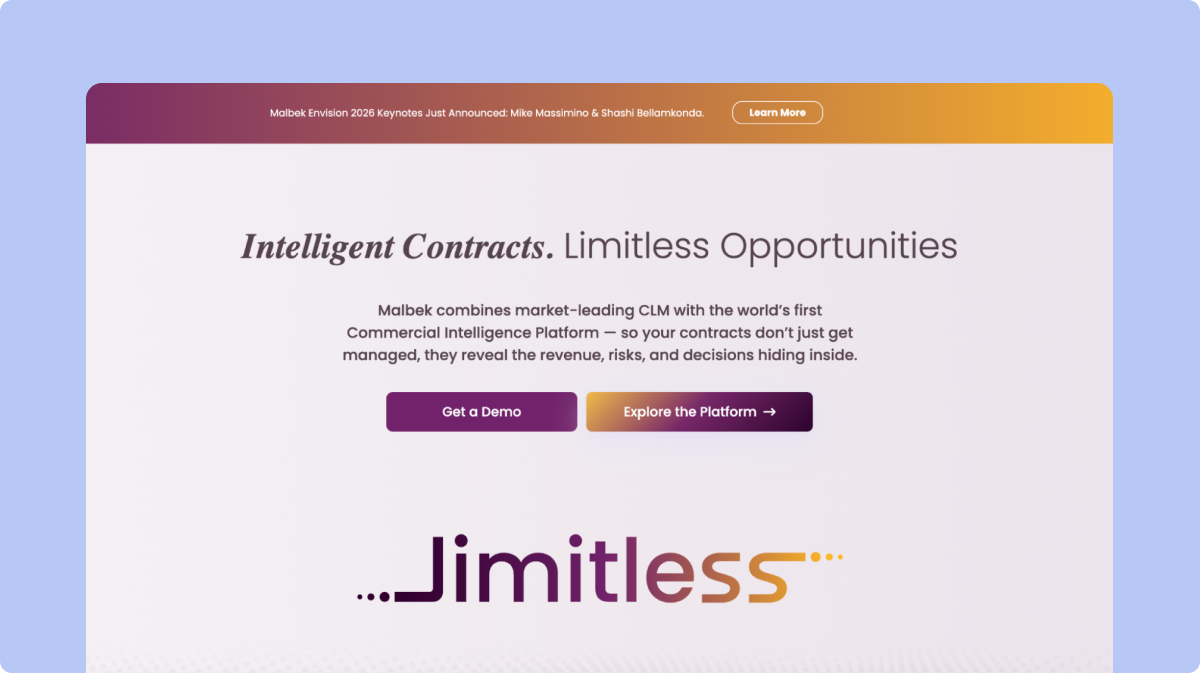
Malbek
Legal and commercial teams with configurable CLM requirements
CLM with commercial intelligence
HyperStart
Growing Legal teams adopting AI-enabled CLM
AI-assisted contract automation
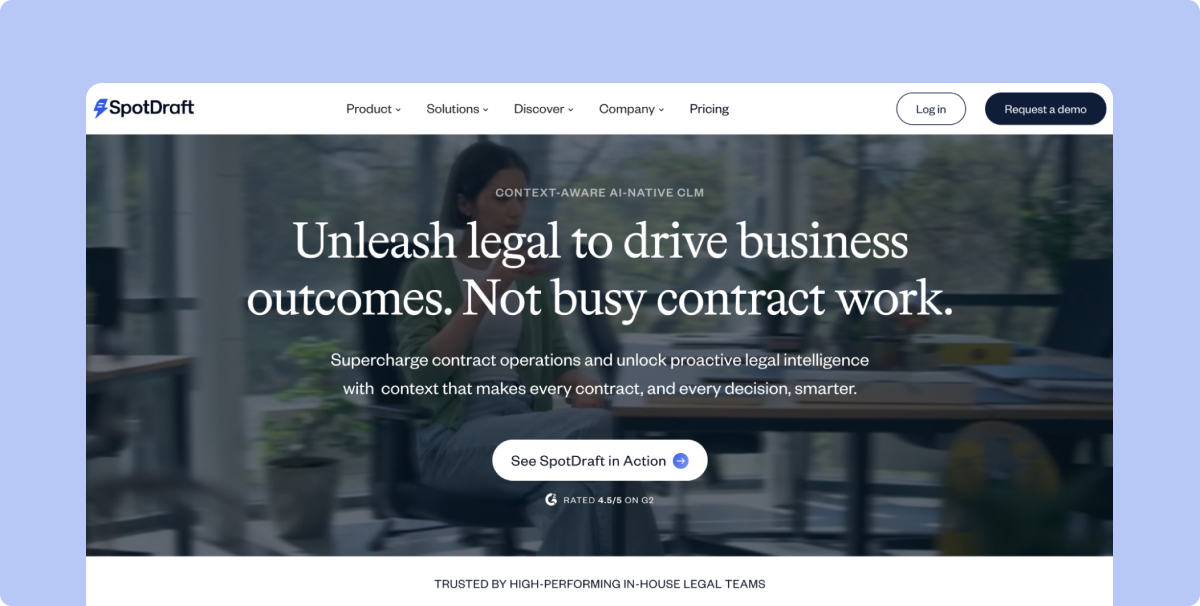
1. SpotDraft
SpotDraft is a legal-led contract management tool that brings contract creation, review, approvals, e-signatures, contract storage, repository management, and analytics into one platform. Legal teams set templates, playbooks, permissions, and approval rules, while business teams can initiate routine contracts within those controls.
Key features
No-code workflows support workflow automation by routing contracts through predefined review and approval paths.
VerifAI reviews contracts against Legal’s playbooks and identifies language that needs attention.
The Contract Repository centralizes agreements and associated contract information.
Native e-signatures keep execution within the contract workflow.
Integrations with CRM, collaboration, storage, e-signature, procurement, and other business systems.
Pros
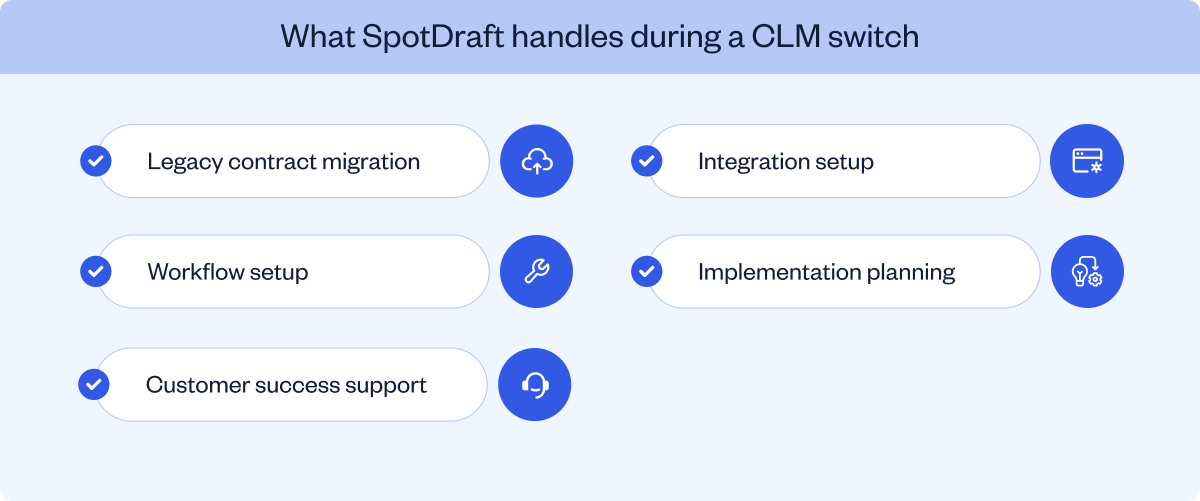
Implementation, workflow setup, integrations, and legacy contract migration are handled in-house.
Legal controls templates, permissions, reviews, and approvals while business users work within predefined workflows.
Dedicated customer success and 24/7 customer support are included.
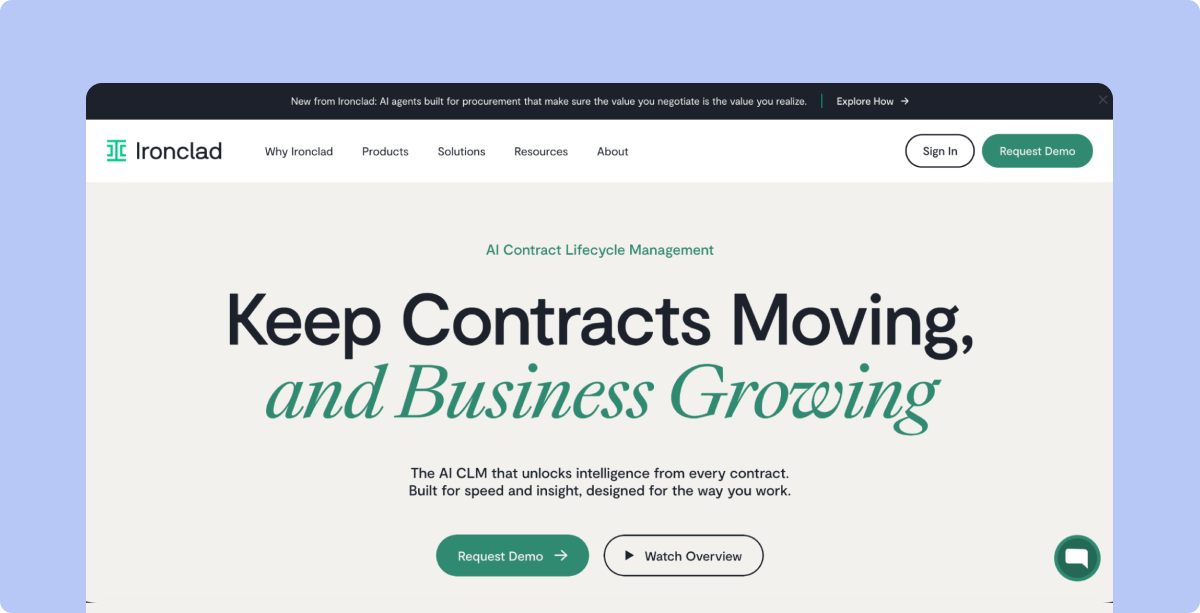
2. Ironclad
Ironclad is contract management software that helps teams collect contract requests, route them to the right stakeholders for review and approval, edit agreements, and store signed contracts. Its Workflow Designer is used to set up approval steps and routing rules, while Ironclad Editor supports contract drafting and negotiation in DOCX files.
Key features
Configures request forms, approval rules, templates, and signature steps through its no-code workflow builder.
Supports DOCX editing, comments, and tracked changes through its contract editor.
Stores completed agreements with structured contract data.
Uses AI capabilities for drafting, review, redlining, and contract analysis.
Pros
Allows teams to configure contract workflows without code.
Brings Legal and business users into the same contracting process.
Connects with tools such as Salesforce, Coupa, and Microsoft Word.
Cons
Administrative permissions are required for workflow, integration, API, and permission settings.
API Access is an add-on, with the standard API allowance calculated as 100 calls per user per 24 hours multiplied by the number of CLM seats.
Some capabilities, including Obligations, are available only as add-ons.
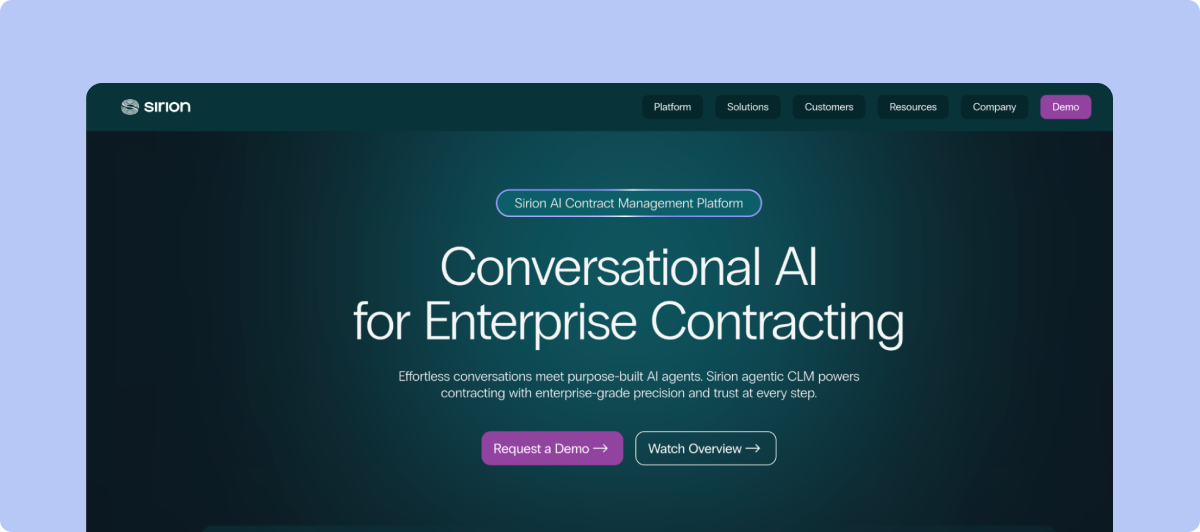
3. Sirion
Sirion is an enterprise CLM platform with a strong focus on managing contracts after they are signed. It helps large enterprises track obligations, service levels, payments, and other commitments made in an agreement.
Key features
Extracts contractual obligations using AI.
Breaks larger obligations into individual tasks.
Compares contractual commitments with actual performance.
Links SLA and financial data with contract obligations.
Pros
Traces obligations back to the clauses they come from.
Tracks whether contractual commitments are being met to support risk management.
Connects contract performance with SLA and invoice data.
Cons
Obligation tracking can require detailed setup across clauses, tasks, owners, and performance data.
Contract-performance monitoring depends on having the relevant SLA, invoice, or operational data available in connected systems.
Teams using Sirion mainly for pre-signature contracting may get less value from its deeper post-signature functionality.
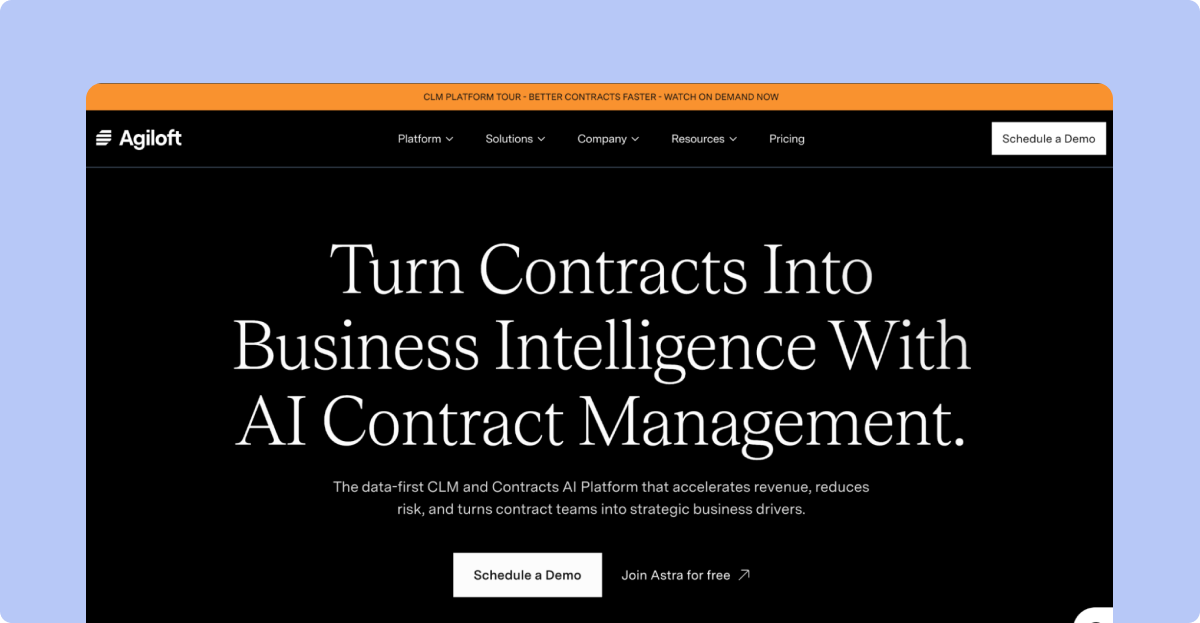
4. Agiloft
Agiloft is a configurable contract management solution that lets teams build complex workflows around their own processes. Its no-code tools can be used to change approval steps, contract fields, automation rules, and other parts of the system.
Key features
Configures workflows, approvals, fields, and automation rules without code.
Structures contract information for search, reporting, and contract analytics.
Provides more than 1,000 connectors through its Integration Hub.
Supports additional custom integrations through APIs.
Pros
Allows many workflow changes without writing code.
Supports different contract processes across business units.
Connects with common enterprise systems.
Cons
The platform can take time to learn for some non-technical users.
More involved customization may require implementation support.
Detailed configurations can take additional time to fine-tune.
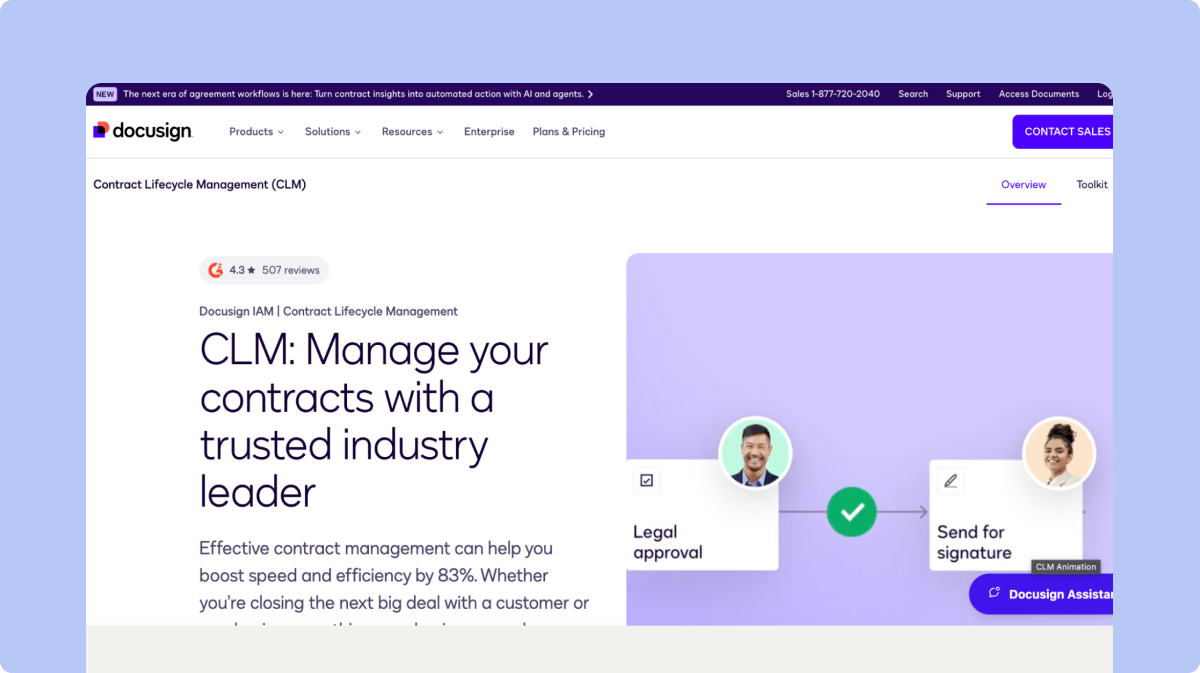
5. DocuSign CLM
DocuSign CLM extends DocuSign beyond electronic signatures. Teams can use it for document automation to generate contracts, route them for review and approval, manage negotiations, and store completed agreements.
Key features
Generates agreements using data from connected business systems.
Stores approved contract language in clause libraries.
Routes non-standard terms for additional review.
Supports contract search and analysis through repository and AI tools.
Pros
Connects directly with DocuSign eSignature.
Supports Salesforce integration by pulling Salesforce data into contract templates.
Keeps contract review and signature within the DocuSign ecosystem.
Cons
Available functionality and integrations vary across DocuSign CLM offerings.
Some capabilities depend on the specific CLM package or connected DocuSign products in use.
Salesforce-centered workflows require the relevant DocuSign CLM and Salesforce configuration.
6. Conga CLM
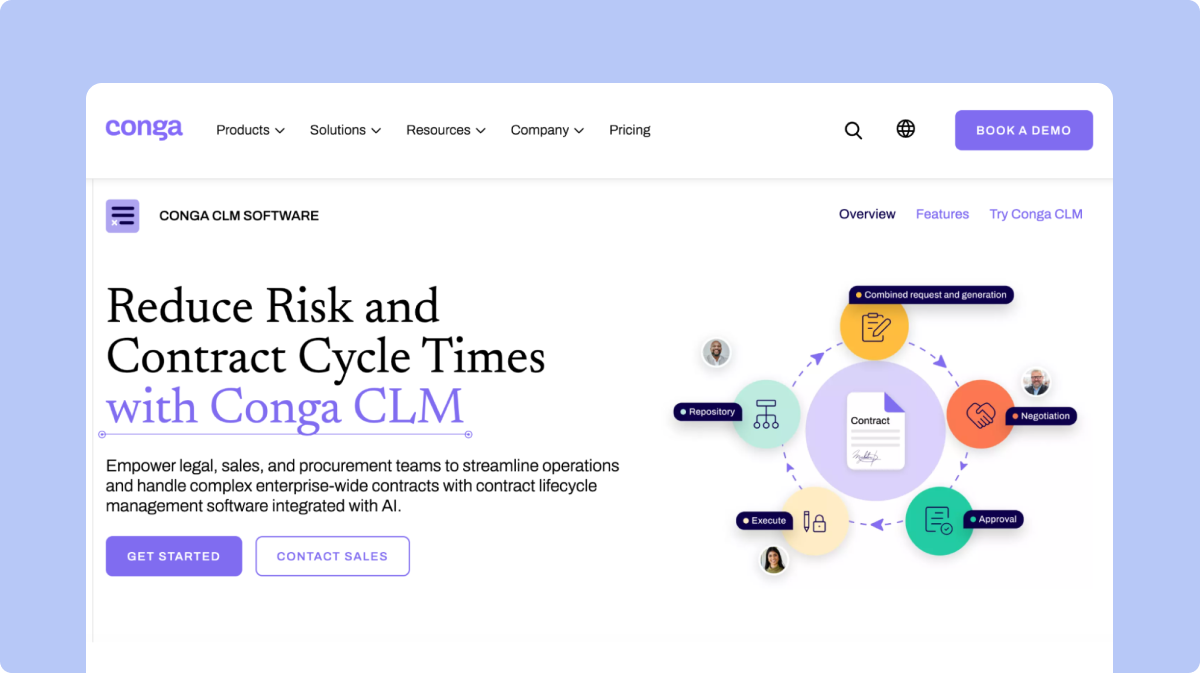
Conga CLM helps teams create, review, approve, sign, and manage contracts across the entire contract lifecycle. It can also connect contract data with Salesforce and other commercial systems used by Sales and Finance teams.
Key features
Checks changed clauses against configured requirements using AI-assisted redlining.
Answers questions about individual agreements using an AI assistant.
Finds information across contract data using AI-powered search.
Connects contract information with CRM and other commercial systems.
Pros
Supports both document review and contract search with AI.
Connects contract information with broader commercial workflows.
Keeps Salesforce-centered contract processes closer to existing sales workflows.
Cons
AI-assisted redlining requires supported CLM versions, tenant onboarding, AI configuration, and administrator setup.
AI-assisted redlining does not apply to supporting documents.
AI-assisted redlining currently works on one selected document at a time.
7. LinkSquares
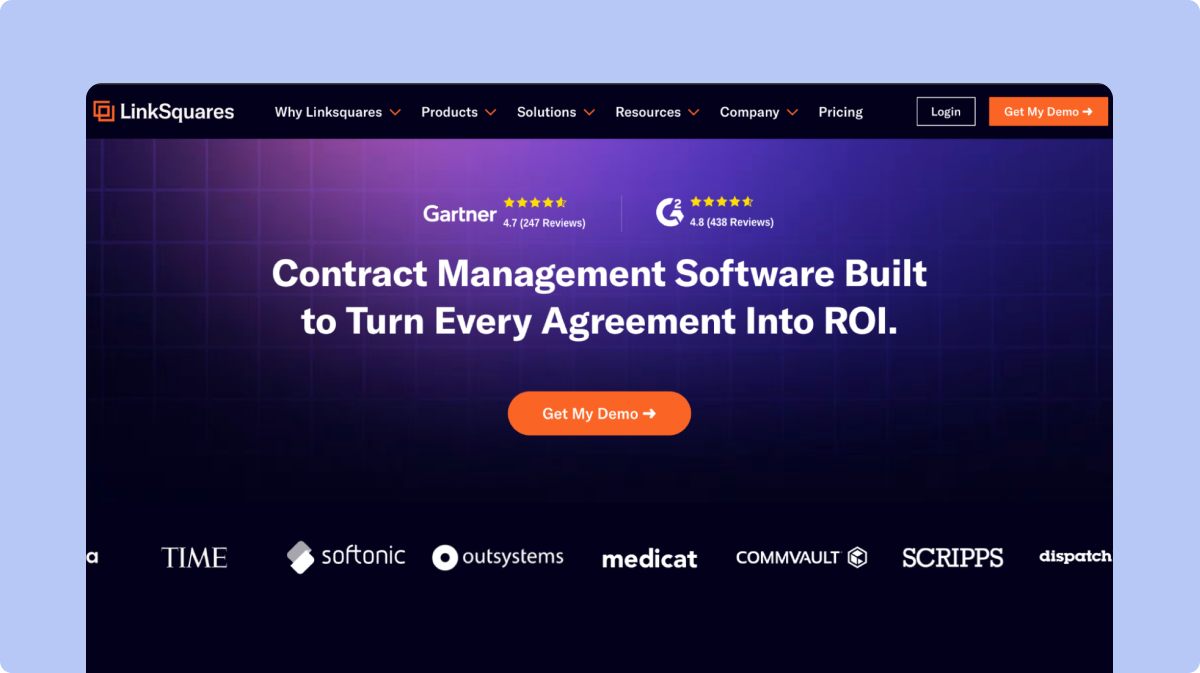
LinkSquares separates contract work into two main products. Finalize is used for contract drafting and negotiation, while Analyze stores the contract portfolio and helps teams search and report on completed agreements.
Key features
Manages drafting, review, negotiation, and execution through Finalize.
Stores completed agreements in Analyze for search and reporting.
Maps contract data as agreements move between Finalize and Analyze.
Keeps agreement IDs searchable after contracts move into Analyze.
Pros
Separates active contracting from post-signature analysis.
Supports search and reporting across completed agreements.
Carries contract data from the contracting process into the repository.
Cons
After an agreement has synced to Analyze, changes made within the Finalize Info tab are not reflected in Analyze.
Related Agreement links created in Finalize do not carry over.
Unsigned attachments and Adobe Acrobat Sign attachments do not sync from Finalize to Analyze.
8. Juro
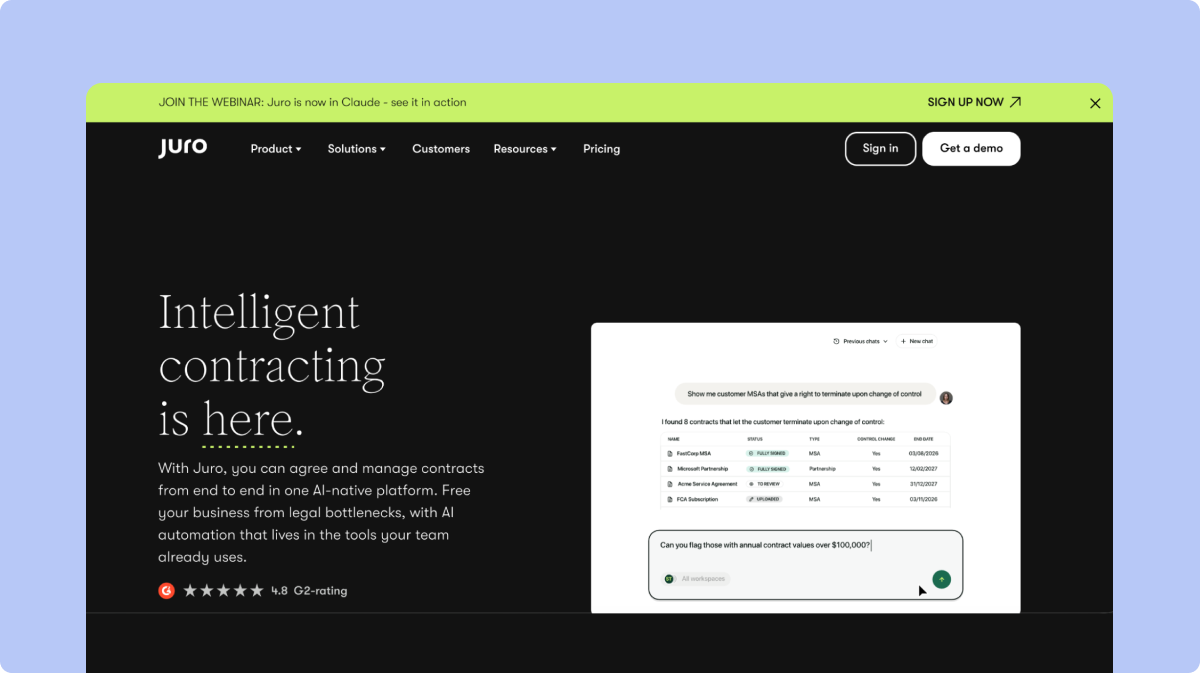
Juro is a contract lifecycle management solution that combines contract workflows with AI-assisted review and analysis. Its AI tools can check agreements against legal playbooks, extract contract data, and answer questions across stored agreements.
Key features
Answers questions across stored contract information using AI.
Checks agreements against user-defined legal playbooks.
Extracts contract terms into structured data.
Supports drafting, summaries, and contract questions with AI.
Pros
Reviews agreements against Legal-defined playbooks.
Supports both individual contract review and portfolio-level questions.
Feeds extracted contract data into workflows.
Cons
Operator is limited to 500 completed Operator tasks per customer each month.
AI contract review is limited to 10 reviews per user every two hours.
Bulk AI extraction is limited to 200 documents per extraction.
9. Leah, Formerly ContractPodAi
ContractPodAi became Leah in January 2026. Its CLM product still manages contract workflows, while the broader Leah platform also uses AI capabilities and AI agents for work across Legal and other business functions.
Key features
Supports contract-management workflows through its CLM platform.
Lets organizations create and manage AI agents.
Extends AI workflows across Legal, Procurement, Finance, and other enterprise functions.
Retains existing ContractPodAi workflows and integrations after the rebrand.
Pros
Combines contract management with broader enterprise AI workflows.
Extends AI automation beyond Legal.
Extends contract workflows into broader AI-agent use cases across Legal, Procurement, and Finance.
Cons
Custom Legal KPI reporting may offer less flexibility for some requirements.
Performance issues can arise during heavier usage or bulk uploads.
Onboarding and workflow setup can require additional learning.
10. Workday Contract Lifecycle Management
Workday Contract Lifecycle Management, powered by Evisort AI, helps teams manage contracts while also analyzing the information inside them. It includes automated redlining and an AI review tool for analyzing agreements, along with contract search and custom AI models.
Key features
Supports contract negotiation through automated redlining.
Answers questions about contract information using an AI assistant.
Analyzes contract data through custom AI models.
Surfaces portfolio information through advanced search and dashboards.
Pros
Analyzes both new and existing agreements.
Searches contract information across the repository.
Connects with systems such as Box, SharePoint, and Salesforce.
Cons
Workday’s current AI Review workflow accepts DOCX files, so PDFs need to be converted before using AI Review.
AI Review must run before users make manual edits in the in-app editor.
Within AI Review, changes involving tables and placeholder values still need to be applied manually.
11. Gatekeeper
Gatekeeper manages contracts and vendor information in the same management software. Procurement teams can connect an agreement with supplier risk, compliance risks, renewal dates, and performance data.
Key features
Connects contract and vendor information within the same records.
Feeds vendor due diligence into contracting workflows.
Links obligations and renewals with vendor information.
Tracks risk and compliance data across the vendor lifecycle.
Pros
Combines contract and supplier information in one system.
Links contractual commitments with vendor risk and performance.
Complex vendor and contract workflows can require additional configuration support.
Reporting may be less flexible for highly customized vendor-management requirements.
Initial setup can require more technical involvement when workflows and integrations are heavily customized.
12. Malbek
Malbek is a contract management solution for creating and managing contract workflows, with AI tools for analyzing agreement language and contract data. Its Bek assistant also lets users ask questions about stored contracts in natural language.
Key features
Supports contract workflows across Legal, Sales, Procurement, and Finance.
Analyzes clauses and contract risks through Malbek AI.
Answers contract questions through Bek.
Connects with CRM, ERP, and other business systems.
Pros
Embeds AI into contract analysis and search.
Provides no-code integrations through Malbek Marketplace.
Allows business administrators to handle most platform administration, according to Malbek.
Cons
Custom reporting may require workarounds for more specialized legal or commercial metrics.
Malbek’s broader feature set can take time for new users to learn.
Heavier customization can increase setup complexity.
13. HyperStart
HyperStart is a contract management tool for creating, reviewing, approving, signing, and storing contracts. It also uses AI for first-pass contract review and for extracting information from agreements after they are added to the repository.
Key features
Routes contracts through approval workflows using conditional rules.
Supports first-pass contract review through AI-assisted redlining.
Extracts metadata from agreements.
Connects with Microsoft Word, Slack, CRM, e-signature, and cloud-storage tools.
Pros
Uses AI for contract review and repository management.
Connects with commonly used business tools.
Publishes an implementation estimate of roughly one month to 4–6 weeks.
Cons
Published implementation estimates are vendor-provided rather than independent implementation benchmarks.
Occasional errors and slower loading have been reported during use.
In-line editing can be limited near signatory fields and address inputs in some workflows.
What to Check Before Replacing Icertis
Before replacing Icertis, identify which parts of Icertis Contract Intelligence are embedded in your legal operations and contracting processes. The migration may involve more than transferring contract files, particularly if teams use Icertis for connected agreement data, SAP workflows, Vera AI, or post-signature obligation management.
Key areas to check include:
Icertis agreement structure: Review how contracts are organized through contract types, attributes, associated agreements, commitments, attachments, and clause libraries. Confirm that the replacement can preserve these relationships rather than migrating only the contract documents.
SAP and enterprise-system workflows: If Icertis is connected with SAP, Salesforce, Microsoft, or other business systems, document how master data, pricing, terms, sourcing records, and approval triggers move between them. These data flows may need to be rebuilt in the replacement platform.
Vera AI and contract intelligence: Identify whether teams use Icertis for obligation extraction, risk insights, clause-deviation detection, contract summaries, or AI-assisted negotiation. Test the replacement using the same contracts instead of comparing the products through feature lists alone.
Rule-based authoring and approvals: Map the templates, automated clause selection, business rules, approval paths, and Microsoft Word or Teams workflows configured in Icertis. Some of these processes may need to be recreated or redesigned.
Post-signature obligations: Check whether Icertis is used to assign obligation owners, issue alerts, track commitments, monitor renewals, or report on compliance. Confirm how open obligations and their current status will remain accessible after migration.
Cost of recreating the Icertis setup: Compare the pricing structure and licensing costs alongside data mapping, integration rebuilding, workflow configuration, validation, training, and any period in which both platforms must run.
How SpotDraft Fits Teams Comparing Icertis Alternatives
SpotDraft is a full-lifecycle contract management solution aimed primarily at in-house legal teams and legal operations. Legal teams set the templates, playbooks, approvals, permissions, and contract controls that define how agreements move through the process. Within those guardrails, business users can initiate and manage lower-risk contracts without routing every step through Legal, helping teams spend less time on routine requests.
Switching from an Existing CLM
SpotDraft offers a Contract Buyout Program for teams switching from another CLM, along with assisted legacy-contract migration.
Implementation is fully in-house, including workflow setup and integrations, with assisted legacy contract migration. Teams can be up and running in under six weeks, although implementation timelines vary based on the complexity of the requirements.
SpotDraft’s Core Capabilities
Templates and approval workflows
Review playbooks through VerifAI
Permissions and business self-service
Native e-signatures
Contract data, repository search, and contract analytics
Integrations across more than 35 business systems
SpotDraft customer case studies report a 65% reduction in contract cycle time at Wingify, a 90% reduction in contract-approval turnaround time at Open, and 100% Sales adoption at Odessa. These are individual customer outcomes rather than guaranteed results.
Ready to see how SpotDraft works for your team? Book a demo.
Frequently Asked Questions
How much does Icertis cost?
Who are the competitors of Icertis?
What should you check before switching to an Icertis alternative?
How long does Icertis take to implement?
Is Icertis easy to use?
Related content
latest
13 Best Workday CLM/Evisort Competitors and Alternatives in 2026
Compare 13 Workday CLM and Evisort competitors by contract workflows, AI review, integrations, implementation, migration, and team fit.
“Before using SpotDraft, executing a contract would take up to weeks. Now, contracts are signed within minutes, with better data security and tracking. The whole process takes us less than a day!”
Arti Singh
Founder’s Office, Growth, UrbanVault
“Before using SpotDraft, executing a contract would take up to weeks. Now, contracts are signed within minutes, with better data security and tracking. The whole process takes us less than a day!”