Huzaifa Sultana is a Marketing Associate at SpotDraft, specializing in organic growth, SEO, and AEO. Her work focuses on content optimization, keyword research, and developing strategies to improve search rankings and organic visibility.
TL;DR
Contract data is the information inside your contracts, such as parties, dates, values and obligations, stored as fields you can search.
Poor contract management erodes value, and scattered contract data makes deadlines and commitments easy to miss.
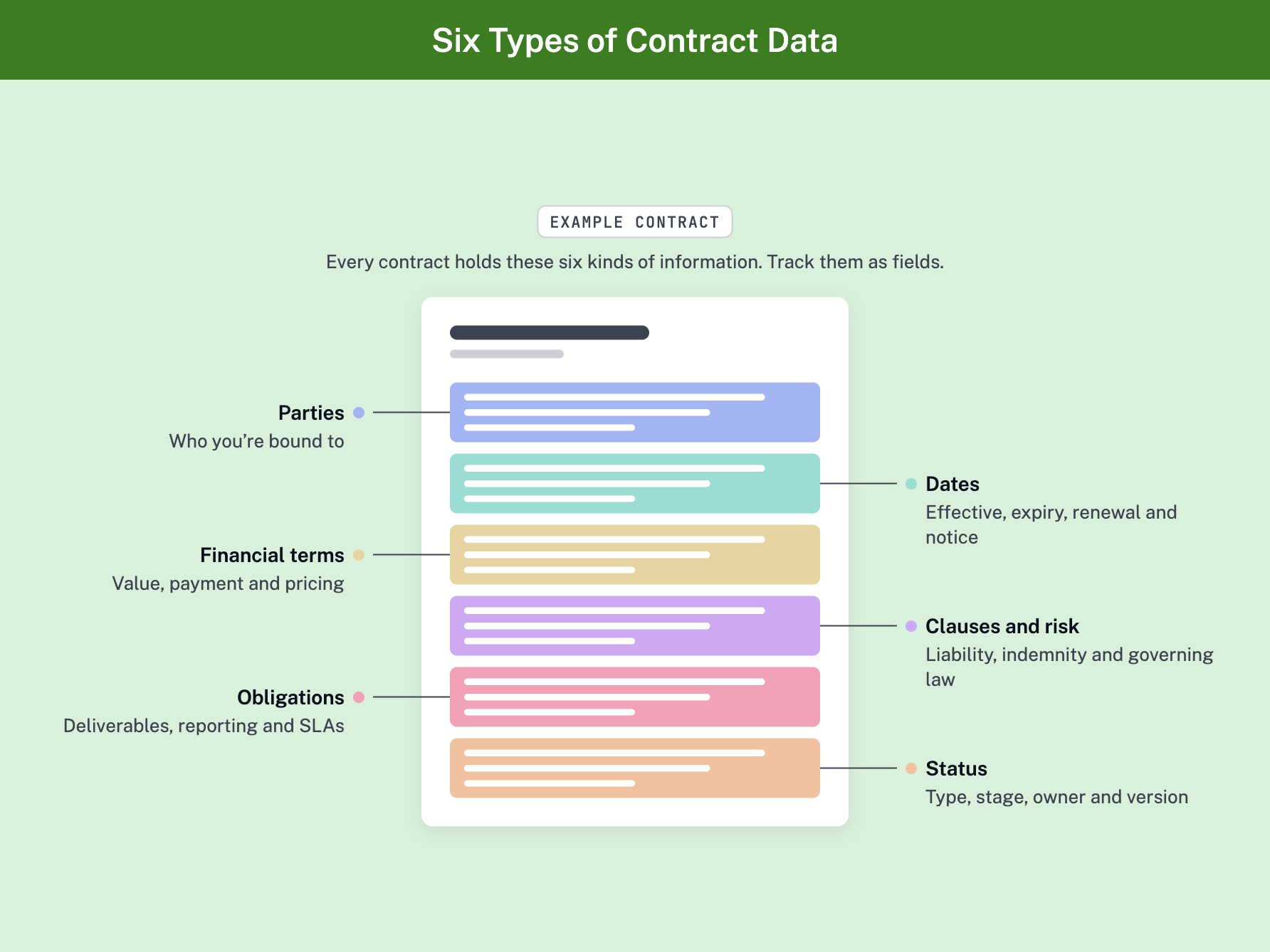
Track six core types: parties, dates, financial terms, clauses and risk, obligations, and status metadata.
Contract metadata is a subset of contract data: the descriptive fields that make agreements easy to find and filter.
A data contract is something else: a data-engineering spec that sets rules for how data moves between systems.
AI can extract contract data from signed agreements at scale, with people checking the results.
Migrating legacy contracts works best in five stages: inventory, clean-up, extraction, validation and import.
Secure your contract data with encryption, access controls and audit logs, then keep it accurate with consistent fields and regular reporting.
Your contracts hold answers your business needs every week. When does this vendor deal renew? Which customers have uncapped liability?
If those answers are buried in PDFs and inbox threads, finding them takes hours. Contract data fixes that.
This article is for in-house counsel, general counsel and legal ops leads who are new to treating contracts as data. You'll see what contract data is, which types to track, how extraction and migration work, and how to keep it all secure.
What Is Contract Data?
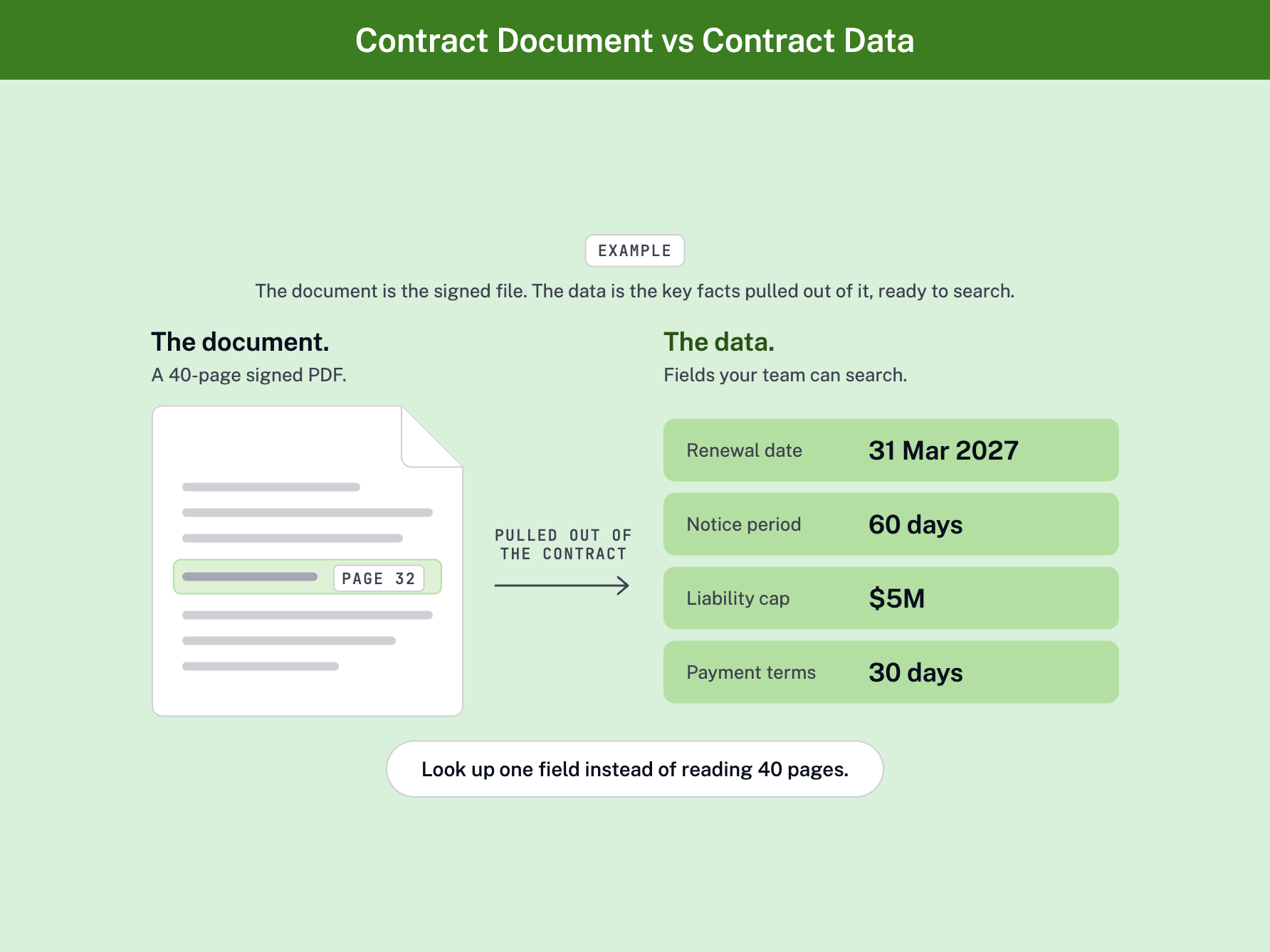
Contract data is the information inside your contracts, like parties, dates, values, clauses and obligations, turned into fields you can search and act on. Instead of reading a 40-page agreement to find a renewal date, you look up one field.
When people ask "what is contract data?", the simplest answer is the gap between the document and the data. The document is the signed PDF sitting in a folder. The data is the renewal date, liability cap and payment terms pulled out of that PDF and stored where your team can find them.
That shift turns your contracts into a system of record instead of a pile of static files. You can ask questions across hundreds of agreements at once and get answers in seconds.
Why Does Contract Data Matter?
Poor contract management is expensive. WorldCC research finds the average business loses almost 9% of value annually through poor contract management. The best performers lose about 3%, while the worst lose 15% or more.
Part of the problem is that the information is hard to find. WorldCC also reports that contract-related data is scattered across an average of 24 different systems. In its words, that makes commitments "nearly impossible to track" on time.
Many legal teams haven't closed that gap yet. According to SpotDraft's 2025 Contracting Efficiency Benchmarking Report, "49% of legal teams still manage contracts like it's 1995—with email and Word docs."
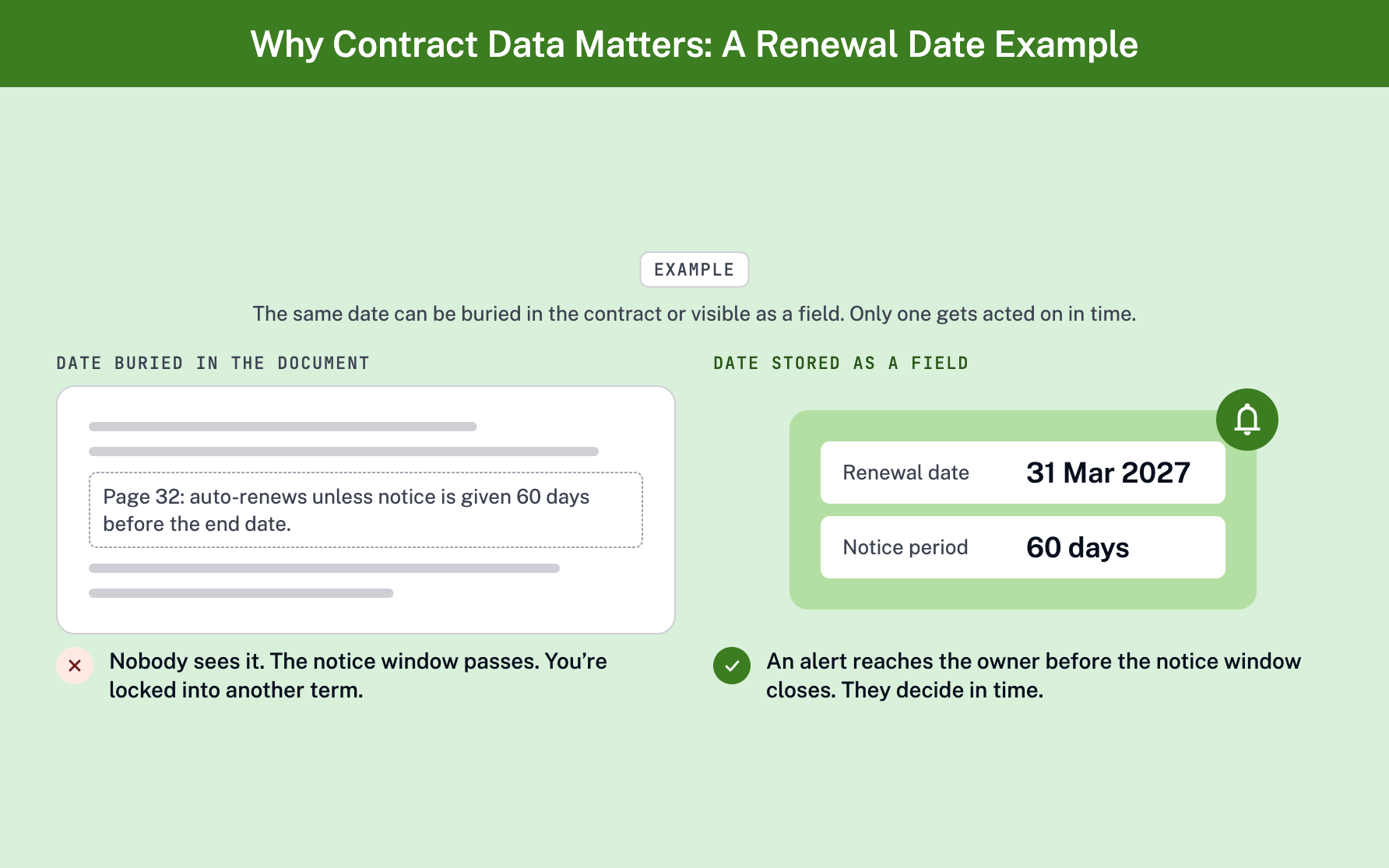
Renewal dates are the classic example: miss the notice window on a contract renewal and you could be locked into another year of a tool nobody uses. The date was in the contract all along. It just wasn't anywhere you could see it in time.
The legal team at a public US university described the same problem before moving to SpotDraft:
"We used to keep contracts in a network-attached storage. It was difficult to keep track, and we couldn't even search for a contract by its name or type."
Shows who you're bound to and who owns the relationship
Dates
Effective date, expiry date, renewal date, notice period
Prevents missed renewals and deadlines
Financial terms
Contract value, payment terms, pricing, penalties
Supports forecasting and spend tracking
Clauses and risk
Liability caps, indemnities, governing law, termination rights
Flags nonstandard or risky terms
Obligations
Deliverables, reporting duties, SLAs
Keeps both sides accountable
Status metadata
Contract type, stage, owner, version
Shows where each agreement stands
Obligation data, such as delivery deadlines, reporting duties and SLAs, feeds directly into contract obligation management once it's captured in structured fields. Without those fields, obligations depend on someone remembering what page 32 says.
What Is Contract Master Data?
Contract master data is the shared core set of fields that every agreement should carry, whatever its type. Think counterparty name, contract type, owner, value, start date and end date.
Storing contract master data in a consistent contract database lets you filter and report across thousands of agreements at once. It also keeps reports consistent, because every team uses the same field names.
Structured vs. Unstructured Contract Data
Structured data lives in defined fields, like a date or a dollar amount. Unstructured data is the free text of the contract itself, such as a custom termination clause. You need both, but only structured data lets you sort, filter and report at scale.
Contract Data vs. Contract Metadata: What's the Difference?
Contract metadata is a subset of contract data. Metadata describes a contract, while contract data covers everything inside it, including clause text and obligations.
Contract metadata is the set of structured fields that describe an agreement. Think contract type, counterparty, effective and expiry dates, value, status, owner, version and signature date.
In SpotDraft, contract metadata shows up as filterable columns in the repository, so you can sort agreements by counterparty, value or expiry date. That's what makes your contracts easy to find.
Contract data is the broader set. It's the metadata plus clause text, obligations, negotiated positions and other content inside the agreement, like the types covered earlier.
Aspect
Contract data
Contract metadata
What it covers
Everything inside the agreement
Fields that describe the agreement
Examples
Clause text, obligations, negotiated positions, plus metadata
The difference matters once your questions get harder. Metadata can tell you which contracts expire next quarter. But "Which contracts have uncapped liability?" needs clause data, because the answer lives in the contract's language.
Contract Data vs. Data Contract: What's the Difference?
If you've searched for contract data, you've probably run into the term "data contract." The two sound alike, but they come from different worlds.
So, what is a data contract? It's an agreement between the teams that produce data and the teams that use it. It defines the schema, quality rules, service levels and ownership for a dataset, often in a machine-readable format like YAML or JSON.
Contract data
Data contract
Who uses it
Legal, procurement, finance, sales ops
Data engineers and analytics teams
What it is
Information pulled from legal agreements
A spec for how a dataset is structured and delivered
Typical contents
Parties, dates, values, clauses, obligations
Schema, field types, quality checks, SLAs, owners
Where it lives
Fields in a contract repository
Code or config files, often YAML or JSON
Legally binding?
The underlying contract is
Usually not; it's an internal technical agreement
Why do legal teams hear both terms? Your data team may use data contracts to manage the pipelines that send contract reports into other systems. Knowing the difference helps you ask the right questions when you work together.
How Does Contract Data Extraction Work?
Contract data extraction is the process of pulling key terms out of contracts and recording them as structured fields. Teams used to do it by hand, reading each agreement and typing values into a spreadsheet. That works for 50 contracts, but it breaks down at 5,000.
Today, you can extract contract data with AI and have people review the results. A Gartner prediction says that by 2029, approximately 50% of contract reviews will be delegated to self-service systems. Those systems will escalate only one in 10 for human review.
Only extracted data makes that second question possible. Here's how the process works.
#1 Define the Fields You Need
Pick the fields your business asks about most, such as dates, parties and values. Most teams start by deciding which fields matter, then apply the same approach to contract metadata extraction across every agreement type.
#2 Gather and Upload Your Contracts
Collect signed agreements from shared drives, inboxes and old systems, including scanned PDFs, so nothing gets left behind.
#3 Let AI Extract the Data
The same models behind AI contract review can read a scanned PDF, find the renewal clause and record the notice period in a structured field.
Smart Data Capture, part of SpotDraft's contract management platform, extracts over 1,000 types of contract metadata without manual data entry. Its AI is model-agnostic and continuously benchmarked for accuracy, and extraction runs at unlimited scale.
#4 Have a Person Verify the Results
AI does the heavy lifting, but a reviewer should spot-check each field before you rely on it. Focus first on high-risk fields like liability caps, indemnities and termination rights.
#5 Store the Data and Put It to Work
Save the verified fields in your repository so they're searchable and tied to the source contract. Then set alerts, build reports and share views with the teams who need them.
How Do You Migrate Contract Data?
Contract data migration means moving your contracts, and the data inside them, from wherever they live today into a new system. A typical legacy contract migration moves through five stages: inventory, clean-up, extraction, validation and import.
Inventory every place contracts live, from shared drives to old inboxes.
Clean up duplicates, stray drafts and agreements you no longer need.
Extract the key fields from each remaining contract.
Validate a sample of records against the source documents.
Import the clean data and documents into your new system.
Don't migrate dead contracts. Check your retention policy first, then archive anything with no surviving obligations instead of moving it.
Teams switching CLM providers face the same steps, plus the extra work of mapping old fields to the new system's structure. Build that field map before you move anything, so a "renewal date" in the old system lands in the right place in the new one.
Eureka Forbes faced a bigger version of this challenge, with more than 4,000 legacy agreements and no single source of truth. SpotDraft's onboarding team digitized the full backlog, captured the metadata and indexed every agreement for natural language search.
"The onboarding was very smooth. We migrated 4,000-odd legacy agreements... I didn't have to break a sweat, and I was quite satisfied with the eventual outcome."
How Does Contract Management Support Data Security and Privacy?
Contract management for data security works on two levels. Your contracts govern how other companies handle your data, and they also contain sensitive data themselves.
Contracts Govern How Others Handle Your Data
When a vendor handles personal data for you, the data processing agreement sets out what they can do with it and how they must protect it. Security clauses, breach notification terms and audit rights add more protection. Tracking those terms as data shows you which vendors have agreed to what.
The stakes are high. The IBM breach report found the global average breach cost climbed 12% in 2026, reaching a record USD 4.99 million.
Contracts Contain Sensitive Data
Under GDPR, personal data includes any information that identifies a person, so the names and email addresses inside your contracts count too. Contracts also hold pricing, IP terms and other confidential details. That's why contract management for data privacy matters as much as security does.
Getting this wrong can be costly. Under GDPR Article 83, maximum fines reach €20 million or 4% of total worldwide annual turnover, whichever is higher. A lower ceiling of €10 million or 2% applies to breaches of controller and processor duties, including security.
Controls to Look For in a CLM
Before you put sensitive agreements into any platform, run through a CLM security checklist covering encryption, access controls and audit logs. Role-based access matters a lot here, since someone who needs your NDAs shouldn't automatically see executive pay terms.
Reading contracts with AI also raises privacy issues with AI, such as where the text is processed and whether it's used to train models. Ask every vendor how they handle both before you upload a single file.
SpotDraft approaches contract management for data protection with ISO 27001 and SOC 2 certifications, GDPR compliance, encryption, role-based access controls and audit logs. Its AI is built to follow your rules and keep your data secure, which SpotDraft calls risk-free AI on your terms.
What Is Contract Data Management?
Extraction gets your data in shape, but it won't stay that way on its own. Contract data management is the ongoing work of keeping that information accurate, organized and usable from signature to renewal. It rests on three habits:
Keep every contract in a single repository.
Use the same fields and formats for every agreement.
Review reports on a regular schedule.
A searchable contract repository with metadata filters lets anyone with access pull up every agreement expiring next quarter in seconds. Once fields are structured, contract analytics can show you cycle times, bottlenecks and which contract types carry the most value.
Wingify connected SpotDraft to Salesforce so contract metadata syncs both ways, and its contract cycle time is now 65% faster.
"Leveraging SpotDraft's Salesforce integration has helped us streamline our contract workflows, accelerate contract cycle time, and gain the autonomy and real-time visibility needed to focus on strategic, high-value deals."
Contract data turns static agreements into answers you can find in seconds. Start with the fields that matter most, extract them with AI and human review, and protect them with strong security controls.
Ready to see how it works? Request a demo and find out how SpotDraft turns your contracts into data you can use.
Frequently Asked Questions
What Is a Data Contract Example?
What Is Contract Data Abstraction?
Can AI Extract Contract Data Accurately?
Related content
latest
Contract Obligation Management: How to Turn Signed Promises Into Delivered Results
See how contract obligation management works after signature, with a five-step lifecycle, clear owners, compliance proof and AI tips for legal teams.
“Before using SpotDraft, executing a contract would take up to weeks. Now, contracts are signed within minutes, with better data security and tracking. The whole process takes us less than a day!”
Arti Singh
Founder’s Office, Growth, UrbanVault
“Before using SpotDraft, executing a contract would take up to weeks. Now, contracts are signed within minutes, with better data security and tracking. The whole process takes us less than a day!”