7 Contract Management Challenges (and How Lean Legal Teams Solve Them)

Huzaifa Sultana is a Marketing Associate at SpotDraft focusing on Organic Growth through SEO and AEO.


Every contract comes with its own set of challenges that can slow down or add risk to how legal teams request, draft, negotiate, approve, sign, store or renew contracts. For lean legal teams, these challenges compound quickly, as one bottleneck can eat into the bandwidth of other team members involved in the lifecycle, affecting the entire contract process.
In this blog, we cover seven common challenges that come up most often for small legal teams and fixes that can help lean legal teams stay ahead of these problems.
Book a demo to see how a contract management platform handles each of these problems in one system.
Challenge: Without a defined intake process, contract requests arrive in a scattered manner through inboxes on different platforms, leaving the legal team with no way to see how many requests are open, what they are for or which ones are urgent. Requests can get missed, duplicated or handled out of order, and the legal team spends time tracking down details instead of reviewing agreements.
How to address it: This can be fixed by routing every request through a single structured intake form that captures the contract type, counterparty and deadline upfront. A legal intake system also gives the legal teams the visibility into request volume, making it easier to prioritize and to justify additional resources when contract volume grows.
Challenge: Negotiation is usually where delays pile up because when a counterparty sends back a redlined document, the legal team has to compare every change against the approved standard positions manually. This takes time and increases the chances of human error.
How to address it: Effective lean legal teams solve this by using AI review tools that check counterparty edits against an approved playbook automatically. Top legal teams rely on tools like VerifAI that flags deviations from standard positions in seconds, so reviewers only spend time on the changes that actually need human intervention. This only works with a contract playbook that reflects real negotiation positions, making the review accurate rather than just fast.
Challenge: Improving the contract turnaround time has been ranked as the most important responsibility by 39% of legal ops professionals, explaining how widespread this problem is. Usually the turnaround slows down when a contract has to move between separate tools for drafting, review, redlining and signing, with someone manually re-sending the contract every time.
How to address it: This can be fixed by keeping the contract in one system from request to signature, instead of moving it between Word, email and separate e-signature tools. Standard templates and pre-approved clauses also let business teams draft routine agreements themselves, so legal only reviews contracts that actually need legal judgment.
Challenge: When approval happens over multiple channels like email or Slack, the chances of it being stalled are higher as there is no single view of where a contract is stuck or who is holding it up, making the legal teams chase sign-off manually on top of everything else.
How to address it: Set up an approval workflow that automatically routes each contract to the right approver and tracks its status at every stage. Everyone involved can then see who needs to act next, reducing the time spent chasing follow-ups. For a closer look at setting this up, see how to build a contract approval process that does not add extra steps.
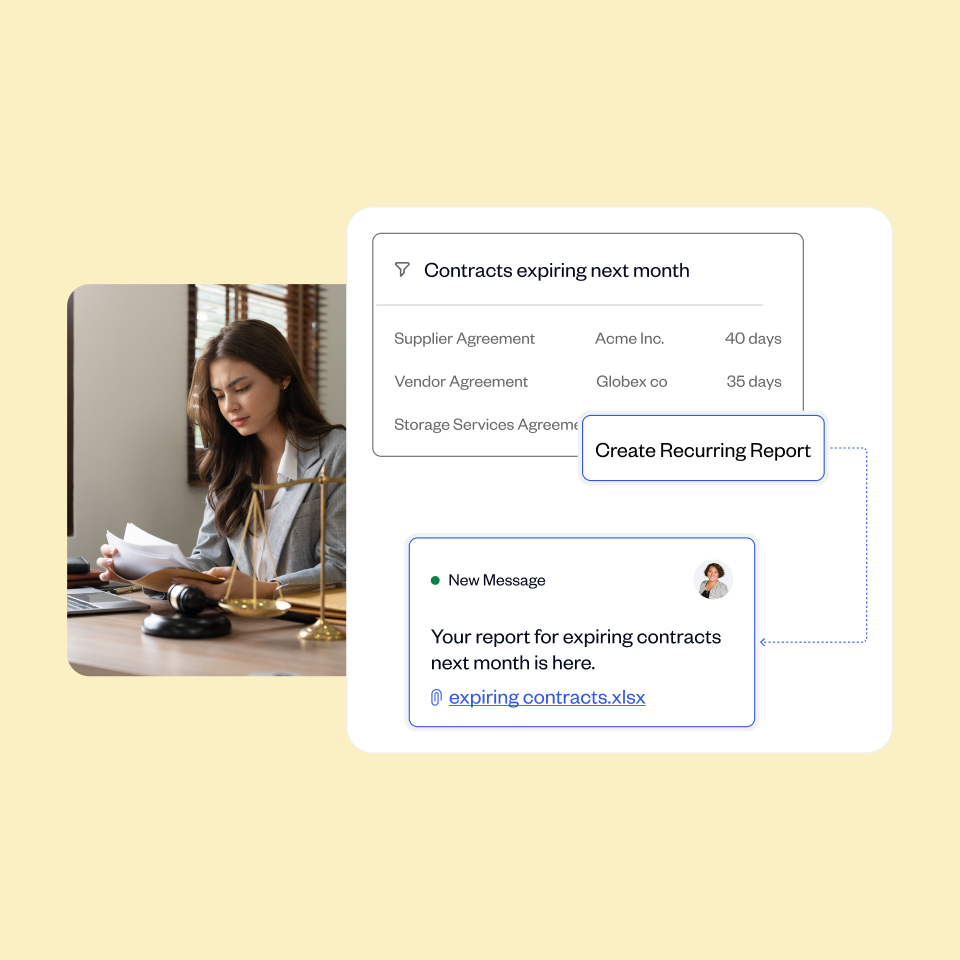
Challenge: Keeping track of renewal or expiry dates is difficult when it’s done manually. One can miss the renewal date or find it in a situation where it’s too close to the date, leaving the team with not enough time to prepare and revise the contract.
How to address it: Lean legal teams solve this with an automated renewal tracking system that tracks contracts approaching their renewal or expiry date well in advance, giving the legal team enough time to negotiate terms or make necessary revisions rather than reacting at the last minute. For a full breakdown of how to set this up, see this guide to contract renewals.
Challenge: When contracts get signed, they usually end up in a shared drive folder, an inbox attachment or a separate signing tool, making it difficult for legal teams to find the latest version when they need it.
How to address it: The fix is a searchable repository where every signed contract is stored automatically after execution, tagged by counterparty, value, key clauses and dates. This removes the need to search across multiple tools or ask around for the latest signed copy. A contract repository that updates on signature also keeps reporting accurate, since every agreement is captured in the same place.
Challenge: Budget limitations have been named as the most pressing operational challenge by 47.6% of legal ops professionals. For a team of five or fewer, this means most process improvements have to come from better use of existing tools and headcount, not from new hires.
How to address it: This is why lean teams tend to prioritize a single platform that covers intake, review, approval, signing and storage, instead of buying separate point solutions for each stage. One system reduces the number of tools a small team has to manage, train on and pay for individually. It also makes it easier to show the return on the investment, since calculating contract management ROI is more straightforward when time savings can be tracked across the whole process rather than pieced together from separate tools.
SpotDraft is built for lean legal teams that need to manage the entire contract process without staffing a dedicated admin function. The platform comes with features like structured intake forms that capture requests from the start, templates and approved clauses that let non-legal teams draft standard agreements on their own. To make life easier for lean legal teams it comes with an AI-assisted contract review tool, VerifAI, that reviews counterparty edits against the approved playbook, approval workflows that keep contracts moving, and native e-signature that keeps signing in the same system.
Book a demo and see how these fixes work with your own contracts, not a generic example.